 All Entries Tagged With: "Democracy"


10 of Thomas Friedman’s Dumbest “Big Ideas”

You know the world is flat — and hot and crowded — but that’s just the tip of Friedman’s iceberg of hackery
How the West Used Libya to Hijack the Arab Revolts

Vijay Prashad talks neoliberal economics, the uprisings in Egypt and Tunisia and why NATO’s intervention in Libya marked a new chapter in the story of the Arab revolts.
Six Things South Africans Learned at AIPAC
 Jews Seek To Learn Tips of Pro-Israel Lobbying From Masters
Must we permit the US military to detain Americans without trial?

The Verdict’s Sixth Anniversary/The Al-Arian Trial on YouTube

The Verdict’s Sixth Anniversary:
December 6 should be celebrated as
“First Amendment Day” Watch on”The Al-Arian Trial:
An Inside Look by A Juror”
December 6, 2005 shall be remembered as a great day in which justice triumphed over intolerance and the First Amendment reigned supreme. On that day, a jury of twelve ordinary citizens refused to return a single guilty verdict against Dr. Sami Al-Arian and three other Palestinian men accused of terrorism in one of the most high profile cases to emerge out of the highly charged atmosphere after 9/11.
Notwithstanding the concerted efforts by the government to instill fear into the public hearts and minds during the trial, coupled with an elaborate intimidation campaign against Arabs and Muslims in the Tampa Bay area, an American jury was able to sit through a six-month trial and uphold the Constitution, despite being subjected to “a mountain of evidence,” as one prosecutor referred to the government’s case. In reality, this “evidence” encompassed activities protected by the First Amendment: speech, beliefs, thoughts, opinions, and associations.
Remarkably, much of the media coverage blurred the line between factual reporting and advocating for the prosecution, disregarding journalistic standards in a disgraceful and sensationalist display that resulted in a trial in the court of public opinion that was more akin to a lynch mob. In spite of these pressures, the courtroom jury was, in the words of one juror, able to see through the “smoke and mirrors” displayed by the government.
In his statement a few months later, Dr. Al-Arian thanked the jury for its “remarkable courage and efforts in the service of justice” in the case. He further stated that serving justice through “an impartial and conscientious jury” is how America could “win the hearts and minds of people across the globe, especially in the Arab and Muslim world.” By rendering a just verdict, the jury understood Martin Luther King’s famous statement, “Injustice anywhere is a threat to justice everywhere.”
Dr. Al-Arian’s defense did not present a single witness despite eighty witnesses offered by the government. The First Amendment was his only defense, a position validated by the jury’s verdict, and the reason why this decision to uphold one of the most sacred founding principles of the United State should be remembered every year on this day. We call upon all First Amendment advocates and people of conscience to honor the First Amendment every year on this day. It protects all of us.
On this day, this great jury stood for the primacy of free speech over government censorship and criminalization of speech. As the former Supreme Court Justice, Thurgood Marshall, once said, “Above all else, the First Amendment means that government has no power to restrict expression because of its message, its ideas, its subject matter, or its content.”
Some time ago the National Liberty Fund (NLF) released a video interview with Ron, a member of the jury who demonstrated his courage in this trial. It is an eyeopening account that presents an inside look at how the jury deliberated and reached its decision for acquittal on major terrorism charges despite thousands of highly inflammatory and prejudicial assertions made by the prosecution.
The interview is featured on YouTube in 3 parts: Part I, Part II, and Part III. The video-interview (total: 26 min.) appears courtesy of Line Halvorsen and Jan Dalchow, the filmmakers behind USA VS. AL-ARIAN, the award-winning Norwegian documentary.
But despite the acquittals and the conclusion of the case between the government and Dr. A-Arian through a plea deal, the case is not over yet after almost nine years (5 1/2 of which were spent in prison including 43 months in solitary confinement) of unjustly persecuting the Muslim Palestinian professor.
Since September 2008 Dr. Al-Arian has been under house arrest in the Washington DC area pending a ruling by the presiding judge of the dismissal motion of the unjust contempt charges brought against him by the government.
On this day we also remember Thomas Jefferson, one of the great founding fathers of this nation who understood the true meaning of the Constitution and the Bill of Rights, but above all the inviolability of justice when he said: “I tremble for my country when I reflect that God is just; that His justice cannot sleep forever.” To honor his words, we must not rest until all those who have been denied justice or continue to await justice will finally receive it.
WASHINGTON DC – Dec. 6, 2011
go to: www.freesamialarian.com
USA vs Al-Arian now vailable on the web Free

In 2007, Norwegian filmmakers released a documentary film entitled USA vs. Al-Arian.
Forbidden Islam: The British State’s War on Islamic Books and Ideas.

Read Jahangir Mohammed’s latest article at NewCivilisation.com:
He highlights a conviction this week, in a UK court, that is based upon “Forbidden Islam: The British State’s War on Islamic Books and Ideas:
Muslim superhero comics meet resistance in U.S.

By Dan Merica, CNN
Naif Al-Mutawa anticipated a struggle when he launched an Islam-inspired comic book series that he hoped would become a symbol of toleration.
He worried about the comics being banned in Saudi Arabia – which wound up happening, briefly – and he expected to be challenged by conservatives in Islam, since Al-Mutawa wanted to buck the trend of Islamic culture being directly tied to the Koran.
But it wasn’t an Islamic cleric that stalled the series, called “The 99,” after the 99 attributes of Allah, which the superheroes are supposed to embody.
It is the American market, and the voices of Islam’s Western critics, that have caused the most problems for “The 99,” says Al-Mutawa, who is the focus of a PBS documentary airing next week.
In 2010, President Barack Obama called the comic books, which debuted in 2006, “the most innovative response” to America’s expanding dialogue with the Muslim world, which Obama has encouraged. The series features 99 superheroes from across the globe who team up to combat villains and who embody what Al-Mutawa calls basic human values like trust and generosity.
But Al-Mutawa, a Kuwaiti-born clinical psychologist and graduate of Columbia Business School, says a vocal minority have raised surprising questions about American tolerance of Islam.
Meeting resistance
The idea for “The 99” started during a conversation in a London cab between Al-Mutawa and his sister. It took off, although slowly, after Al-Mutawa raised $7 million from 54 investors across four continents.
The first issue was released during the Muslim holy month of Ramadan in 2006. The comic book was quickly banned in Saudi Arabia and Al-Mutawa received threats of fatwas against him and his project from clerics. But Saudi Arabia eventually lifted the ban and the television adaptation of “The 99” will be aired there this year.
Al-Mutawa and his team have now raised more than $40 million in venture capital for the project.
But when word leaked that The Hub, a Discovery Channel cable and satellite television venture, purchased the series and planned to air it in the United States, the response from conservative bloggers and authors was swift.
A burqa-wearing superhero?
Pamela Geller, founder of the Atlas Shrugs blog, called the series, part of the “ongoing onslaught of cultural jihad,” and created a counter-comic strip that made the 19 hijackers behind the September 11, 2001 attacks the superheroes.
New York Post columnist Andrea Peyser, meanwhile, urged readers to “Hide your face and grab the kids. Coming soon to a TV in your child’s bedroom is a posse of righteous, Sharia-compliant Muslim superheroes – including one who fights crime hidden head-to-toe by a burqa.”
According to Al-Mutawa, the criticism spooked The Hub. “All of a sudden we couldn’t get an airdate and I was asked to be patient and we have been,” Al-Mutawa said. “But it has been a year and the actual push-back died down.”
Mark Kern, Senior Vice President of Communication for The Hub, told CNN that “‘The 99’ is one of the many shows we have on the possible schedule, but at this time, no decisions have been made about scheduling.”
Al-Mutawa isn’t shy about responding to the criticism his comics have received in the U.S. “There is nothing different from them and the extremists in my country,” he says. “They are just as bad. They are just intellectual terrorists.”
Geller, author of the book “Stop the Islamization of America,” called Al-Mutawa’s statement “ridiculous victimhood rhetoric.”
“He is the one mainstreaming oppression and discrimination,” Geller says. “I work for equality of rights for all people. So which one of us is the intellectual terrorist?”
Geller also takes issue with Al-Mutawa’s assertion that “The 99” exemplifies “moderation” and “toleration,” pointing to a “burqa-wearing superhero.”
But Al-Mutawa says criticisms of burqas are evidence that, “for some people anything to do with Islam is bad.”
“How cliché is it that characters created to promote tolerance are getting shot down by extremists,” he says.
Chronicling the ordeal
Al-Mutawa’s frustrations are chronicled in the new documentary “Wham! Bam! Islam!,” which will air on PBS on October 13 as part of the Independent Lens series.
The film’s director, Isaac Solotaroff, began shooting before the comic was released.
He said that one of the most surprising aspects of the story is how “a very small group of people who scream very loud, have a disproportionate share of the public discourse when it comes to culture.”
Echoing Al-Mutawa, Solotaroff calls it a case of the tail wagging the dog. He says that initial concerns of censorship in the Middle East began to change as the project progressed.
“We were waiting for a fatwa from a cleric in Saudi Arabia, Solotaroff says,” when it ended up being the U.S. market that has been resistant to “The 99.”
“Realizing that The 99 will not survive if focused solely on the Middle East, Al-Mutawa must now target an international and predominantly non-Muslim market,” reads the website for “Wham! Bam! Islam!”
Citing The Hub holdup, Solotaroff says the project is now stuck in the most important market” for “The 99.”
Al-Mutawa is also trying to gain distribution for his TV series in France and other countries, but his main focus remains the United States.
“One way or the other,” he says, “‘The 99’ will get on air in the U.S.”
Don’t fear us: Tunisian Islamist leader

By Tarek Amara | Source
The October 23 vote for an assembly that will draft a new constitution has pitted resurgent Islamists against secular groups who say their modern, liberal values are under threat.
Tunisia electrified the Arab world 10 months ago when a popular uprising overthrew autocratic leader Zine al-Abidine Ben Ali, creating a model that was copied by people hungry for change in Egypt, Libya, Yemen, Syria and elsewhere.
Western powers and governments in other Arab states are watching Tunisia’s election closely, worried that democratically elected Islamists might impose strict Islamic law and turn their back on Western allies.
Rachid Ghannouchi, who returned to Tunisia from exile in Britain after Ben Ali’s fall, told Reuters in an interview that Western countries and Tunisian liberals had nothing to fear from a victory for his Ennahda party.
“Ben Ali did everything he could to convince the West that we are a terrorist group but he couldn’t do it,” he said.
“We are not cut off from our environment … All the values of democracy and modernity are respected by Ennahda. We are a party that can find a balance between modernity and Islam.”
LITMUS TEST
More than 100 parties will contest the election, but Ennahda has the highest public profile and biggest support network. Opinion polls suggest it will get the most votes, but not win an outright majority in the assembly drafting the constitution.
In the interview, Ghannouchi denied an allegation by his critics that he presents a moderate image in public but that once in power his party’s hardline character will emerge.
Two issues in particular, women’s equality and liberal moral attitudes, are seen by many Tunisians as a litmus test of how tolerant Ennahda will be if it gains power.
In an indication of the party’s stance on women’s rights, a woman who does not wear the head covering favored by Islamists is Ennahda’s candidate for one district in the capital, Tunis.
“The values ??of modernity and women’s freedom began with the first president of Tunisia, Habib Bourguiba,” Ghannouchi said at his party headquarters, where many of the staff are women.
“We will not retreat from these values ??… We will support these values,” he said. “A woman’s freedom and her freedom of dress has been established and we will develop it.”
Western tourists are a major source of income for Tunisia but their habits of drinking alcohol and wearing skimpy clothing can cause tensions with devout Muslims.
Nevertheless, Ghannouchi said he did not favor any restrictions.
“We will seek to create a diversified tourism product, like Turkey,” he said, adding that hotels would not be prevented from offering alcohol and swimming pools, but that they would be encouraged to offer packages for observant Muslims without access to alcohol and with Islamic dress codes at the pool.
FOREIGN RELATIONS
European states for years tolerated Ben Ali’s autocratic rule because Tunisia was a trading partner and it helped curb the flow of drugs, illegal migrants and Islamist militants northwards across the Mediterranean.
Ghannouchi said it was in the interests of all sides for Tunisia to maintain good relations with the West.
“I lived for a long time in Europe without any problems,” he said. “I lived in tolerance with everybody.”
“During my meetings with Western officials and diplomats, I received the message that Ennahda will be welcomed if it wins the elections,” he said.
“They told me that they stand at the same distance from all competitors and their goal is the success of the democratic transition, because the failure of the transition would be catastrophic for Europe, for example, which will be flooded by hundreds of thousands of migrants.”
“We will maintain the relations with our traditional partners such as Europe, but we will seek to improve them in order to get advanced status,” Ghannouchi said, referring to a trade pact Tunisia is seeking with the European Union.
“But we will try also to diversify our partnership to open up to the United States and Latin America, Africa and Asia, and especially Arab markets,” he said.
One reason for the uprising against Ben Ali was that the economy was growing too slowly to generate jobs for youngsters.
Ghannouchi said his party’s foreign policy would be driven by the need to fix this problem. “The biggest concern is to attract foreign investment as part of foreign and local partnerships to drive growth and increase jobs.”
“The party aims to develop the knowledge economy by encouraging investment in the technology industry … There are significant growth opportunities in the telecommunications sector,” he said.
He said he had a message for potential investors.
“Tunisia has become beautiful without Ben Ali … We will put an end to corruption, we will develop legislation to stimulate investment,” said Ghannouchi. “We will confront the corruption that has spread in the structures of the state.”
(Editing by Christian Lowe and Alistair Lyon)
Commentary: The real threat in Egypt: Delayed democracy

Jackson Diehl wrote for the Washington post an op-ed on the “real threat in Egypt: Delayed democracy“:
A lot of people in Washington seem to think so, though they are talking about it quietly so far. Their fears are specific: that the Muslim Brotherhood and other Islamic fundamentalist parties will take power when Egypt’s first democratic elections are held later this year; and that peace with Israel — the foundation of a 30-year, American-backed order in the Middle East — is “hanging by a thread,” as Robert Satloff of the Washington Institute for Near East Policy put it.
No one in Egypt is talking about demolishing the peace treaty with Israel, even the Muslim Brotherhood. The Muslim Brotherhood is standing against the Israeli violations against humanity, despite of their complete understanding for the Egyptian foreign policy and its international complications.
So The Muslim Brotherhood cannot seek a new war with Israel, at the same time, they will express -in case of being in power- the real pulse of the Egyptian street.
So fearing the Muslim Brotherhood and thinking of them as the new threat in the region is unrealistic talk based on arbitrary speculations.
True, Islamist parties may win a plurality in the parliamentary elections. Estimates of their potential vote range from 10 to 40 percent. But that still means they would hold a minority of seats; and the Islamists themselves are divided into several factions. The strongest of them recognize that they will not be able to force a fundamentalist agenda on Egypt’s secular middle class or its large Christian minority, at least in the short and medium terms.
This paragraph is full of deceptions. First of all, The Muslim Brotherhood or the other moderate Islamists in Egypt don’t aim to impose or to force Sharia on the Egyptian people.
On the other hand, the Christian minority are believing in the Islamic component of the Egyptian civilisation! So being ruled by moderate Islamists is not representing a real fear for a very large section of the Egyptian Copts.
Those who worry about an Egyptian implosion sometimes hint that the elections should be further postponed or even canceled. In fact, the opposite is needed. The United States and other Western governments ought to adopt the demand put forward in a letter last week by Wael Ghonim, the Google executive who was one of the leaders of the revolution: that the military “quickly announce specific dates for the process of transferring complete power . . . to an elected civilian authority that would control everything in the nation.” Egypt’s problem is neither its revolution nor its prospective democracy: It’s what is happening — and may yet happen — between the two.
In Egypt, We believe that the best thing to do right now is to transfer the power to an elected civilian government, and the Muslim Brotherhood just like the other civilian political forces will not save any efforts to save Egypt and the whole region.
Islamophobia Network Targets Top Performing American Schools

Source | By Michael Shank
This September, I was interviewed by a communications firm on the topic of Islamophobia. The firm is planning a campaign to counteract Islamophobia in America and was conducting interviews with Washington policymakers who have addressed this topic. The interview came on the heels of a Center for American Progress (CAP) report published last month, called “Fear Inc: The Roots of the Islamophobia Network in America,” which found a well-financed, well-organized network of advocates, experts and media partners conducting a strategic campaign throughout America and “spreading hate and misinformation,” as CAP put it.
Islamophobia is on the rise in America, but this is hardly surprising. Scan recent American history to witness the consistent creation of an “other”, whether it was anti-Catholicism and anti-Semitism in the 19th century (and beyond), the first Red Scare in the early 1900s, the Japanese-American scare and second Red Scare in the mid-1900s, or the Muslim American scare in the early 2000s. There is purpose here. When entire races, religions or regions are dehumanized, it is easier to wage war, expel immigrants, and forge new, discriminatory (or oppressive) domestic and foreign policies to deal with these vilified populations.
Turkish-Americans are the latest to feel the heat. Despite serving as NATO’s number two troop supplier and recently agreeing to host a NATO radar defense system, Turkey is often accused by Washington for contradicting US foreign policy aims and objectives when negotiating with Iran, Syria, Israel and Libya. Additionally, Turkey’s market-friendly version of political Islam has often rubbed the West the wrong way.
Now, targeted discrimination aimed at the Turkish American community is centering on a Turkish educational effort, which was identified in CAP’s “Fear Inc” report. The new supposed Turkish threat to America: “Muslim Gulen schools, which [members of the Islamophobia network] claim would educate children through the lens of Islam and teach them to hate Americans”. The authors of the CAP report flatly reject this assertion, however, saying that the schools started by Turkish-American Fethullah Gulen are “nothing of the sort” and that “they are a product of moderate Turkish Muslim educators who want a ‘blend of religious faith and largely western curriculum’.”
CAP is on to something. Two Gulen charter schools ranked 5th and 6th on Newsweek’s 2011 Top Ten Miracle High Schools and two Gulen schools ranked 144th and 165th on Newsweek’s 2011 list of America’s 500 Best High Schools. So what is going on here? Gulen talks of peace and tolerance and was compared by Georgetown professor John Esposito to the Dalai Lama and praised by Madeleine Albright and James Baker III for his advocacy of democracy and dialogue. You would think this is the type of Muslim that America wants. While I recognize that there are legitimate concerns regarding the use of public funds for these charter schools, and concerns about the Gulen movement’s democratic proclivities in Turkey, it seems that at the heart of this is an undercurrent of phobia about Islamic teaching in America.
Having received my high school diploma from a Christian school and my master’s degree at a Mennonite university, which received funding from the US State Department, I know how comfortable this country is with Christian education. Islamic education, however, remains new. The Khalil Gibran International Academy in New York, for example, which aimed to teach Arabic and train students to become “ambassadors of peace and hope”, was vilified as having a “jihadist” agenda. Teachers were termed “terrorists” and founders were called “9/11 deniers,” to which Georgetown’s Esposito responded: “It’s an agenda to paint Islam, not just extremists, as a major problem.”
All of this is new to many Americans, and it is likely scary, especially since the prevailing association vis-à-vis Islam is violence. We have few notions of Islam and nonviolence, in large part because our fear has focused on the extreme outliers and because our largely Christian nation has not yet fully embraced — in media, policy, education or law — religious diversity, no matter how nonviolent, peaceful and tolerant the religion’s majority. It is time we do so. There is much to embrace — if only we open our eyes to it.
Michael Shank is a doctoral candidate at George Mason University’s School for Conflict Analysis and Resolution, a board member of the National Peace Academy and an associate at the Global Partnership for the Prevention of Armed Conflict.
Farha Khaled: Bat Ye’or and The Dhimmitude of Eurabia
By Farha Khaled

Meet Bat Ye’or, the Islamophobia industry’s favourite historian who popularised such terms as ‘Eurabia’, a Euro Arab Axis and “Dhimmitude” the servile state Christians and Jews are condemned to under Islamic rule.
 |
| Bat Ye’or historian to Islamophobes |
Born in Cairo as Gisèle Orebi to a Jewish family she and her parents were forced to flee leaving behind everything in 1956. Settling in England, she married David Littman in 1959 and moved to Switzerland. Gisèle Littman writes under the name Bat Ye’or, Hebrew for ‘daughter of the Nile’. Now in her seventies she wrote her first book about Jews in Egypt under the name ‘Yahudiya Masriya’ which means “Egyptian Jewess” in Arabic.
Bat Ye’or wrote a series of books and articles about life under Islamic rule for Christians and Jews, drawing mainly from her own experiences. With no qualifications or academic background in history, she routinely denigrates the contributions to humanity made by successive Muslim civilisations, magnifies their intolerant periods, ignores the periods of tolerance and generally paints a selective agenda driven picture which grossly distorts the truth and ignores the wider historical context. Despite her pretensions, she was not taken seriously in academic circles and remained on the fringes until 9/11. Her star rose after 9/11 when bashing Islam became a lucrative business most ardently embraced by conservative extremists. Some right wing Zionists have since made it a career. Prior to 9/11 the only Islamophobe of note was Daniel Pipes. By comparison he seems almost a moderate now, indeed he has bemoaned his growing irrelevance by whining that he does believe in a ‘moderate Islam’, a view that puts him at odds with the radical Zionist Islamophobes. These links have been elaborated in ‘ The Islamophobia Industry: Zionism and The Middle East‘ and highlighted by Ali Abunimah in an article for Al Jazeera English ‘Islamophobia, Zionism and the Norway massacre‘ shortly after the Norwegian massacre.
 |
| Eurabia the myth Bat Ye’or invented |
One of the first to cite Bat Ye’or’s work was the Israeli American historian on Islamic history Bernard Lewis, who predicts that ‘Europe would be Islamic by the end of the century’. Self styled ‘counter jihad’ experts like Robert Spencer of Jihad Watch, Brigette Gabriel a Christian Zionist with her Act for America minions, and the shrieking Pamela Geller enthusiastically promoted Ye’or as ‘an expert on Islamic history’. She propagates that European and Arab elites along with the Muslim Brotherhood, have a secret plan to usher in a world caliphate through the OIC. This revisionist history, packaged with images from round the clock 9/11 coverage was sold as the ‘true face of Islam’. Included in this propaganda was the mantra that 9/11 was the same threat Israel faced daily. It was in this manipulated climate of fear that the Iraq war was sold, though Saddam Hussein’s regime was secular.
Since the Anders Breivik massacre, Bat Ye’or has been under the spotlight for having been a prime influence upon the murderer. Her conspiracies however, had already been discredited prior to the Anders Breivik massacre. One of the first to deconstruct the Eurabia myth was Matt Carr of ‘The Institute of Race Relations.’ In 2006 he authored a 23 page report which is downloadable as a free PDF document ‘You are now entering Eurabia’. On page 8 Carr notes:
‘The EU’s perceived tilt towards the Palestinians is crucial to Ye’or’s indictment of Eurabia, where ‘the conception and practice of Palestinianism as a hate cult against Israel has had a profound impact on European society’ and where anti-Zionism is always synonymous with anti-Semitism.’
In his report, Matt Carr mused that the Eurabia myth had the potential of evolving from a fringe conspiracy to a ‘dangerous Islamophobic fantasy’. With hindsight his words proved to have been tragically prophetic with the Norwegian massacre. Loon Watch which has indepth and intelligent responses to Islamophobic smears published ‘Bat Ye’or: Anti-Muslim Loon with a Crazy Conspiracy Theory Named “Eurabia’.
David Horowitz’s Front Page Mag interviewed Bat Ye’or in 2006. The interview began with the pretentious introduction ‘the world’s foremost authority on ‘dhimmitude’. Ye’or was then asked to explain her new term, ‘Palestinianization’. She replies:
‘I think that it is, precisely, ’Palestinianism’ which is at the root of Europe’s decadence. It is an ideology based on a replacement theology whereby Palestine replaces Israel. As it has been conceived and instigated together by European and Arab intellectuals and politicians, it combines the worst of both cultures.’
She continues:
‘The European trend has added to it traditional Christian anti-Semitism which condemns the Jews to perpetual exile till they convert. The Palestinian war against Israel, strongly encouraged by many in Europe, came as a magnificent opportunity to continue and maintain the culture of hate and denigration against the Jews — now the State of Israel — and by lending a moral and political support to a second Holocaust. Europe has been the biggest supporter and subsidizer for the Palestinians, as well as their ideological teachers.’
Which is it? Is it the OIC imposing their caliphate on the ‘dhimmified’ Europeans for the past thirty-five years or is it the Europeans imposing their Christian anti-semitism on the Palestinians since Israel’s creation so that they can carry out a second Holocaust against Israelis? Either way, both the OIC and the Europeans with their combined resources have been miserable failures, after having had decades to complete this mission! < Putting things into perspective, one could view Bat Ye’or’s pathological hatred and attempt to explain it in psychological terms as being a reaction to her earlier life and expulsion from Egypt. Or one could compare it to the route Judea Pearl embraced after the murder of his son Daniel Pearl in Pakistan. Judea Pearl set up the ‘Daniel Pearl Foundation‘ which he hopes will address the root causes of the tragedy. Since 2002 the organisation has held musical concerts around the world promoting the values of tolerance, integrity, and respect.
Feigning a concern for Europe’s supposed demise into ‘dhimmitude’, Ye’or’s real agenda becomes apparent. In her sanctimonious, holier than thou diatribes addressed to the ignorant, dhimmified, Jew hating Europeans, Bat Ye’or unwittingly shows herself to be the very antithesis of those same virtues she claims Europeans have abandoned.
Farha Khaled is a freelance writer. Her op eds are published in the Saudi based Arab News. You can follow her on Twitter http://twitter.com/farhakhaled
Dudley Council mosque refusal is ‘Islamophobic’

Plans for a new mosque and community centre in the West Midlands have been turned down for the second time.
Dudley Council refused permission on Monday for the buildings measuring 6,415 m sq.
Dr Kurshid Ahmed, chairman of the town’s Muslim association, said the decision was “Islamophobic”.
The council said its decision was based solely on planning reasons as the scale and design of the building would be out of keeping with buildings in the area.
The council originally refused outline planning permission for the Hall Street mosque in February 2007 on the basis the land had already been designated exclusively for employment use under the council’s unitary development plan.
‘Not surprised’
A planning inspectorate overturned the council’s reason for refusing outline planning approval in July 2008.
The council fought the decision in the High Court in July 2009 and lost.
Full plans for a mosque and community centre went before Dudley planning committee on Monday night but were rejected.
Dr Ahmed said: “Obviously I am disappointed but certainly not surprised because decisions in Dudley Planning committee are driven by the influence of bigotry, racism and Islamophobia.”
Dr Ahmed said he was aware that the proposed buildings had been described by some councillors as “an alien feature” and “a blot on the landscape”.
He added: “There’s not really any planning consideration as the two comments that you’ve just referred to suggest, so it is a decision based on people’s prejudices against Islam.
“They don’t want to see a mosque or they see it as a blot, they see it as completely out of character, which means that they are still living in some historical context and don’t see the globalisation of today and Dudley as part of that.”
‘Passed two mosques’
Dr Ahmed said it was evidence that council policy was being determined on the basis of anti-Muslim prejudices and described it as “institutional Islamophobia”.
Tim Wright, deputy leader of the Conservative-run council, denied the decision meant the council was Islamophobic.
He said five of the nine members of the planning committee had been on the committee previously when he was its chairman.
He said: “To my knowledge, over the time that I was there, we passed two mosques so how can that be Islamophobia?
“It doesn’t matter whether it’s a mosque, whether it’s a school, whether it’s office block, whether it’s a private house, in planning law it’s a building.
“And basically the refusal was because… its overall scale, mass and design was out of keeping with what is in Dudley.”
Dudley Muslim Associates, which submitted the plan, has three years to submit an alternative before the outline planning approval expires.
Interview: ‘West cannot understand Middle East, Turkey only through prism of Islam’

Michael Thumann, the Middle East bureau chief for the liberal-centrist German weekly Die Zeit in İstanbul, has said that since Sept. 11, 2001, but even before, a strong suspicion has existed in the West that conflict and trouble in the Middle East are primarily caused by religion or religious groups; however, that is a mistaken view.
“This is what I call the delusion over Islam. Old obsessions die hard. Seeing Islam and Islamists behind every move in the Middle East is an old obsession of many Western observers,” Thumann told us while answering our questions for Monday Talk.
In his new book “Der Islam-Irrtum: Europa und die muslimische Welt” (The Islam Fallacy: Europe’s Fear of the Muslim World), he says the West’s exaggeration of the influence of religious convictions and attempts to understand the Middle East and Turkey mainly through the prism of Islam could lead to misperceptions about the real strengths and weaknesses of the actors in the Middle East.
He elaborated on the issue for our interview.
A German publication called Prime Minister Recep Tayyip Erdoğan the “new caliph of the Middle East.” What do you think about the extent of support for this view in German and even in European foreign policy circles?
These catch phrases from the past are inept attempts by some of the German yellow press media not to explain but just to label Turkish foreign policy. These labels are not useful for serious reporting but for making the case that Turkey does not belong in Europe, or Turkey is teaming up with sinister forces in the Middle East. These stereotypes blur the real facts and events.
|
‘Old obsessions die hard. Seeing Islam and Islamists behind every move in the Middle East is an old obsession of many Western observers. This is why I wrote my book; the delusion is wrong. Conflict, politics and social developments in most Middle Eastern countries have not differed much from Western or Eastern European ways in the last century’ |
What do you think is really happening? What are the real facts as you observe them in regard to Turkey and the Middle East?
My reading of the most recent trip of the prime minister to the Middle East is that it was not an attempt to regenerate historic roles. I see a major shift here from policies that Turkey pursued until this spring, which was to have good relations with some neighbors despite their undemocratic character. The reality has changed very much in the region. Turkey’s foreign policy has changed from supporting authoritarian leaders to supporting freedom movements and people’s aspirations. It is accompanied by an earlier trend in Turkish foreign policy: Take into account what people think inside and outside of Turkey. There is also a strongly populist aspect to Erdoğan’s Israel policy. Whenever he turns the heat up on the issue, it either suits him or he intends to address larger audiences in the region. The latest fallout with Israel was preparation for but not the eventual focus of his trip to the Arab world.
You often travel to the Middle East. Why do you think Turkey is supported by the people of the region? Is it because of what Prime Minister Erdoğan says about Israel? Is it because of the relative success of the Turkish system? Or something else?
There are several factors. Prime Minister Erdoğan is very popular because people perceive him as a pious Muslim who is a successful leader. Turkey’s economic rise is very much reported in the Arab world. What people see is that he has managed to pursue economically oriented pragmatic policies. This has started a debate in hopefully democratizing states in North Africa and beyond. I am careful about the “model” talk because Turkey’s experience in the 20th century is so different from that of the Arab world. There is also increased economic and cultural exchange between Turkey and Arab countries, as opposed to 20 years ago. There are films and television series from Turkey reaching across the Arab world, much like the Egyptian movie industry’s dominance in the 1960s and 1970s, but in a more limited way. There is also the fact that Turkey is an open country now with all these visa agreements with the countries of the region. When I moved here in 2007, I met no Arabs in İstanbul and hardly anybody that I met in Cairo and Damascus ever came here. Beginning in 2009, it shifted. Now every month, I have somebody from a Middle Eastern country sitting in my office. İstanbul has turned into a place of encounter and meeting.
So they don’t see Prime Minister Erdoğan as the new caliph?
What is important is the soft power effect of Turkey. Arabs like Turkish soft power, but if Turkish policies change, you might see all the old prejudices resurfacing. The aggressive tendencies of Turkey with regard to the Cypriot drilling case could have a negative effect concerning the Arabs’ perception of Turkey. Turkey’s arguments about the Cypriot drilling case could trigger those prejudices, for example, because the exploration site is close to the shores of Egypt, Israel and Lebanon.
You say that Arabs like Turkish soft power. Does that also mean that Arabs do not like being hard? When the Arab Spring started, most Western observers thought it would be chaotic and Islamic or Islamist.
Old obsessions die hard. The obsession of seeing Islam and Islamists behind every move in the Middle East is an old habit of many Western observers. This is why I wrote my book; the delusion is wrong. Conflict, politics and social developments in most Middle Eastern countries have not differed much from Western or Eastern European ways in the last century — nationalist movements, power struggles, the quest for money and success, etc. Many of the leaders of the Middle East have motives similar to actors in the West. The Arab Spring is a perfect illustration of that. When [Muammar] Gaddafi faced the uprising, the first thing he said was that this is the work of al-Qaeda. A similar reaction came from Hosni Mubarak, who always used Islamists as a tool to scare the West and continue his dictatorship. However, the Jan. 25 Revolution in Egypt was a revolution of young middle class people who proved to be highly disciplined and well-organized citizens. In the absence of any police, they managed to hold orderly demonstrations of a million in Tahrir Square, set up their own hospitals and security services and cleaned the square after major events. It was a revolution for a new civil order of Egypt, for transparency and freedom.
What about Syria and Tunisia?
That is also what we see in Tunisia and Syria. The Muslim Brotherhood is basically absent in Syria. There has been a law since 1980 requiring the death penalty for anybody discovered to be a member of the Muslim Brotherhood. Rather than an Islamic uprising, there is a civil uprising in Syria. In the course of a revolution, there are different phases. There could be a stronger showing by Islamist movements in the future. When I wrote about Islamist movements in Egypt, I described discussions over the last decade that indicate that they cannot survive as one party under democratic conditions; they have to split up because there are so many diverging views on any question; I heard starkly different opinions by Brotherhood leaders and mainstream Islamists. Today, there are at least 10 different Islamist-related parties in Egypt.
So there is nothing to fear from Islamist or Islamic movements, whether they be Hamas or Hezbollah?
There is a distinction to be made. We have mainstream Islamist movements related to the Muslim Brotherhood that clearly renounced violence some 20 years ago as a means of political struggle. This is very different from Hamas and Hezbollah, which are also Islamist movements in a broader sense; Hamas was initially tied to the Muslim Brotherhood but is now a rather distant offspring, and Hezbollah is a Shiite movement. They call themselves resistance movements, and I call them Islamic nationalists because they were founded to fight Israeli aggression as they see it. They are anti-Israeli movements in the tradition of secularist anti-Israeli movements. They take the flag of resistance from secularist parties like Fatah and combine it with an Islamist formula which is tough for Israel because their ideology is nationalism, but they also pursue religious goals. Then there are those fundamentalist terrorist organizations — I would not call them Islamists — we saw after the invasion of Iraq, which are al-Qaeda and al-Qaeda-related movements.
You also shake up Western perceptions concerning Turkey-Iran relations and say that they are competitors.
There was a stupid equation in 2010 when there was the argument between the US and Turkey about Iran. The equation was that Turkey sides with Iran because Erdoğan has an Islamist background and Iran has an Islamist government; here is the link! That was a misperception disregarding facts on the ground. Turkey and Iran have been competitors. Their size, industrial base, population and military powers show similarities. These are two large non-Arab nations of the Middle East. They are often interested in selling similar items in the same areas in the region and elsewhere. When it comes to the political aspect, you have two models in the Middle East: soft power Turkey and hard power Iran, which fights with Israel and the West, provides Hamas with weapons, wants to bring down the Israeli regime, takes an aggressive stance militarily in Iraq if necessary and supports President Bashar al-Assad by all means. And Turkey is on the other side regarding Syria, supporting the population rather than Assad. You see Turkey having an entirely different role in Egypt, where Prime Minister Erdoğan has secular suggestions — entirely different than Iran’s stance. Additionally, Turkey sided with NATO as it will host the radar component of a missile shield in the region.
‘World-wide recognition of Palestine inevitable’
We heard quite dramatic addresses by President Mahmoud Abbas and Israeli Prime Minister Benjamin Netanyahu at the United Nations General Assembly in New York. What is your assessment of those addresses in regards to the hopes of achieving peace in the region?
In a concise and deeply moving speech, Mahmoud Abbas made the case for a Palestinian state impressively clear. Benjamin Netanyahu’s answer sounded cynical and unconvincing. His right-wing government has thwarted all peace efforts over the last [number of] years, although Abbas was more than ready for a deal. The Palestinian state’s recognition bid at the UN is just a logical step now. Turkey is absolutely right in supporting statehood. Unfortunately, [US] President [Barack] Obama is domestically in a difficult position one year before elections, which prevents him from doing the same thing. But worldwide recognition is inevitable sooner or later.
‘Turkey’s good image at risk over oil exploration’
Turkish warships have set out for the Mediterranean at a time when Turkey and Greek Cyprus are deadlocked over possible deposits of oil and natural gas off the coast of the island. Turkish officials have said Turkey would start drilling in the area soon. What risks are involved in this move?
Turkey has been enjoying a soft power image in the region as a broker, an interlocutor. But the rhetoric of the prime minister on some issues such as Israel, and especially the escalating crisis over drilling rights in the eastern Mediterranean, has a strong potential to tarnish this image. It is highly unwise that the Greek Cypriots launch drilling activities at this critical moment, but we have to be clear here: It is their right by international law, and they have international agreements with Egypt, Lebanon and Israel to delimitate the economic zones in the southeastern Mediterranean. Egypt has strong interests there as well. This is far away from Turkey. Turkey and northern Cyprus may launch similar activities along their shores. But any military or other interference in the area between Cyprus, Egypt, Israel and Lebanon would put Turkey’s good image at risk in Arab countries.
‘Merkel’s privileged membership idea evaporated’
Turkish President Abdullah Gül was recently on a four-day visit to Germany and made clear during his stay there that joining the European Union remains Turkey’s “strategic goal.” He also told journalists there that Germany has been more open than France during Turkey’s EU accession process, pointing out that more chapters had been opened during Germany’s EU presidency. Would you talk about the difference between the approaches of Germany and France to Turkey’s EU accession?
There is a big difference in the way Germany acts regarding Turkey’s accession. In Germany it’s quite rhetorical, whereas France actively blocks chapters. And it has blocked important chapters that could lead to membership. Germany did not block any chapters; it opened chapters during its presidency. Similarities between French and German attitudes toward Turkey’s membership are rhetorical — like the CDU’s (Christian Democratic Union of Germany) “privileged membership” idea for Turkey. There is no clearly defined policy about it — no clear concept behind it or solid thought. It has simply evaporated. Chancellor Angela Merkel said in her visit to İstanbul last year that she understands Turks do not like the privileged membership idea that much. At the moment the EU has entirely different problems to worry about. The whole debate has shifted from enlargement to the survival of the EU.
‘Is Turkey’s ruling party an Islamist group?’
Thumann asks this question in his book and responds that the Justice and Development Party (AK Party or AKP) is an offshoot of the movement of political Islam in Turkey. He further explains that the party has neither a religious program nor does it implement any Islamist policies, and is basically a pragmatist conservative party.
The AKP faces competition on the religious right from two parties that garnered some 3 percent in the elections of June 12, while the AKP got almost 50 percent. It is a politically conservative and economically liberal party that makes politics for the pious middle classes and for those who were middle class and then became rich. It is a determined capitalist party. The questions over AKP rule do not arise from religion but from economic and political factors. Due to Turkey’s fast growth rate, it has won a third election in a row with an absolute majority. Today, Turkey’s Kemalist heritage of over-centralization plays into the hands of the ruling party. The Turkish Republic has a striking lack of checks and balances both in the center and the provinces. The AKP proves too successful for the old Turkish system, which is in dire need of a democratic constitutional overhaul.
Thumann also said in our interview that perceptions about the AK Party have shifted.
It is widely known now that the AKP is different than Arab Islamist parties. The negative view regarding the AK Party has changed in that it is now perceived as a party with authoritarian tendencies trying to monopolize power in Turkey. In this respect, it is interesting to observe how the views of the opposition parties have influenced Western perceptions.
PROFILE
Michael Thumann
He has been the Middle East bureau chief for the liberal-centrist German weekly Die Zeit in İstanbul since September 2007 and has been reporting on the region since 2002. Previously, he was the foreign editor for the same paper in Hamburg, and from 1996 to 2001, he reported on Russia and Central Asia as the Moscow bureau chief. During the Yugoslav wars in the 1990s, he worked as Die Zeit’s correspondent for Southeastern Europe. For his new book he did additional research as a Bosch public policy fellow at the Transatlantic Academy in Washington, D.C. His books include “Das Lied von der russischen Erde. Moskaus Ringen um Einheit und Größe” (The Song of the Russian Earth. Moscow’s Struggle for Unity and Greatness, 2002); “La puissance russe: un puzzle à reconstituer?” (The Russian Power: Can it be put together again? 2003); and “Der Islam und der Westen. Säkularisierung und Demokratie im Islam” (Islam and the West. Secularization and Democracy in the Islamic World, 2003).
MTA Rejects Pamela Geller’s Subway Advertisement That Calls Muslims ‘Savages’ (PHOTO)

Pamela Geller, New York City’s most vocal Islamophobe, is having a rough week.
Not only is Palestine asking for statehood up in Midtown, but that pesky “Ground Zero Mosque” Park 51 Community Center she fought so hard to prevent from opening, held its first exhibit Wednesday night.
And as if that wasn’t enough for the right-wing blogger, now the MTA won’t even put up her advertisement!
Last week, in response to a subway ad calling for the end of US military support to Israel, Geller submitted this to the MTA:
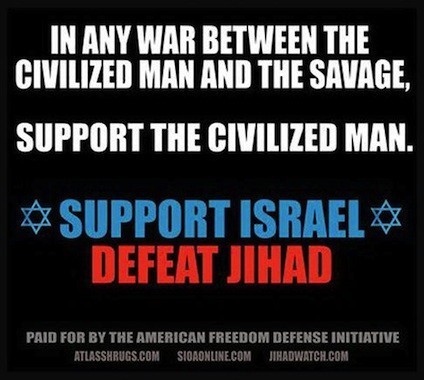
Geller made the papers when she said she’d sue if the MTA refused to put up the advertisement, calling it “a free speech issue.”
And now, well, the MTA’s refusing to put up her advertisement.
Geller was notified of the ad’s rejection Thursday and the rejection letter, which she’s posted on her Atlas Shrug blog in an entry titled, “IT’S OFFICIAL: PRO-JIHAD MTA BANS PRO-ISRAEL ADS, RUNS ANTI-ISRAEL ADS“, explains that Geller’s ad “contains language that, in our view, does not conform with the MTA’s advertising standards regarding ads that demean an individual or group of individuals…” A call to the MTA confirms that her ad didn’t pass muster.
And the MTA has a good point. As Gothamist sarcastically notes: “Yeah! Why is everyone shocked at the word “savage?” Or the phrase “war between the civilized man and the savage?” It’s not as if that phrase has ever been used in history to suppress minorities or advance theories of white supremacy. Nope.”
Geller, who’s done this kind of thing before, is keeping her promise and is preparing to sue the MTA. She writes:
The pro-jihad MTA is refusing my ad for the word “savage.” Just so you know, I will be suing, with the aid of my inestimable legal team, David Yerushalmi and Robert Muise of the Thomas More Law Center. We are what? 4-0, now? Tarazi lawsuit roundly defeated, check. Detroit/SMART Transit on “Leaving Islam” bus ad lawsuit, check. MTA on the Ground Zero Bus ads lawsuit, check. Miami Transit for “Leaving Islam” bus ads lawsuit, check.
I will say this until someone in those clueless ivory towers of the sharia-compliant MTA understands this. “Savage” is accurate. The pro-jihad MTA cannot ban the the truth, particularly in the political arena…
In the spring of 2010, as part of her “Leave Islam” campaign, Geller paid $10,000 to put this advertisement on city buses:

And in the summer of 2010, during the “Ground Zero Mosque” controversy she helped spearhead, she successfully scared the MTA into keeping up this advertisement:
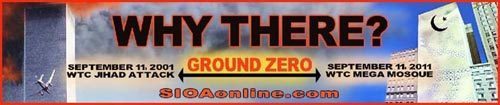
The Muslim Brotherhood is not a threat
By Zhao Li | Source

“I’m fed up,” complained President Hosni Mubarak about ruling Egypt, “But if I resign now, there will be chaos. And I’m afraid the Muslim Brotherhood will take over.”
His fear is echoed by several prominent American politicians, including Republican presidential hopefuls Minnesota Governor Tim Pawlenty and former Speaker of the House Newt Gingrich. They suggested that the deposition of Mubarak would most likely lead to an Islamic government in Egypt, a change many perceived as worse off than the status quo. But why should we prefer a 30-year-old authoritarian regime to a potential democratic government involving the Brotherhood? And why are we fearful of Islam as an obstacle to democracy?
The word Islam is almost synonymous with terrorism to many Americans. We often perceive any Islamic political organization as inevitably violent and even necessarily evil. However, while there is a presence of extremism in Islam, the public often neglects the much more dominant and moderate factions such as Egypt’s Muslim Brotherhood. The Brotherhood’s recent record of violence was but one highly disputed assassination attempt at the ex-President Gamal Abdel Nasser in 1954. Since then the Brotherhood has adopted a nonviolent reformist strategy which Bin Laden criticized as “betraying jihad.” Among all Islamist political organizations, the Brotherhood is probably one of the last to ever be suspected of extremist influences.
Not only is the Brotherhood non-violent, but it has also consistently outperformed the Mubarak regime in enabling progress in Egypt. Since Mubarak’s presidency, the Brotherhood has drawn many students and professionals alike. Moreover, the Brotherhood has continued to advocate for Islamic reforms, a democratic system and a vast network of Islamic charities helping the Egyptian poor.
All evidences show that the Brotherhood is a much needed impetus for peaceful democratic reform in Egypt. In contrast, the Egyptian government’s relentless oppression of the Brotherhood as well as Mubarak’s stubborn hold to power make the regime an antithesis to democracy. It is no wonder that the Egyptian people felt the urgency to rise up for democracy and regime change.
If Mubarak and his friends in the U.S. Congress are concerned about the Egyptian people’s well-being, why would they continue to misrepresent the will of the Egyptian people by demonizing Islam and denying democracy to a Muslim nation?
Again, self-interest is at work. Mubarak has been striving to present himself as the “better” option for the Egyptian people, as if the country must choose between an authoritarian and an extremist rule. Similarly, out of self-interest, politicians such as Pawlenty and Gingrich would maintain a U.S.-friendly regime in the Middle East at the expense of true democratization in the region. The opinions of these politicians mirror those of their constituency. A recent Rasmussen poll showed that 60 percent of Americans think it is more important for the United States to be allies with any country that protects our national security than it is to be allied only with countries that have freely elected government.
The contradiction between the United States’ official stance and its actual goals only lead to two conclusions: first, the United States is not actually concerned with spreading democracy, using it as a public relations tool. Second, the American public believes that Muslims are incapable of building their own democracy.
The reactions of both Mubarak and his American supporters to the Egyptian uprising reveal their prejudice against Islam. Unless we challenge the existing distortion of Islam in the American society, the true process of democratization in the Middle East as well as the image of the United States in the region will remain hindered for years to come.
Al Arabiya Poll: Some Arabs Justify 9/11 And Deny Al-Qaeda’s Culpability; I Say: Yeah, So What? (I)

I recently published two articles: Gallup Poll: Jews and Christians Way More Likely than Muslims to Justify Killing Civilians and Surveys Show in Every Country Muslims Less Likely to Justify Killing Civilians Than Americans and Israelis.
One anti-Muslim critic posted the following comment in response:
Interesting poll carried out by al-Arabiya…..
More than one-third of Arabs justify the 9/11 attacks, and only 23 percent believe Al Qaeda was behind the aerial suicide bombings.
The survey included 220,000 Arabs and was carried out by the Al-Arabia television channel in Dubai and a British research institute.
Thirty-six percent of the respondents justified the attacks, but only 38 percent took the opposite view, leaving another 16 percent undecided or with no opinion.
(You can google for the link)
I did google for the link and could not find it. Instead, I found link after link of Islamophobic websites all linking to each other. Finally, it seems I located what seems to be the original anti-Muslim site to make the claim, the Israel National News:
Dubai Poll: More than Third of Arabs Justify 9/11
More than one-third of Arabs justify the 9/11 attacks, and only 23 percent believe Al Qaeda was behind the aerial suicide bombings.
The survey included 220,000 Arabs and was carried out by the Al-Arabia television channel in Dubai and a British research institute.
Thirty-six percent of the respondents justified the attacks, but only 38 percent took the opposite view, leaving another 16 percent undecided or with no opinion.
Only 23 percent believe that Al Qaeda was behind the attacks, while a large number – 26 percent – think that the terrorist organization did not plan and carry out the hijack-bombings.
Slightly less than half of those participating in the survey – 48 percent – do not think that the assassination of Osama Bin Laden was a criminal act…
Forgive me if I take Israel National News with a grain of salt. The hyperlinks to “the survey” in that article lead nowhere.
On the other hand, it could also be good old MEMRI:
36% of Arabs in Al-Arabiya TV Survey Justify 9/11
Al-Arabiya TV, in collaboration with a British research institute, conducted an online survey on the occasion of the tenth anniversary of 9/11. Out of the 220,000 Arabs who participated, 23% believed Al-Qaeda was responsible for the 9/11 attacks and 26% did not. 36% said that the attacks were justified and 38% that they were not. 16% considered the assassination of Osama bin Laden a criminal act, 48% did not, and 36% were undecided.
Source: Facebook site of Al-Arabiya TV
No hyperlink is provided to the “Facebook site of Al-Arabiya TV.” I visited the Facebook site myself and did not find any such information.
Forgive me once again for not taking MEMRI as the Gospel truth. MEMRI’s founder and president is Yigal Carmon, who served as a Colonel in the Military Intelligence Directorate of Israel. He also had a direct governmental role in the administration of Israel’s occupation of the West Bank. One can hardly be faulted for doubting MEMRI’s reliability.
Indeed, Middle East expert Dr. Norman Finkelstein calls MEMRI “a main arm of Israeli propaganda,” noting that the organization “use[s] the same sort of propaganda techniques as the Nazis.” Says Finkelstein further:
They take things out of context in order to do personal and political harm to people they don’t like.
And he concludes by saying:
I think it’s a reliable assumption that anything MEMRI translates from the Middle East is going to be unreliable
One should note, however, that MEMRI says that it was “an online survey.” What is interesting is that when I finally did find some mention of this poll in an article on the Al Arabiya website (helpfully linked to by an anti-Muslim, pro-Israeli website), the article itself–the same Arabic article on Al-Arabiya that the Islamophobes cite, no less–concludes by questioning the scientific validity of the survey. The concluding paragraph notes that a “survey expert” contacted by Al Arabiya “does not view the results as [accurately] reflecting the trends in the Arab world,” and that “we must look into the study more and study its [research] methodology” to confirm its validity.
Why would anyone rely on a possibly unscientific internet poll instead of the far more reliable Gallup poll which found that only 7% of the Muslim and Arab world thought the 9/11 attacks were justified? Robert Spencer of JihadWatch cited an article by Robert Satloff of The Weekly Standard, which pointed out that this “7%” figure includes only those who thought the 9/11 attack was “completely justified” and that the data shows “another 23.1 percent of respondents” who thought the attacks were “in some way justified.” In other words, a total of 30.1% of the Muslim and Arab world thought the 9/11 attacks were either “completely justified” (7%) or “in some way justified” (23.1%).
Coincidentally enough, the number 30.1% is close to the number found by the Al Arabiya poll. Therefore, although there still exist unanswered questions about the scientific validity of the study, the number seems to corroborate the data found by Gallup. However, the Gallup poll reveals what is missing from what we have from Al Arabiya (since we don’t have the actual study): the difference between thinking the 9/11 attacks were “completely justified” and “in some way justified.”
It is well-known that respondents to surveys often have complex answers to questions asked by the polls but are forced to choose between answer choices that do not adequately reflect this complexity. For example, a question asking “do you support Barack Obama, Sarah Palin, or neither/no answer” would be difficult to answer for many progressive voters who do not like Barack Obama due to his failed campaign promises and the fact that he has not followed progressive policies. Yet, many of them will still select Barack Obama in this poll, because they like him more than Sarah Palin, thinking of it as a “what team are you on” sort of question (i.e. liberal vs. conservative).
In other words, the complex answer of “I supported Barack Obama in the 2008 election and still do support him over Sarah Palin, yet I am totally disappointed by him” is not one of the options to choose from. Therefore, such a progressive would choose what he thinks is the best approximation, and this may well be tick-marking Barack Obama’s name.
Similarly, when a Muslim or Arab is asked “Do you think that the 9/11 attacks were justified?” and the answer choices are between completely justified, somewhat justified, and not justified at all, many of them will select “somewhat justified” to convey the thought that one Arab acquaintance of mine told me (which of course I strongly disagree with):
I don’t think the 9/11 attacks were justified in the sense of killing civilians. That is against Islam and what I believe in. However, I feel that it is justified in the sense that America had it coming to them for what they did to us and continue to do.
This point is conveyed in the Al-Arabiya article itself, which states that many Arabs “considered the U.S. deserving of this [the 9/11 attack] and that what happened was justified as vengeance against its atrocities and positions against the Arabs” even while at the same time holding the view that the “operation [was] abhorrent enough not to want to attribute it to [themselves].”
These Arabs thought 9/11 was a case of the chickens coming home to roost, and were hopeful that Americans would know how it feels. This is certainly different than thinking that the 9/11 attacks were completely justified. Indeed, most Arabs feel deeply uncomfortable with killing civilians. In the minds of these Arabs and Muslims, tick-marking “somewhat justified” is a way of refusing to give “victim status” or “hands clean status” to the United States.
* * * * *
In any case, even if we interpret the poll results as saying that 36% of Arabs (or the Muslim world) think that the 9/11 attacks were “somewhat justified” in the sense of the targeting and killing of civilians, in that case so what? It is still far less than the percentage of Americans, specifically Jewish and Christian Americans, who think that that “it is sometimes justifiable to target and kill civilians.”
The percentage of Christian Americans who think “it is sometimes justifiable to target and kill civilians” is a whopping 58%, with an almost equal percentage of Jewish-Americans thinking the same (54%). Indeed, Mormon-Americans came in first place, with 64% saying so, which is more than double the percentage of Arabs or Muslims in the Muslim world who thought 9/11 was “somewhat justified” (30.1%).
As for Israeli Jews, 51% of them believe “it is sometimes justifiable to target and kill civilians,” so these Israeli propagandists doth protest too much, methinks. Indeed, even more worrisome is the fact that according to a survey conducted by Haifa University’s Center for the Study of National Security a majority of Israeli Jews support a policy of ethnic cleansing against Palestinians, with a quarter saying they would consider voting for the Kahanist party Kach, known for its vocal support of ethnic cleansing as a resolution to the conflict.
Meanwhile, nearly half of Israeli Jews (46%) support “price tag” terrorism against Palestinians, with the percentage being far higher in traditional, national-religious (Religious Zionists), and ultra-Orthodox Jews (55%, 70%, and 71% respectively). Price tag terrorism refers to “acts carried out against Palestinians in revenge of government actions harming the settler enterprise.” These are characterized as “pogroms meted out by fanatical settlers against defenseless Palestinians.” Price tag terror is conducted by “Israeli soldiers and settlers” who”rampag[e] through” Palestinian villages, meting out “retributive violence.”
The vast majority of Israeli Jews (see here, here, and here) supported Operation Cast Lead in which more than a thousand Palestinian civilians were slaughtered. Operation Cast Lead was described by the United Nations as an operation “designed to punish, humiliate and terrorize a civilian population.” This is the level of morality and humanity among Israelis.
One does not expect such polls to be included on MEMRI’s website, no doubt I’m sure due to no other reason than their “limited resources.” Meanwhile, anti-Muslim and Zionist websites will continue to peddle statistics without any context. Thirty-point-one percent percent seems unusually high, until one looks at the far higher percentages among Jews and Christians.
Interestingly, one of the main anti-Muslim websites featuring the Al Arabiya poll, the Infidel Blogger’s Alliance, concludes with the genocidal call to “Nuke Mecca already. Nuke e’m.” This perfectly encapsulates the irony of throwing hissy-fits when Moozlums justify violence while at the same enjoining far more violent acts.
Islamophobia: Paranoia infects North America

By Haroon Siddiqui | Source
One legacy of the decade since 9/11 has been the growing fear of Muslims and Islam.
Many Europeans dread “Eurabia,” the ostensibly imminent Arab/Muslim takeover of the continent, even though its Muslim population is less than 3 per cent. Among those convinced of the coming apocalypse was Norwegian terrorist Anders Breivik. Other believers express themselves peacefully but no less fervently.
Americans have come to share this European paranoia.
Many dread “New Yorkistan” and the takeover of America by Muslims, who constitute only 0.8 per cent of the population.
Nearly half of the 50 states have taken legislative steps to stop sharia, Muslim personal law.
Nearly a fifth of Americans believe that Barack Obama is Muslim or Arab or both. He fretted so much over this that during the 2008 election his organizers ejected two hijabi women from camera range. At a Republican rally, a woman called out to John McCain that Obama was an Arab; the Republican candidate responded: “No, ma’am. He’s a decent family man and citizen.”
Last year, Obama and Mayor Michael Bloomberg tamped down the hysteria over “Ground Zero mosque” but they could not persuade aFlorida pastor from commanding national attention for weeks before burning a copy of the Qur’an.
This year Peter King, chair of the security committee of the House of Representatives, held hearings into “the homegrown radicalization” of American Muslims. He believes that “80-85 per cent” of America’s 1,900 mosques are “controlled by Islamic fundamentalists. This is an enemy living amongst us.” In fact, a study this year by Duke University found that American Muslims have been the biggest source of tips to the FBI in disrupting terror plots. Attorney General Eric Holder lauded the Muslim community for it.
In Oklahoma, Republicans are accusing Democrats of plotting an Islamic state on the Plains. Elsewhere, school texts are being challenged as being pro-Islamic, meaning, they are neutral and do not condemn Islam.
Among the 23 anti-sharia states, the Tennessee Assembly said sharia promotes “the destruction of the national existence of the United States.”
Newt Gingrich believes, or at least says he does, that “sharia is a mortal threat to the survival of freedom in the United States and in the world as we know it.” Sarah Palin says sharia is going to be “the downfall of America.” Michele Bachman says sharia means Muslim “totalitarian control” over America.
This is “is disturbingly reminiscent of the accusation in 19th-century Europe that Jewish religious law was seditious,” writes Eliyahu Stern, professor of Judaic studies at Yale.
It turns out that the sharia panic is not a grassroots movement but rather an orchestrated campaign by one man backed by anti-Islamic think tanks and private funders.
David Yerushalmi, a Brooklyn lawyer, works in collaboration with anti-Muslim groups to stoke the anti-sharia hysteria and distribute model legislation for states to adopt.
The Anti-Defamation League, a leading American Jewish agency, has lambasted Yerushalmi for his “anti-Muslim, anti-immigrant and anti-black bigotry.”
He’s among five individuals named recently by the Washington-based Center for American Progress in its report Fear Inc.: Exposing the Islamophobic Network in America.
It names him along with Frank Gaffney of the Center for Security Policy; Daniel Pipes of Middle East Forum; Robert Spencer of Jihad Watch and Stop Islamization of America; and Steve Emerson of Investigative Project on Terrorism. Their propaganda is parroted by Rep. King and other Republicans as part of their wedge politics. It is also repeated ad nauseum by such media outlets as Fox-TV.
The report also lists seven foundations that since 9/11 have dispersed $42.6 million to individuals and groups that work with the Tea Party’s state chapters: Brigitte Gabriel’s ACT! for America; Pamela Geller’s (and Spencer’s) Stop Islamization of America; etc.
Some of them were behind the “Ground Zero mosque” protests, and are part of the agitation against the building of mosques and Islamic centres, 35 of which have been held up or delayed across the U.S.
The American Civil Liberties Union said:
“While mosque opponents frequently claim their objections are based on practical considerations such as traffic, parking and noise levels, those asserted concerns are often pretexts masking anti-Muslim sentiment. Government officials in some areas have yielded to this religious bigotry.”
As in most things , Canada is somewhere in between Europe and the U.S. in dealing with its 850,000 Muslims, both in the battle against terrorism and in the public discourse about Islam.
There was the bungled case of Maher Arar, tortured in Syria with Canadian complicity. There was the 2003 case of 23 Indian and Pakistani students accused of plotting terror acts, though not one was ever charged. There are the lingering cases of three Canadian Arabs who, too, got tortured in the Middle East with Canadian complicity. There’s the ongoing legal battle of five Arab-Canadians over security certificates that permit indefinite detention of non-Canadians.
On the other side of the ledger, there was the successful prosecution of 11 of the “Toronto 18” charged with terrorism, and that of an Ottawa man for his involvement in a British bomb plot.
Canada has not imported European aversion to Muslim immigration, yet. But our debate on multiculturalism has also become a smokescreen for attacking Muslims and Islam.
“Almost every reason for toleration’s apparent fall into disrepute concerns Islam,” notes Prof. Charles Taylor of McGill University, one of the inventors of our constitutional multiculturalism.
Multiculturalism was blamed during the noisy 2005-06 debate over sharia in Ontario, and also during Quebec’s 2008-09 debate on reasonable accommodation that preceded the anti-niqab legislation to deny all public services, including health services, to those wearing it.
Mind you, Quebec has long resisted the term multiculturalism and preferred inter-culturalism, with its implied primacy of not only the French language but also French culture. This year, the Parti Quebecois baldly asserted that “multiculturalism is not a Quebec value,” even though it is the law of the land (Section 27 of the Charter and the Multiculturalism Act).
Of the five high-profile Canadian cases of hijabis barred from soccer, judo and taekwondo tournaments, three were in Quebec. And in 2007, a Quebec corrections officer was fired for wearing a hijab. Opposition to the hijab is highest in Quebec, according to an Environics poll.
Across Canada, mosques in Hamilton, Montreal and the Vancouver area have been firebombed and vandalized since 2010.
European and American Islamophobes do have fans in Canada.
Geert Wilders, the anti-Muslim MP from the Netherlands, was here last year on a three-city tour, to much fanfare in the right-wing media. Among those applauding him was the virulently anti-Muslim group Canadian Hindu Advocacy. It is in the forefront of the protest against Friday prayers at Valley Park Middle School.
Another pro-Wilders group is the Jewish Defence League of Canada, which has an alliance with Britain’s anti-Muslim and racist English Defence League.
Among the anti-Islamic writers quoted by Breivik in his 1,500-page anti-Muslim manifesto were two Canadians — Mark Steyn and Salim Mansur.
Steyn, author and columnist, was the subject of a 2006-07 controversy when Maclean’s magazine ran his 4,800-word rant that Muslims pose a demographic, cultural and security threat to the West. When a group of Canadian Muslims complained to the human rights commission, they were vilified by Steyn supporters as well as free speech advocates in a way not seen before against any anti-hate complainants.
Mansur, a professor at University of Western Ontario and a columnist for the Toronto Sun, is a frequent critic of fellow Muslims and Islam. He is a member of the academic council of Gaffney’s Center for Security Policy, and much used by Islamophobes in the U.S. and Canada.
hsddiqui@thestar.ca
Islamophobia: The new anti-Semitism

By Haroon Siddiqui | Source
One byproduct of 9/11 has been Islamophobia — fear of Islam and its adherents, Muslims. Rather than recede with time, it has been growing in the United States and Europe, while Canada has not been immune to it.
Hardly a month goes by without some controversy over hijab, niqab, “honour killings,” polygamy, “forced marriages,” “sharia,” prayers in public places, such as at Valley Park Middle School in Toronto, or over how far free speech may be invoked to disproportionately demonize Muslims and Islam without running afoul of Canadian and European anti-hate laws.
There are arguments, for sure, over:
• What constitutes Islamophobia. A critical study of Islam and Muslims obviously does not.
• How we got to this stage of what Prof. John Esposito of Georgetown University in Washington, D.C. — the most prolific author on the subject — calls “the new anti-Semitism,” a “spreading social cancer.”
“In the past 10 years, we’ve seen an exponential increase in hostility towards Muslim fellow-citizens,” he tells me.
“This hatred threatens the democratic fabric of North American and European societies and impacts not only the civil liberties and safety of Muslims but also, as Norway shows, the safety of all citizens.”
Anders Breivik’s murder of 77 people in July to protest what he perceived as the Islamization of Europe was the most extreme example of Islamophobia. But there’s no shortage of incendiary anti-Muslim rhetoric. And there’s also little doubt that anti-Muslim demagoguery has moved from the margins to the mainstream.
Across Europe, far-right parties have made record political gains and are partners in some coalition governments. In the U.S., four Republican presidential candidates are openly on a warpath against Islam and Muslims. Twenty-three states are in various stages of banning sharia, Muslim religious law, as though its imposition was imminent.
It was not supposed to come to this.
In 2001, George W. Bush said that his war was on terrorists, not Muslims or Islam.
But he went on to claim, just as had Osama bin Laden, that his crusade was guided by God. His wars in Afghanistan and Iraq turned into disastrous occupations. Tens of thousands of civilians were killed. There was Guantanamo Bay, Abu Ghraib, torture and indefinite detentions.
Wars, especially long ones, need propaganda that, inevitably, produce narrow nationalism and cultural warfare.
If the jihadists were on a holy mission against the evil American empire, the U.S. and its NATO partners were targeting peoples and nations in need of our democracy, even if by force, and whose women needed liberating.
Just as the Muslim world turned against the U.S. and Europe, Americans and Europeans turned against Muslims, including their own minorities, nearly half of whom were born in Europe and North America. Fellow citizens were cast as strangers and potential fifth columnists.
Thousands were arrested. There was religious and ethnic profiling, mosque surveillance and warrantless wiretapping.
Canadian Muslims avoided crossing the border into the U.S., unless they absolutely had to, and stopped flying overseas through the U.S.
As collective guilt was spread, former British prime minister Margaret Thatcher and others said all Muslims were responsible for terrorism.
Conflating Muslim terrorists with all Muslims was just the beginning.
If Muslims over “there” were our enemies, Muslims “here” must be as well. If the Taliban and others in far-off lands mistreated their women, Muslim men in the West must be doing the same. Hijabi women here had to be rescued as well, even if we couldn’t make up our mind whether that piece of cloth represented oppression or rebellion.
Not all the blame rested with Bush and Co.
Several groups exploited the fear factor after the terrorist murders in New York, Madrid and London.
American neo-cons demonized Arabs and Muslims to push their war agenda.
Evangelical Christians — believing that the eagerly awaited End of the World wouldn’t happen until all Jews returned to the Holy Land and converted to Christianity — joined right-wing Zionists. For both, pro-Israel equalled anti-Muslim.
Many among them made alliances with European right-wingers who had traded their old anti-Semitism for anti-Islamism, which was “only a slightly modified version of traditional anti-Semitism,” says Jocelyne Cesari, fellow at the French National Centre for Scientific Research.
Uri Avnery, longtime Israeli peace activist, wrote recently that when he saw some anti-Muslim German blogs, he was “shocked to the core. These outpourings are almost verbatim copies of the diatribes of Joseph Goebbels,” the propaganda minister for Hitler. “The same rabble-rousing slogans. The same base allegations. The same demonization.”
European extremists have been skilful in exploiting public panic over economic crises, unemployment and a loss of national identity under the European Union and globalization.
Combining xenophobia and Islamophobia, they said no to Muslim immigration, no to Muslim Turkey joining the EU and no to multiculturalism that mollycoddled Muslims. The message was delivered in the liberal language of women’s liberation and gay rights.
In France, Marine Le Pen, leader of the far-right National Front Party, is leading Nicolas Sarkozy in the polls for next year’s presidential election.
In the Netherlands, Geert Wilders, the anti-Muslim MP, led his Freedom Party into a partnership with the centre-right government. He wants to ban “the fascist Qur’an;” forbid the building of mosques, “palaces of hatred;” and impose a tax of 1,000 Euros a year on those wearing the hijab, “a swastika.”
Wilders was a key source of inspiration for Breivik, who belonged for nine years to Norway’s far-right Progress Party, which is now the second-largest party in parliament.
In Finland, the right-wing True Finns won 19 per cent of the vote in the elections in April to become the third-largest party.
In Sweden, the Democrats with neo-Nazi roots won their first seats in federal parliament last fall.
In Denmark, the land of the 2005 Muhammad cartoons, the right-wing People’s Party, which works with the governing coalition, calls Muslims “cancer cells,” “seeds of weeds” and “a plague on Europe.”
In the U.K., about 50 per cent of mosques, Islamic centres and Muslim organizations have suffered at least one attack since 9/11, according to the European Muslim Research Centre at Exeter University.
Instead of confronting the right, the mainstream parties have been pandering to or partnering with them.
Belgium and France banned the niqab (as has Quebec since). Italy, under Silvio Berlusconi’s centre-right government, is in the process of doing so.
British Prime Minister David Cameron and German Chancellor Angela Merkel followed Sarkozy in pronouncing multiculturalism a failure.
Six German states banned the hijab. Some others instituted Muslim-specific questions in tests for citizenship, denied those deemed to have a religious orientation.
Anti-Islamic sentiment crosses ideological lines.
Its proponents include leftist intellectuals. In the 2008 Swiss referendum to ban minarets, left-of-centre voters voted with right-wingers.
When German central bank member Thilo Sarrazin said in his best-selling book Germany Does Away with Itself that Muslim genes are inferior and that Muslims are incapable of being integrated, he was backed by former chancellor Helmut Schmidt.
Haroon Siddiqui is the Star’s editorial page editor emeritus. hsiddiqui@thestar.ca
The Brotherhood and America Part Six

by Manal Lutfi, Asharq Al-Awsat
First Published at Ikhwanweb.com, March 2007
“Fear” is a key word when considering the future of the relationship between the Muslim Brotherhood and the US. This multifaceted fear can be explained for a number of reasons. There is the well-known anxiety of what the Islamists would do if they came to power in one country or another and how this would affect American interests. There is the fear that US relations with regional allies will deteriorate if they began dialogue with moderate Islamic organizations, who have proven to have street influence and are capable of winning elections. The third concern is that a dialogue is not opened with these groups, and one of them rise to power. It is due to this mixed bag of fears that is difficult to lay down a clear US policy. A study written by David Shankar and published by Washington Institute for Near East Policy, in November 2006, discussed the various strategies that could be considered if the Islamists rose to power through an election.
The first strategy Shankar suggests is to isolate Islamist groups politically and financially by first drawing a clear distinction between “non-Islamist Muslims” and “Islamists” and secondly increasing the political cost for governments or parties dealing or allying with Islamists (including banning financial grants and imposing economic constraints). The second strategy is to delay the spread of democracy in the region, based on a refutation of George Bush’s fundamental notion on the close relation between political despotism and the spread of terrorism [supporting evidence is the existence of terrorist movements in democratic states such as the Basque National Liberation Movement in Spain, the Japanese Red Army in Japan and the Red Brigades in Italy]. Delaying the spread of democracy in the region will prevent Islamists from coming to power but will not affect the course of the American war on terror. The third strategy is to integrate moderate Islamists without waiting to strengthen the liberal current; however, this option should be resorted to along with consolidating regional cultural and educational reforms and recognizing that this option shall not be without cost.
But why discuss the future of Muslim Brotherhood/US relations? Do some American officials and researchers believe that there are common interests shared by both parties? And if so, is it better to put the future of relations on the table? The answer is yes; there are some who believe in the possibility and necessity of dialog to maintain US interests in the region.
Discussing this point, a key US State Department official told Asharq al Awsat that there is an agenda of common interests between Islamists and the Americans in some regional states, but that America does not want to publicly show its interest in one group or another for fear of the so-called American “kiss of death”. After all, any political current that is directly backed by America has many shadows of doubt cast across it.
Speaking to Asharq al Awsat, on the condition of remaining anonymous, the American official said, “I think there can be an agenda of common interests between Islamists and the US administration; however, this should not to be overestimated.
The fact is that there is currently no common agenda, although many people think it already exists. For example, we criticize the Syrian regime, as does the Muslim Brotherhood in Syria, however this does not imply that we work with the Muslim Brotherhood in Syria or work against the Syrian regime. So, one has to be careful to avoid exaggeration. There is a common agenda but this does not mean we work closely together. We adhere to American non-intervention in internal partisan policies, we support political process transparency and election monitoring, but we do not want to select favorites because we fear the American “kiss of death”. We reject the “kiss of death” notion for any Arab world party or direct US support because this is forbidden and this does not serve the interests of America or these parties.”
For his part, John Alterman, the director of the Middle East Programme at the Center for Strategic and International Studies in Washington, stresses that there is increasing understanding of political Islam in Washington, pointing out that regional governments no longer monopolize political power. He cited last summers events, when the Middle East witnessed an unprecedented escalation of violence, both in Iraq (between the Americans and the “resistance” forces or “militants”, who are armed organizations rather than governments) and in Lebanon as a war broke out between Israel and Hezbollah (which is not a government either), indicating that this is a reason for concern. “If we look at governments alone, we will miss part of the picture,” he said, explaining that the rise of armed organizations, non-official political bodies and Islamic organizations has to be accompanied by changes in how American policy in the region is formulated. “America often talks to Islamists. In the cases where dialogue does not exist, the main obstacles arise from some rejections by regional governments, rather than from hesitation by the US administration. But if we are serious, we have to interact with politically active groups, and the Muslim Brotherhood is definitely a key part of local political interactions in the region. However, questions will remain about how Islamists would act if they gained more political power and about the relationship between political Islam and violence”, he told Asharq al Awsat.
Alterman said there must be ongoing discussions in Washington on the relationship with Islamic organizations. In fact, one reason why it is difficult to determine the US policies dealing with Islamists is the existence of the push and pull between some State Department officials and US ambassadors to the region. State Department officials may propose contacts with one Islamist party while embassies in respective capitals are more interested in maintaining diplomatic relations, and even in consolidating such relations, especially with America’s key allies in the region. In this respect Alterman says, “There is a difference between realizing information and wisdom. There are people inside the administration who have information but it is not integrated correctly so as to be comprehensible to senior administration officials and therefore the whole picture is sometimes lost. Most foreign US policies are put in force by the various US embassies in world’s capitals and embassies depend on the existence of strong relations with the governments of these countries. So on the whole, in the administration there may be people who believe in opening dialogues with Islamists, but the focus of embassies in respective countries is focused on strong bilateral relations.”
If the American fear of angering Washington’s regional allies plays a key role in formulating the future of relations between the Muslim Brotherhood and the Americans, there is another fear factor that has to be considered. Attention must be paid to the agendas and goals of the Islamists, and consideration must be taken into whether they will not harm US interests in the region or turn against the principles of pluralism that brought them to power.
Marina Ottaway, the Director of Middle East Program at Carnegie Endowment for International Peace, Washington, says that there is a mistrust, even of the so-called “moderate Islamists”, as it is suggested that they are not loyal to democracy, they just use democracy as a means to come to power, and that if they came to power they would turn against democracy. The cause, she explained, is the existence of a deep misunderstanding of Islamists and the view that they are “non-democrats”, as well as the existence of the concept of the clash of civilizations and regarding Islamists as anti civil freedoms.
“I think a dialogue with Islamists will lead to a return to a foreign policy concept that is comparable to the state of affairs during the Cold War-maintaining an interest in a state (the Soviet Union) that poses a great risk to us, rather than going to war. The solution to getting out of this situation is to open dialogue, gain understanding and differentiate between dangerous and non-dangerous groups; after all, there is the international terrorism challenge to consider” she added. While some maintain that the goal of dialogue with Islamists is to improve America’s image in the region, Daniel Kurtzer, the former US Ambassador to Egypt, played down this argument, pointing out that chief among these goals is to explain the US policy; “We believe that if we better understand people, they will be less hostile towards us. We see unfounded reports in American newspapers and this happens in regional countries also. Sometimes newspapers and other media outlets publish and broadcast reports that are simply untrue but people tend to believe them, drawing false conclusions about America.
So the first goal of dialogue is to give an accurate picture of America, of who we are and of what issues concern us. The second goal of dialogue is to listen to the viewpoints of the “other”. We hear of the Muslim Brotherhood, the Jamaa Islamiya, Hamas and Hezbollah. If we talk with people from these organizations, we can better understand their positions on supporting terrorism, peace, Israel, America and many other issues. The third goal of dialogue is for the administration to see whether or not there are practical techniques to move forward. For example, we have in place a policy on spreading democracy in the region. The Bush administration is strict in pushing this, but all administrations sought to make success in spreading democracy. It is important to seek to understand what this means and whether there is a potential to increase the number of states involved in the agenda of democratic transformation, not according to the American culture but rather according to the respective cultures of these countries—the cultures of Egypt, Jordan, Saudi Arabia and Kuwait,” he added.
In fact, there is a correlation between dialogue with Islamists and American efforts to boost political and constitutional reform in the region. Some officials and researchers interviewed by Asharq al Awsat believe that the key is to back the truly moderate Islamic organizations that have introduced remarkable changes to their political and intellectual discourse, actions and practices. Support for these moderate Islamic organizations is accompanied by real pressure on US allies in the region to forge ahead on the track of political reform rather than take a step forward then another step back, as is happening in some regional countries. Amongst the factors that encourage such a proposal is that Islamic organizations in the region have increased internal intellectual debates regarding their agendas and positions towards many issues. They include the Muslim Brotherhood and the Center Party in Egypt, the Islamic Constitutional Movement in Kuwait and its debates on the political participation of women, the Islamic Action Front in Jordan and Hamas in Palestine. In this respect, Marina Ottaway says, “There is an ongoing debate within the Islamic movements, such as with the Muslim Brotherhood group in Egypt. There is a more moderate, flexible and reformative wing that talks of laws drafted within and conforming to an Islamic framework; yet they do not mean a literal interpretation of Islamic Sharia like the 7th century interpretations. When we talk of the application of sharia laws we mean the hadd penalties and personal status law, not the legislation regulating everyday life, such as traffic laws, water distribution or taxes. The majority of laws in the region today are based on the French laws. There is also the hardline wing within the Muslim Brotherhood leadership that wants the application of sharia.” Ottaway notes that centrist organisations in Egypt, Justice and Development Party in Morocco, the brotherhood in Kuwait have become more flexible. “I do not believe this poses a threat to America,” she emphasized. However, she blamed the US administration for observing the ongoing debate between “moderate” Islamists and “hardline” Islamists (without taking a particular position) to see who will be successful, pointing out that because the victory of those who call for jihad against the “infidels” will not be good for America, the administrations has to do one of two things.
First is to press for the changing of laws regulating political parties and second, allowing the creation of more moderate Islamic political parties. She pointed out that the registration of Egypt’s center party, as a political party was rejected about three times. “However, does America have to back moderate Islamic parties such as the center party? I’m not sure this will help the center party. I think if the US supported any political organization, this would be viewed with suspicion. This has happened with liberal groups in the past. This concern is what the US State Department dubbed “the kiss of death”. It is amongst the difficulties facing the formulation of the American policy towards Islamists in the region.” The American official, however, sought to give regional people and governments a role in solving this dilemma based on his rejection of the statement that “America is both problem and solution” – pointing out that the fate and future of the region lies in the hands of its people rather than the hands of America in spite of Washington’s influence that cannot be underestimated. “There is difference between supporting democracy and supporting parties. American concerns go beyond the issue of Islamists. Where is the region heading and what is its future? What is its future model? Is there any future model or will the situation remain the same? Whose thoughts will prevail? Moderate Islamists or Takfiris and Al Qaeda? This is the 1 million dollar question, and I do not know the answer.
America is marginal in this internal debate, as is Israel. America can facilitate or hinder, but the solution to the issue lies with the Arabs. There is a major problem in the Arab world – a form of inferiority complex. The problem is always with the others – e.g. the Americans and Israelis are to blame. I know that America’s image is a bad one, and that Israel’s is even worse, but the problem is that there exists an obsession with focusing on the external rather than internal factors. I think that local internal factors are more important to consider, for instance, Syria blames the state of internal conditions on the confrontation with Israel, although Syria is not engaged in direct confrontation with Israel (or is only engaged through Lebanon). Syria uses Israel as a cover up for internal mistakes. Regional problems and solutions do not lie with America. We deal with the current regimes and so do the entire world”, the American official pointed out.
The views of American officials differ on Islamists in the region, particularly the Muslim Brotherhood. But can one talk of the “friends” and “enemies” of Islamists in Washington? Scott Carpenter, the Deputy Assistant Secretary of State and Coordinator of the Middle East and North Africa Partnership Initiative, told Asharq al Awsat that one cannot talk of the “friends” and “enemies” of Islamists inside the administration. “We believe that all political players desirous of political participation have to comply with the principles of democracy, pluralism, minority rights, market economy and modernization. I do not believe there are friends and enemies. Rather there is a pragmatic process concerning Islamists and other political forces,” he added. Carpenter said that there are American research centers that encourage dialogue with Islamists, but that this is not binding to policy makers in America since those are mere views expressed. Carpenter cites the Council on Foreign Relations, as one of those centers that encourage dialogue with Islamists. Founded in 1921, the Council on Foreign Relations is headed by Richard Haas. Amongst its key researchers are Vali Nasr and Noah Feldman, both of whom are defenders of practical dealings with Islamists in the region away from ideology and preconceptions, viewing the shifts taking place on the Islamic map objectively. It is one of the centers that focus on foreign policy issues and seek to offer work sheets and advice to American policy makers. However, the center, which publishes Foreign Affairs journal, was not spared controversy in several situations, last of which was when it hosted Iranian President Mahmoud Ahmadinejad last year, to deliver a speech on his vision of world politics as he took part in UN General Assembly meetings. Although it is not easy to determine who in the administration does not want openness with Islamists, Marina Ottaway, draws attention to the fact that within the administration there are neo-Conservative politicians who do not back the idea of openness to Islamists, pointing out that these officials maintain that it is not possible for the American values to coincide with the values of Islamic organizations, even if they are moderate ones. She points out that the neo-Conservative concept suggests that “America does not have to adapt itself to what already exists because it has the power to change it”, and therefore their approach is to surround Islamists or ignore their presence on the regional political scene.
The Brotherhood and America Part Five

by Manal Lutfi, Asharq Al-Awsat
The American invasion of Iraq led to a significant deterioration in the relationship between the United States and the Muslim Brotherhood organizations. Many Muslim Brotherhood members had frozen or restricted their contact with American officials; such contact usually took place in American embassies of various Arab capitals or on the sidelines of conferences. The position of different Muslim Brotherhood organizations was similar in various countries. The Muslim Brotherhood of Jordan, was similar to those of Egypt and Morocco; they had all taken a step back following the invasion of Iraq. However, other member organizations of the Muslim Brotherhood were less reserved concerning their relationships with the Americans. What is the ceiling of meetings between Americans and Muslim Brotherhood organizations of the region nowadays? What are the issues and objectives of dialogue between America and the Muslim Brotherhood? In this regards, three observations must be cited.
The first of these is that the majority of Islamic leaders, with whom Asharq Al Awsat newspaper had spoken, had expressed their frustration at the sluggish progress of dialogue with the Americans. They emphasized that dialogue with American officials did not result in any change in US policies in the region and had not changed the known positions of the United States towards Arab and Islamic causes. The second observation is that the majority of leading figures within the Muslim Brotherhood member organizations that are not permitted to legally operate in their countries stressed the fact that they only tackle general Arab and Islamic causes with American officials. They stated that their dialogues do not address issues of domestic policy, especially those regarding political reforms. The third observation is that the dialogue between Americans and some moderate Islamic organizations in the region had recently deteriorated. This is not only because of the war in Iraq but mainly because of the US apprehension towards the potential threat of recent electoral victories of Islamists.
As stated by a number of American officials, there is no rejection of dialogue with Islamic parties as “Islamic or religious” parties. Conceivably, the dialogue is rejected because of the agenda and actions of certain Islamist parties and movements that American diplomats are banned from dealing with.
Danielle Pletka, researcher at the American Enterprise Institute based in Washington, said that the basic condition for conducting dialogue with Islamic organizations in the region should be determined according to their position towards violence. She told Asharq Al Awsat that she dislikes the term “moderate Islamist organizations” as it is meaningless. Pletka claims that the only way to distinguish between different organizations is through their approach towards violence and whether that is an appropriate means to achieve political objectives at the local, regional and international levels. She states that the US government is very clear in this regard and does not address terrorists and it would not talk to movements that target civilians, antagonize the United States or call for the destruction of Israel, for example. Pletka adds that the message addressed to Islamic movements is that if they want to be part of the global political scene, they must not be involved in any terrorist activity. However, Pletka highlighted that there are two sides to the problem of dialogue with Islamists. The first is that in the past, some Islamic movements such as the Egyptian Muslim Brotherhood had promoted violence and would not recognize Israel’s right to exist. However, on the other hand, the Muslim Brotherhood of Egypt was exploited by Egyptian authorities as a pretext to prevent the progress of reforms. She elaborated that such an issue is a dilemma for the United States because if the United States should support democracy then it should support it in all its forms. This means that if Islamic organizations were ready to renounce violence, recognize Israel and accept the rule of law, then they should be granted the right to political participation. Pletka stated that this is the prevalent opinion within and outside the US administration as not all Islamic organizations support the use of violence.
Pletka argues that while the principle of non-violence is a global call, the issue of women’s rights or the application of Shariah falls under the cultural and religious interpretation of each country. She asks if there is a group that advocates the application of Shariah and at the same time rejects and condemns violence and recognizes the right of countries in the region to live in peace and does not issue any fatwas that denounce its enemies as infidels or legalize killing them, should this group be ousted from the political process because it wants to impose restrictions on the rights of women or minorities? In this case, Pletka states that within the presence of real democracy, people will choose who is to represent them. If women as well as various religious minorities could vote, they would vote either in favor or against this group through the ballot boxes. Pletka told Asharq Al Awsat that the United States should not address parties that call for violence; the importance of the United States should never be underestimated to that extent. She claims that there are many issues that the United States can discuss with the centrist party, the Muslim Brotherhood in Egypt and Hamas for example, yet there are standards that should be adhered to. If that is not the case, the influence of the United States would diminish and friendship with the United States would lose its value because if the US spoke to every party then this may indicate that it believes that the parties it is addressing are part of the political process. Those who want to establish a dialogue with the United States want the credibility that comes with it but this comes at a price. The price is the abolition of terrorism and elimination of calls for the destruction of others.
The United States keenly avoids dialogue with movements that promote violence, whilst the equally keen Muslim Brotherhood talks about Arab and Islamic public issues and this widens the gap between the two sides. In this regard, a leader of the Islamic Action Front Party, Ali Abu Sukkar, told Asharq Al Awsat that the issues raised by the Jordanian Muslim Brotherhood members with American officials are often regional and international issues. He denied that any of the local issues in Jordan are discussed with the American administration. Regarding the current status of the relationship between the Jordanian Muslim Brotherhood and American officials, Abu Sukkar stated that communication with the Americans had stopped for quite some time in the embassy and through conferences. He stated that there are Muslim Brotherhood representatives in parliament who refused to take part in any delegations that visited the United States. They also rejected any invitation to express their discontent regarding the occupation of Iraq.
Abu Sukkar believes that the decision-making process in US administration is fully controlled by the Jewish lobby in a way that infringes upon the interests of the United States itself. He states that even when suggestions are made that could best serve American interests, they are not considered if they would not benefit Israel.
Abu Sukkar states that Jordan’s Muslim Brotherhood organization is a legal and legitimate movement that represents moderation and Islamic enlightenment; nevertheless, it lacks positive reaction towards some of the issues that it proposes. This in turn reflects a more negative image of the American administration, where US stances against Islam instigate further extremism, adds Abu Sukkar.
It is apparent that most Muslim Brotherhood organizations in the region do not reject, in principle, the idea of dialogue with an American party either formally or informally and do not set any preconditions. However, there is a fundamental and essential objection shown by Muslim Brotherhood organizations in the region towards the fact that Washington turns a blind eye completely in cases of arrest of Muslim Brotherhood members in Arab countries, which contradicts the American position towards the arrest of liberalists.
Independent MP in Egyptian parliament Gamal Heshmat, who is considered a member of the Muslim Brotherhood told Asharq Al Awsat that he does not think that there are any set preconditions as this would mean the termination of any dialogue before it even starts. Heshmat emphasized that dialogue with Americans takes place with academics, civil society institutions and journalists. He affirmed that many of them meet with Muslim Brotherhood members, emphasizing that there had been no dialogue between the Muslim Brotherhood as an organization and the American administration or other governments at the official level. Heshmat stated that any dialogue is a discovery of ideas and attitudes and that he believes that their opinions may need to be conveyed regarding the behavior of the American administration from the standpoint of human rights, especially in dealing with Islamic and Arab issues and even in dealing with Egypt. Elaborating on that point, he stated US administration has created a state of hatred towards Americans and that its foreign policy should be reconsidered and that the astringent American foreign policy and the dominance of Republicans has caused much harm to the American image. He admitted that there is an anti-American/Zionist project within the Brotherhood but this is because it [US] adopts an expansionist, colonialist and settlement project that does not comprehend equal relationships or opportunistic relations but wants to deal with the world out of a desire for domination, which is clearly unacceptable. He finally adds that the Islamic project rejects the practice of domination and refuses it to be practiced against it; therefore, it may be necessary that the American party talks to the Muslim Brotherhood directly.
Regarding the issue of dialogue, Heshmat told Asharq Al Awsat that Egypt is part of the regional situation and it cannot be separated from American plans in the region. He stated that Americans use Egypt to mediate in some cases and achieve their goals without direct intervention. Thus the Muslim Brotherhood’s conditions for dialogue, he explains, is that there must be a set agenda for the dialogue, the Egyptian Foreign Ministry should be informed and the meeting should be declared. He adds that the absence of the American intention and will towards such initiative [for dialogue] hampers the actualization of this meeting.
The stance of the Muslim Brotherhood in Morocco regarding dialogue with the Americans is similar to that of its Egyptian counterpart. Secretary-General of the Justice and Development Party, Ali al Rumeed told Asharq Al Awsat that ever since the invasion of Iraq, he had decided to boycott any American activity or contact any person who works within the official American institution. He pointed out that others from within party had also taken part in the boycott of the United States, although the party did not issue any formal decision regarding this.
It is noteworthy that the Muslim Brotherhood organizations in the region do not necessarily coordinate with one another regarding dialogue with the Americans. The deputy Supreme Guide of the Muslim Brotherhood in Egypt, Mohammed Habib, elaborated on this point saying that there is no coordination since the statements of the US are contradictory. Habib claims that there is a state of deliberate misunderstanding and that US administration is trying to cause confusion between Al Qaeda and moderate Islamic organizations represented by the Muslim Brotherhood. He continued, explaining that if the US State Department wanted to establish dialogue with leading figures of the Muslim Brotherhood, then this would be done through the Egyptian Foreign Ministry. He underlined that the Muslim Brotherhood does not consider itself a state within a state.
In contrast to the Muslim Brotherhood organizations of Egypt, Jordan and Morocco, whose contacts with American officials were affected after the Iraqi invasion of Kuwait, the Muslim Brotherhood organization in Kuwait maintained relatively stronger contact with the American party on the basis that dialogue is an opportunity to put across Arab and Islamic viewpoints of major issues.
Mohamed al Dalal, member of the Islamic Constitutional Movement in Kuwait, told Asharq Al Awsat that there are some established communications with the American embassy in Kuwait regarding a number of issues such as those related to the conditions of the region as a whole; most notably Iraq and Palestine, as well as others regarding reform in the region in general especially after the US adoption of the slogan of reform since 2004. He stated that in regular meetings, members of the movement would express their reservations and dismay concerning the negative American position and its support for Israel for instance, or its stance against the rights of the Palestinians as well as its contradictory and conflicting position on its strategy towards Iraq. He stated that they hold the Americans accountable for the mismanagement and that they call for the American party to be more impartial in support of Arab issues. Nevertheless, he explained that recently, he had noticed the US still has a set of reservations related to its relationship with Islamists, including those who are moderates. Al Dalal claims that there is a state of reconsideration that some observers attribute to the fact that reform proposals which were presented in 2004 and the following years, contributed to Islamists becoming members of parliament and assuming power in a number of states. Accordingly, the persistence of such proposal may lead to the fact that a large number of Islamists would take hold of power in many Arab states and this may not serve the interests of the American strategy and its relationship with existing regimes and governments in the region. Al Dalal stated that this point has been made clear for the American party in recent meetings. He asserted that communications exist between both parties; however, dialogue is conducted in the most objective manner. Finally, he states that the objective is to establish communication and convey the viewpoints that best serve societies and countries in the most objective, fair and equitable manner.
Washington, rather than the Islamists, is accused of being the sole party responsible for the deterioration of dialogue with Islamist parties owing to its “concern” towards the victory of Islamists in Egypt and Hamas in the latest parliamentary elections in the respective countries. Heshmat agrees with this idea and believes that the victory of Hamas had caused the Americans to be fearful. Heshmat stated that the success of 80 candidates and the failure of 40 others from the Muslim Brotherhood in the Egyptian parliament led the Americans to reconsider their position on the issue of dialogue with the Muslim Brotherhood. The Egyptian regime wants to use the Muslim Brotherhood to inspire fear in other groups, he claims. On the other hand, Americans are worried by the Islamist wave. Heshmat believes that the fact that the two sides exploit the Muslim Brotherhood is probably what delays dialogue.
Al Dalal supported Heshmat’s claim that Americans differ in dealing with Islamists from country to country. He explained that they may not agree with Hamas owing to the nature of the conflict and the nature of their support for Israel, therefore, there might not be dialogue because of this position. However, they may agree with the Islamic Party in Iraq and may have some points in common points with this party and consider it relatively moderate, therefore they are willing to deal with it. Al Dalal explains that because of the nature of the Islamic stream in Kuwait and relative democracy existing in the country, there is another outlook adopted towards Kuwaiti Islamists. He explains that Americans do not treat all parties equally and whilst they widen the scope for Washington’s relations with others with respect to dialogue and discussion and try to identify the viewpoints of others, they close the doors to some such as Hamas in Palestine. There is a state of give and take with respect to the Muslim Brotherhood in Egypt in accordance with the nature of the American administration’s relationship with the Egyptian regime and the limits of this relationship, al Dalal explained. He continued to say that in Kuwait, there are still some channels of dialogue, which convey different viewpoints transparently and clearly. With regards to the Palestinian cause, he explained that his party expressed its support for national and Islamic resistance against Israel in the recent war despite American rejection of this support. Ever since the establishment of the movement in 1991, a specific approach was adopted concerning certain issues, al Dalal explained. For example, his movement supported the Islamic Party in Iraq as it joined the political arena. Furthermore, it condemned the actions of Al Qaeda and the resistance that led to the killings of civilians and the destruction of the Iraqi infrastructure. On the other hand it has also denounced the American position and the method with which the US is dealing with Iraq. He states that in Kuwait, they believe that the public interest of Iraq lies in the fact that people of Iraq are more aware of their interests, however, they call upon all Islamic streams including the Muslim Brotherhood and others to seek balance and objectivity that serve the best interest of all communities in general.
There are some parties that defend the launch of dialogue between America and the Muslim Brotherhood on the basis that moderate Islamic movements would “benefit” the United States, especially in light of the continual rise in hard-line ideologies that support the use of violence. Former American Ambassador to Egypt, Daniel Kurtzer told Asharq Al Awsat that allies of Arab governments should not be concerned about dialogue with Islamic organizations in the region given the lengthy relationship between the United States and its allies in the region. He stated that the US addresses many parties all over the world but holding dialogue does not necessarily mean that it is convinced by what others defend, but grants the opportunity to understand what others are saying and to understand their viewpoints.
As for Marina Ottaway, a senior researcher at the Carnegie Endowment for International Peace, she defended the idea of dialogue saying that the US should address Islamists and should talk to every party that wants to talk to the US whether the US likes that party or not. She explains that dialogue should not be confined to the parties that agree with [US] viewpoints. However, Ottaway explains that dialogue with Islamists does not mean that the United States will restore its lost credibility in the Middle East as the issue is not that simple. Ottaway believes that there is nothing the Bush administration could do to reinstate its credibility in the region and that the US may be forced to talk with certain Islamist organizations that want to participate in the political process and form their own political parties in order to better understand these movements. She states that the lack of dialogue in principle does not actually help matters and gives the example of the Palestinian Liberation Organization, which the US did not talk to for several decades. The American Ambassador to the United Nations talked to representatives of the PLO in the United Nations and it is evident how greatly the situation has changed. She finally adds that the United States is trying to support Fatah against Hamas after a long period in which it considered Fatah a dangerous movement.