 Archive for September, 2011
Islamophobia Network Targets Top Performing American Schools

Source | By Michael Shank
This September, I was interviewed by a communications firm on the topic of Islamophobia. The firm is planning a campaign to counteract Islamophobia in America and was conducting interviews with Washington policymakers who have addressed this topic. The interview came on the heels of a Center for American Progress (CAP) report published last month, called “Fear Inc: The Roots of the Islamophobia Network in America,” which found a well-financed, well-organized network of advocates, experts and media partners conducting a strategic campaign throughout America and “spreading hate and misinformation,” as CAP put it.
Islamophobia is on the rise in America, but this is hardly surprising. Scan recent American history to witness the consistent creation of an “other”, whether it was anti-Catholicism and anti-Semitism in the 19th century (and beyond), the first Red Scare in the early 1900s, the Japanese-American scare and second Red Scare in the mid-1900s, or the Muslim American scare in the early 2000s. There is purpose here. When entire races, religions or regions are dehumanized, it is easier to wage war, expel immigrants, and forge new, discriminatory (or oppressive) domestic and foreign policies to deal with these vilified populations.
Turkish-Americans are the latest to feel the heat. Despite serving as NATO’s number two troop supplier and recently agreeing to host a NATO radar defense system, Turkey is often accused by Washington for contradicting US foreign policy aims and objectives when negotiating with Iran, Syria, Israel and Libya. Additionally, Turkey’s market-friendly version of political Islam has often rubbed the West the wrong way.
Now, targeted discrimination aimed at the Turkish American community is centering on a Turkish educational effort, which was identified in CAP’s “Fear Inc” report. The new supposed Turkish threat to America: “Muslim Gulen schools, which [members of the Islamophobia network] claim would educate children through the lens of Islam and teach them to hate Americans”. The authors of the CAP report flatly reject this assertion, however, saying that the schools started by Turkish-American Fethullah Gulen are “nothing of the sort” and that “they are a product of moderate Turkish Muslim educators who want a ‘blend of religious faith and largely western curriculum’.”
CAP is on to something. Two Gulen charter schools ranked 5th and 6th on Newsweek’s 2011 Top Ten Miracle High Schools and two Gulen schools ranked 144th and 165th on Newsweek’s 2011 list of America’s 500 Best High Schools. So what is going on here? Gulen talks of peace and tolerance and was compared by Georgetown professor John Esposito to the Dalai Lama and praised by Madeleine Albright and James Baker III for his advocacy of democracy and dialogue. You would think this is the type of Muslim that America wants. While I recognize that there are legitimate concerns regarding the use of public funds for these charter schools, and concerns about the Gulen movement’s democratic proclivities in Turkey, it seems that at the heart of this is an undercurrent of phobia about Islamic teaching in America.
Having received my high school diploma from a Christian school and my master’s degree at a Mennonite university, which received funding from the US State Department, I know how comfortable this country is with Christian education. Islamic education, however, remains new. The Khalil Gibran International Academy in New York, for example, which aimed to teach Arabic and train students to become “ambassadors of peace and hope”, was vilified as having a “jihadist” agenda. Teachers were termed “terrorists” and founders were called “9/11 deniers,” to which Georgetown’s Esposito responded: “It’s an agenda to paint Islam, not just extremists, as a major problem.”
All of this is new to many Americans, and it is likely scary, especially since the prevailing association vis-à-vis Islam is violence. We have few notions of Islam and nonviolence, in large part because our fear has focused on the extreme outliers and because our largely Christian nation has not yet fully embraced — in media, policy, education or law — religious diversity, no matter how nonviolent, peaceful and tolerant the religion’s majority. It is time we do so. There is much to embrace — if only we open our eyes to it.
Michael Shank is a doctoral candidate at George Mason University’s School for Conflict Analysis and Resolution, a board member of the National Peace Academy and an associate at the Global Partnership for the Prevention of Armed Conflict.
Farha Khaled: Bat Ye’or and The Dhimmitude of Eurabia
By Farha Khaled

Meet Bat Ye’or, the Islamophobia industry’s favourite historian who popularised such terms as ‘Eurabia’, a Euro Arab Axis and “Dhimmitude” the servile state Christians and Jews are condemned to under Islamic rule.
 |
| Bat Ye’or historian to Islamophobes |
Born in Cairo as Gisèle Orebi to a Jewish family she and her parents were forced to flee leaving behind everything in 1956. Settling in England, she married David Littman in 1959 and moved to Switzerland. Gisèle Littman writes under the name Bat Ye’or, Hebrew for ‘daughter of the Nile’. Now in her seventies she wrote her first book about Jews in Egypt under the name ‘Yahudiya Masriya’ which means “Egyptian Jewess” in Arabic.
Bat Ye’or wrote a series of books and articles about life under Islamic rule for Christians and Jews, drawing mainly from her own experiences. With no qualifications or academic background in history, she routinely denigrates the contributions to humanity made by successive Muslim civilisations, magnifies their intolerant periods, ignores the periods of tolerance and generally paints a selective agenda driven picture which grossly distorts the truth and ignores the wider historical context. Despite her pretensions, she was not taken seriously in academic circles and remained on the fringes until 9/11. Her star rose after 9/11 when bashing Islam became a lucrative business most ardently embraced by conservative extremists. Some right wing Zionists have since made it a career. Prior to 9/11 the only Islamophobe of note was Daniel Pipes. By comparison he seems almost a moderate now, indeed he has bemoaned his growing irrelevance by whining that he does believe in a ‘moderate Islam’, a view that puts him at odds with the radical Zionist Islamophobes. These links have been elaborated in ‘ The Islamophobia Industry: Zionism and The Middle East‘ and highlighted by Ali Abunimah in an article for Al Jazeera English ‘Islamophobia, Zionism and the Norway massacre‘ shortly after the Norwegian massacre.
 |
| Eurabia the myth Bat Ye’or invented |
One of the first to cite Bat Ye’or’s work was the Israeli American historian on Islamic history Bernard Lewis, who predicts that ‘Europe would be Islamic by the end of the century’. Self styled ‘counter jihad’ experts like Robert Spencer of Jihad Watch, Brigette Gabriel a Christian Zionist with her Act for America minions, and the shrieking Pamela Geller enthusiastically promoted Ye’or as ‘an expert on Islamic history’. She propagates that European and Arab elites along with the Muslim Brotherhood, have a secret plan to usher in a world caliphate through the OIC. This revisionist history, packaged with images from round the clock 9/11 coverage was sold as the ‘true face of Islam’. Included in this propaganda was the mantra that 9/11 was the same threat Israel faced daily. It was in this manipulated climate of fear that the Iraq war was sold, though Saddam Hussein’s regime was secular.
Since the Anders Breivik massacre, Bat Ye’or has been under the spotlight for having been a prime influence upon the murderer. Her conspiracies however, had already been discredited prior to the Anders Breivik massacre. One of the first to deconstruct the Eurabia myth was Matt Carr of ‘The Institute of Race Relations.’ In 2006 he authored a 23 page report which is downloadable as a free PDF document ‘You are now entering Eurabia’. On page 8 Carr notes:
‘The EU’s perceived tilt towards the Palestinians is crucial to Ye’or’s indictment of Eurabia, where ‘the conception and practice of Palestinianism as a hate cult against Israel has had a profound impact on European society’ and where anti-Zionism is always synonymous with anti-Semitism.’
In his report, Matt Carr mused that the Eurabia myth had the potential of evolving from a fringe conspiracy to a ‘dangerous Islamophobic fantasy’. With hindsight his words proved to have been tragically prophetic with the Norwegian massacre. Loon Watch which has indepth and intelligent responses to Islamophobic smears published ‘Bat Ye’or: Anti-Muslim Loon with a Crazy Conspiracy Theory Named “Eurabia’.
David Horowitz’s Front Page Mag interviewed Bat Ye’or in 2006. The interview began with the pretentious introduction ‘the world’s foremost authority on ‘dhimmitude’. Ye’or was then asked to explain her new term, ‘Palestinianization’. She replies:
‘I think that it is, precisely, ’Palestinianism’ which is at the root of Europe’s decadence. It is an ideology based on a replacement theology whereby Palestine replaces Israel. As it has been conceived and instigated together by European and Arab intellectuals and politicians, it combines the worst of both cultures.’
She continues:
‘The European trend has added to it traditional Christian anti-Semitism which condemns the Jews to perpetual exile till they convert. The Palestinian war against Israel, strongly encouraged by many in Europe, came as a magnificent opportunity to continue and maintain the culture of hate and denigration against the Jews — now the State of Israel — and by lending a moral and political support to a second Holocaust. Europe has been the biggest supporter and subsidizer for the Palestinians, as well as their ideological teachers.’
Which is it? Is it the OIC imposing their caliphate on the ‘dhimmified’ Europeans for the past thirty-five years or is it the Europeans imposing their Christian anti-semitism on the Palestinians since Israel’s creation so that they can carry out a second Holocaust against Israelis? Either way, both the OIC and the Europeans with their combined resources have been miserable failures, after having had decades to complete this mission! < Putting things into perspective, one could view Bat Ye’or’s pathological hatred and attempt to explain it in psychological terms as being a reaction to her earlier life and expulsion from Egypt. Or one could compare it to the route Judea Pearl embraced after the murder of his son Daniel Pearl in Pakistan. Judea Pearl set up the ‘Daniel Pearl Foundation‘ which he hopes will address the root causes of the tragedy. Since 2002 the organisation has held musical concerts around the world promoting the values of tolerance, integrity, and respect.
Feigning a concern for Europe’s supposed demise into ‘dhimmitude’, Ye’or’s real agenda becomes apparent. In her sanctimonious, holier than thou diatribes addressed to the ignorant, dhimmified, Jew hating Europeans, Bat Ye’or unwittingly shows herself to be the very antithesis of those same virtues she claims Europeans have abandoned.
Farha Khaled is a freelance writer. Her op eds are published in the Saudi based Arab News. You can follow her on Twitter http://twitter.com/farhakhaled
Dudley Council mosque refusal is ‘Islamophobic’

Plans for a new mosque and community centre in the West Midlands have been turned down for the second time.
Dudley Council refused permission on Monday for the buildings measuring 6,415 m sq.
Dr Kurshid Ahmed, chairman of the town’s Muslim association, said the decision was “Islamophobic”.
The council said its decision was based solely on planning reasons as the scale and design of the building would be out of keeping with buildings in the area.
The council originally refused outline planning permission for the Hall Street mosque in February 2007 on the basis the land had already been designated exclusively for employment use under the council’s unitary development plan.
‘Not surprised’
A planning inspectorate overturned the council’s reason for refusing outline planning approval in July 2008.
The council fought the decision in the High Court in July 2009 and lost.
Full plans for a mosque and community centre went before Dudley planning committee on Monday night but were rejected.
Dr Ahmed said: “Obviously I am disappointed but certainly not surprised because decisions in Dudley Planning committee are driven by the influence of bigotry, racism and Islamophobia.”
Dr Ahmed said he was aware that the proposed buildings had been described by some councillors as “an alien feature” and “a blot on the landscape”.
He added: “There’s not really any planning consideration as the two comments that you’ve just referred to suggest, so it is a decision based on people’s prejudices against Islam.
“They don’t want to see a mosque or they see it as a blot, they see it as completely out of character, which means that they are still living in some historical context and don’t see the globalisation of today and Dudley as part of that.”
‘Passed two mosques’
Dr Ahmed said it was evidence that council policy was being determined on the basis of anti-Muslim prejudices and described it as “institutional Islamophobia”.
Tim Wright, deputy leader of the Conservative-run council, denied the decision meant the council was Islamophobic.
He said five of the nine members of the planning committee had been on the committee previously when he was its chairman.
He said: “To my knowledge, over the time that I was there, we passed two mosques so how can that be Islamophobia?
“It doesn’t matter whether it’s a mosque, whether it’s a school, whether it’s office block, whether it’s a private house, in planning law it’s a building.
“And basically the refusal was because… its overall scale, mass and design was out of keeping with what is in Dudley.”
Dudley Muslim Associates, which submitted the plan, has three years to submit an alternative before the outline planning approval expires.
Interview: ‘West cannot understand Middle East, Turkey only through prism of Islam’

Michael Thumann, the Middle East bureau chief for the liberal-centrist German weekly Die Zeit in İstanbul, has said that since Sept. 11, 2001, but even before, a strong suspicion has existed in the West that conflict and trouble in the Middle East are primarily caused by religion or religious groups; however, that is a mistaken view.
“This is what I call the delusion over Islam. Old obsessions die hard. Seeing Islam and Islamists behind every move in the Middle East is an old obsession of many Western observers,” Thumann told us while answering our questions for Monday Talk.
In his new book “Der Islam-Irrtum: Europa und die muslimische Welt” (The Islam Fallacy: Europe’s Fear of the Muslim World), he says the West’s exaggeration of the influence of religious convictions and attempts to understand the Middle East and Turkey mainly through the prism of Islam could lead to misperceptions about the real strengths and weaknesses of the actors in the Middle East.
He elaborated on the issue for our interview.
A German publication called Prime Minister Recep Tayyip Erdoğan the “new caliph of the Middle East.” What do you think about the extent of support for this view in German and even in European foreign policy circles?
These catch phrases from the past are inept attempts by some of the German yellow press media not to explain but just to label Turkish foreign policy. These labels are not useful for serious reporting but for making the case that Turkey does not belong in Europe, or Turkey is teaming up with sinister forces in the Middle East. These stereotypes blur the real facts and events.
|
‘Old obsessions die hard. Seeing Islam and Islamists behind every move in the Middle East is an old obsession of many Western observers. This is why I wrote my book; the delusion is wrong. Conflict, politics and social developments in most Middle Eastern countries have not differed much from Western or Eastern European ways in the last century’ |
What do you think is really happening? What are the real facts as you observe them in regard to Turkey and the Middle East?
My reading of the most recent trip of the prime minister to the Middle East is that it was not an attempt to regenerate historic roles. I see a major shift here from policies that Turkey pursued until this spring, which was to have good relations with some neighbors despite their undemocratic character. The reality has changed very much in the region. Turkey’s foreign policy has changed from supporting authoritarian leaders to supporting freedom movements and people’s aspirations. It is accompanied by an earlier trend in Turkish foreign policy: Take into account what people think inside and outside of Turkey. There is also a strongly populist aspect to Erdoğan’s Israel policy. Whenever he turns the heat up on the issue, it either suits him or he intends to address larger audiences in the region. The latest fallout with Israel was preparation for but not the eventual focus of his trip to the Arab world.
You often travel to the Middle East. Why do you think Turkey is supported by the people of the region? Is it because of what Prime Minister Erdoğan says about Israel? Is it because of the relative success of the Turkish system? Or something else?
There are several factors. Prime Minister Erdoğan is very popular because people perceive him as a pious Muslim who is a successful leader. Turkey’s economic rise is very much reported in the Arab world. What people see is that he has managed to pursue economically oriented pragmatic policies. This has started a debate in hopefully democratizing states in North Africa and beyond. I am careful about the “model” talk because Turkey’s experience in the 20th century is so different from that of the Arab world. There is also increased economic and cultural exchange between Turkey and Arab countries, as opposed to 20 years ago. There are films and television series from Turkey reaching across the Arab world, much like the Egyptian movie industry’s dominance in the 1960s and 1970s, but in a more limited way. There is also the fact that Turkey is an open country now with all these visa agreements with the countries of the region. When I moved here in 2007, I met no Arabs in İstanbul and hardly anybody that I met in Cairo and Damascus ever came here. Beginning in 2009, it shifted. Now every month, I have somebody from a Middle Eastern country sitting in my office. İstanbul has turned into a place of encounter and meeting.
So they don’t see Prime Minister Erdoğan as the new caliph?
What is important is the soft power effect of Turkey. Arabs like Turkish soft power, but if Turkish policies change, you might see all the old prejudices resurfacing. The aggressive tendencies of Turkey with regard to the Cypriot drilling case could have a negative effect concerning the Arabs’ perception of Turkey. Turkey’s arguments about the Cypriot drilling case could trigger those prejudices, for example, because the exploration site is close to the shores of Egypt, Israel and Lebanon.
You say that Arabs like Turkish soft power. Does that also mean that Arabs do not like being hard? When the Arab Spring started, most Western observers thought it would be chaotic and Islamic or Islamist.
Old obsessions die hard. The obsession of seeing Islam and Islamists behind every move in the Middle East is an old habit of many Western observers. This is why I wrote my book; the delusion is wrong. Conflict, politics and social developments in most Middle Eastern countries have not differed much from Western or Eastern European ways in the last century — nationalist movements, power struggles, the quest for money and success, etc. Many of the leaders of the Middle East have motives similar to actors in the West. The Arab Spring is a perfect illustration of that. When [Muammar] Gaddafi faced the uprising, the first thing he said was that this is the work of al-Qaeda. A similar reaction came from Hosni Mubarak, who always used Islamists as a tool to scare the West and continue his dictatorship. However, the Jan. 25 Revolution in Egypt was a revolution of young middle class people who proved to be highly disciplined and well-organized citizens. In the absence of any police, they managed to hold orderly demonstrations of a million in Tahrir Square, set up their own hospitals and security services and cleaned the square after major events. It was a revolution for a new civil order of Egypt, for transparency and freedom.
What about Syria and Tunisia?
That is also what we see in Tunisia and Syria. The Muslim Brotherhood is basically absent in Syria. There has been a law since 1980 requiring the death penalty for anybody discovered to be a member of the Muslim Brotherhood. Rather than an Islamic uprising, there is a civil uprising in Syria. In the course of a revolution, there are different phases. There could be a stronger showing by Islamist movements in the future. When I wrote about Islamist movements in Egypt, I described discussions over the last decade that indicate that they cannot survive as one party under democratic conditions; they have to split up because there are so many diverging views on any question; I heard starkly different opinions by Brotherhood leaders and mainstream Islamists. Today, there are at least 10 different Islamist-related parties in Egypt.
So there is nothing to fear from Islamist or Islamic movements, whether they be Hamas or Hezbollah?
There is a distinction to be made. We have mainstream Islamist movements related to the Muslim Brotherhood that clearly renounced violence some 20 years ago as a means of political struggle. This is very different from Hamas and Hezbollah, which are also Islamist movements in a broader sense; Hamas was initially tied to the Muslim Brotherhood but is now a rather distant offspring, and Hezbollah is a Shiite movement. They call themselves resistance movements, and I call them Islamic nationalists because they were founded to fight Israeli aggression as they see it. They are anti-Israeli movements in the tradition of secularist anti-Israeli movements. They take the flag of resistance from secularist parties like Fatah and combine it with an Islamist formula which is tough for Israel because their ideology is nationalism, but they also pursue religious goals. Then there are those fundamentalist terrorist organizations — I would not call them Islamists — we saw after the invasion of Iraq, which are al-Qaeda and al-Qaeda-related movements.
You also shake up Western perceptions concerning Turkey-Iran relations and say that they are competitors.
There was a stupid equation in 2010 when there was the argument between the US and Turkey about Iran. The equation was that Turkey sides with Iran because Erdoğan has an Islamist background and Iran has an Islamist government; here is the link! That was a misperception disregarding facts on the ground. Turkey and Iran have been competitors. Their size, industrial base, population and military powers show similarities. These are two large non-Arab nations of the Middle East. They are often interested in selling similar items in the same areas in the region and elsewhere. When it comes to the political aspect, you have two models in the Middle East: soft power Turkey and hard power Iran, which fights with Israel and the West, provides Hamas with weapons, wants to bring down the Israeli regime, takes an aggressive stance militarily in Iraq if necessary and supports President Bashar al-Assad by all means. And Turkey is on the other side regarding Syria, supporting the population rather than Assad. You see Turkey having an entirely different role in Egypt, where Prime Minister Erdoğan has secular suggestions — entirely different than Iran’s stance. Additionally, Turkey sided with NATO as it will host the radar component of a missile shield in the region.
‘World-wide recognition of Palestine inevitable’
We heard quite dramatic addresses by President Mahmoud Abbas and Israeli Prime Minister Benjamin Netanyahu at the United Nations General Assembly in New York. What is your assessment of those addresses in regards to the hopes of achieving peace in the region?
In a concise and deeply moving speech, Mahmoud Abbas made the case for a Palestinian state impressively clear. Benjamin Netanyahu’s answer sounded cynical and unconvincing. His right-wing government has thwarted all peace efforts over the last [number of] years, although Abbas was more than ready for a deal. The Palestinian state’s recognition bid at the UN is just a logical step now. Turkey is absolutely right in supporting statehood. Unfortunately, [US] President [Barack] Obama is domestically in a difficult position one year before elections, which prevents him from doing the same thing. But worldwide recognition is inevitable sooner or later.
‘Turkey’s good image at risk over oil exploration’
Turkish warships have set out for the Mediterranean at a time when Turkey and Greek Cyprus are deadlocked over possible deposits of oil and natural gas off the coast of the island. Turkish officials have said Turkey would start drilling in the area soon. What risks are involved in this move?
Turkey has been enjoying a soft power image in the region as a broker, an interlocutor. But the rhetoric of the prime minister on some issues such as Israel, and especially the escalating crisis over drilling rights in the eastern Mediterranean, has a strong potential to tarnish this image. It is highly unwise that the Greek Cypriots launch drilling activities at this critical moment, but we have to be clear here: It is their right by international law, and they have international agreements with Egypt, Lebanon and Israel to delimitate the economic zones in the southeastern Mediterranean. Egypt has strong interests there as well. This is far away from Turkey. Turkey and northern Cyprus may launch similar activities along their shores. But any military or other interference in the area between Cyprus, Egypt, Israel and Lebanon would put Turkey’s good image at risk in Arab countries.
‘Merkel’s privileged membership idea evaporated’
Turkish President Abdullah Gül was recently on a four-day visit to Germany and made clear during his stay there that joining the European Union remains Turkey’s “strategic goal.” He also told journalists there that Germany has been more open than France during Turkey’s EU accession process, pointing out that more chapters had been opened during Germany’s EU presidency. Would you talk about the difference between the approaches of Germany and France to Turkey’s EU accession?
There is a big difference in the way Germany acts regarding Turkey’s accession. In Germany it’s quite rhetorical, whereas France actively blocks chapters. And it has blocked important chapters that could lead to membership. Germany did not block any chapters; it opened chapters during its presidency. Similarities between French and German attitudes toward Turkey’s membership are rhetorical — like the CDU’s (Christian Democratic Union of Germany) “privileged membership” idea for Turkey. There is no clearly defined policy about it — no clear concept behind it or solid thought. It has simply evaporated. Chancellor Angela Merkel said in her visit to İstanbul last year that she understands Turks do not like the privileged membership idea that much. At the moment the EU has entirely different problems to worry about. The whole debate has shifted from enlargement to the survival of the EU.
‘Is Turkey’s ruling party an Islamist group?’
Thumann asks this question in his book and responds that the Justice and Development Party (AK Party or AKP) is an offshoot of the movement of political Islam in Turkey. He further explains that the party has neither a religious program nor does it implement any Islamist policies, and is basically a pragmatist conservative party.
The AKP faces competition on the religious right from two parties that garnered some 3 percent in the elections of June 12, while the AKP got almost 50 percent. It is a politically conservative and economically liberal party that makes politics for the pious middle classes and for those who were middle class and then became rich. It is a determined capitalist party. The questions over AKP rule do not arise from religion but from economic and political factors. Due to Turkey’s fast growth rate, it has won a third election in a row with an absolute majority. Today, Turkey’s Kemalist heritage of over-centralization plays into the hands of the ruling party. The Turkish Republic has a striking lack of checks and balances both in the center and the provinces. The AKP proves too successful for the old Turkish system, which is in dire need of a democratic constitutional overhaul.
Thumann also said in our interview that perceptions about the AK Party have shifted.
It is widely known now that the AKP is different than Arab Islamist parties. The negative view regarding the AK Party has changed in that it is now perceived as a party with authoritarian tendencies trying to monopolize power in Turkey. In this respect, it is interesting to observe how the views of the opposition parties have influenced Western perceptions.
PROFILE
Michael Thumann
He has been the Middle East bureau chief for the liberal-centrist German weekly Die Zeit in İstanbul since September 2007 and has been reporting on the region since 2002. Previously, he was the foreign editor for the same paper in Hamburg, and from 1996 to 2001, he reported on Russia and Central Asia as the Moscow bureau chief. During the Yugoslav wars in the 1990s, he worked as Die Zeit’s correspondent for Southeastern Europe. For his new book he did additional research as a Bosch public policy fellow at the Transatlantic Academy in Washington, D.C. His books include “Das Lied von der russischen Erde. Moskaus Ringen um Einheit und Größe” (The Song of the Russian Earth. Moscow’s Struggle for Unity and Greatness, 2002); “La puissance russe: un puzzle à reconstituer?” (The Russian Power: Can it be put together again? 2003); and “Der Islam und der Westen. Säkularisierung und Demokratie im Islam” (Islam and the West. Secularization and Democracy in the Islamic World, 2003).
MTA Rejects Pamela Geller’s Subway Advertisement That Calls Muslims ‘Savages’ (PHOTO)

Pamela Geller, New York City’s most vocal Islamophobe, is having a rough week.
Not only is Palestine asking for statehood up in Midtown, but that pesky “Ground Zero Mosque” Park 51 Community Center she fought so hard to prevent from opening, held its first exhibit Wednesday night.
And as if that wasn’t enough for the right-wing blogger, now the MTA won’t even put up her advertisement!
Last week, in response to a subway ad calling for the end of US military support to Israel, Geller submitted this to the MTA:
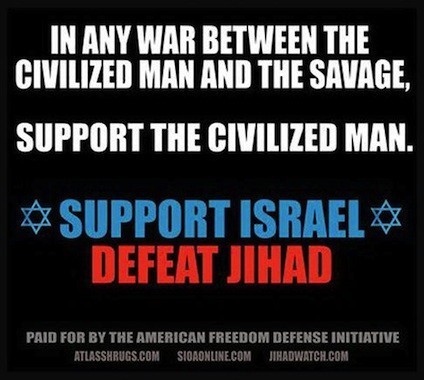
Geller made the papers when she said she’d sue if the MTA refused to put up the advertisement, calling it “a free speech issue.”
And now, well, the MTA’s refusing to put up her advertisement.
Geller was notified of the ad’s rejection Thursday and the rejection letter, which she’s posted on her Atlas Shrug blog in an entry titled, “IT’S OFFICIAL: PRO-JIHAD MTA BANS PRO-ISRAEL ADS, RUNS ANTI-ISRAEL ADS“, explains that Geller’s ad “contains language that, in our view, does not conform with the MTA’s advertising standards regarding ads that demean an individual or group of individuals…” A call to the MTA confirms that her ad didn’t pass muster.
And the MTA has a good point. As Gothamist sarcastically notes: “Yeah! Why is everyone shocked at the word “savage?” Or the phrase “war between the civilized man and the savage?” It’s not as if that phrase has ever been used in history to suppress minorities or advance theories of white supremacy. Nope.”
Geller, who’s done this kind of thing before, is keeping her promise and is preparing to sue the MTA. She writes:
The pro-jihad MTA is refusing my ad for the word “savage.” Just so you know, I will be suing, with the aid of my inestimable legal team, David Yerushalmi and Robert Muise of the Thomas More Law Center. We are what? 4-0, now? Tarazi lawsuit roundly defeated, check. Detroit/SMART Transit on “Leaving Islam” bus ad lawsuit, check. MTA on the Ground Zero Bus ads lawsuit, check. Miami Transit for “Leaving Islam” bus ads lawsuit, check.
I will say this until someone in those clueless ivory towers of the sharia-compliant MTA understands this. “Savage” is accurate. The pro-jihad MTA cannot ban the the truth, particularly in the political arena…
In the spring of 2010, as part of her “Leave Islam” campaign, Geller paid $10,000 to put this advertisement on city buses:

And in the summer of 2010, during the “Ground Zero Mosque” controversy she helped spearhead, she successfully scared the MTA into keeping up this advertisement:
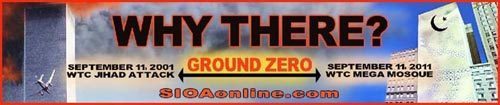
Pamela Geller to Delete Posts as Part of Settlement in Rifqa Bary Lawsuit

More retreating from the anti-Muslim bigots. Pamela Geller will probably scream censorship, however this just underscores how obscene and twisted Pamela Geller’s anti-Muslim crusade during the Rifqa Bary case was (hat tip: W. Ruiz):
Tarazi had argued that New York-based blogger Pamela Geller defamed him by alleging he has terrorist ties. One posting linked him to Hamas, for example, which the State Department has designated a foreign terrorist organization.
That blog and four others will be removed permanently from Geller’s “Atlas Shrugs” blog under the settlement, which did not involve any money.
Anti-Islamic blogger to delete posts as part of settlement in Rifqa Bary lawsuit
By Ashley Lopez (Florida Independent)
Pamela Geller, an anti-Islamic blogger based in New York, settled a lawsuit filed by one of Rifqa Bary’s attorneys this week.
Bary, a minor, fled from her parent’s house in Ohio to Florida because she converted to Christianity. According to Bary’s attorneys, she moved to Florida in an effort to practice Christianity away from her disapproving parents. A website created about the case claims that Bary left “after her father threatened to kill her for apostasy, a crime under Islamic Sharia law.”
Geller — along with a small group of anti-Muslim advocates in Florida, including a U.S. Senate candidate — fought to keep the young girl away from her parents. An attorney for Bary’s parents, Omar Tarazi, later sued some of those involved in the case for defamation.
Florida Family Policy Council President John Stemberger was sued by Tarazi for saying Tarazi was unqualified. Stemberger also alleged that Tarazi had terrorist ties in a 2009 TV interview. Last month, the defamation lawsuit was dropped after the two men reached an undisclosed agreement.
Geller and Rifqa Bary’s attorney were also sued for defaming Tarazi, a case that was settled this week.
According to the Associated Press:
Columbus attorney Omar Tarazi represented Bary’s parents, who denied intending to harm their daughter. Investigators in Florida and Ohio documented tension in the family but never found evidence that Bary was in danger.
Police recommended criminal charges be filed against adults in Ohio and Florida, including Christian ministers, who helped Bary run away, but prosecutors declined to pursue the charges.
Tarazi had argued that New York-based blogger Pamela Geller defamed him by alleging he has terrorist ties. One posting linked him to Hamas, for example, which the State Department has designated a foreign terrorist organization.
That blog and four others will be removed permanently from Geller’s “Atlas Shrugs” blog under the settlement, which did not involve any money.
Atlas Shrugs was described by The New York Times as a “site that attacks Islam with a rhetoric venomous enough that PayPal at one point branded it a hate site.” According to the Times, Geller “has called for the removal of the Dome of the Rock from atop the Temple Mount in Jerusalem; posted doctored pictures of Elena Kagan, the Supreme Court justice, in a Nazi helmet; suggested the State Department was run by ‘Islamic supremacists’; and referred to health care reform as an act of national rape.”
In court documents, Geller argued “that many of the postings singled out in the lawsuit also could fall in the realm of hyperbole and not defamation.”
Bary was eventually returned to Ohio. She has yet to reconcile her with her family. She turned 18 last year and is no longer embroiled in a public legal battle.
The Muslim Brotherhood is not a threat
By Zhao Li | Source

“I’m fed up,” complained President Hosni Mubarak about ruling Egypt, “But if I resign now, there will be chaos. And I’m afraid the Muslim Brotherhood will take over.”
His fear is echoed by several prominent American politicians, including Republican presidential hopefuls Minnesota Governor Tim Pawlenty and former Speaker of the House Newt Gingrich. They suggested that the deposition of Mubarak would most likely lead to an Islamic government in Egypt, a change many perceived as worse off than the status quo. But why should we prefer a 30-year-old authoritarian regime to a potential democratic government involving the Brotherhood? And why are we fearful of Islam as an obstacle to democracy?
The word Islam is almost synonymous with terrorism to many Americans. We often perceive any Islamic political organization as inevitably violent and even necessarily evil. However, while there is a presence of extremism in Islam, the public often neglects the much more dominant and moderate factions such as Egypt’s Muslim Brotherhood. The Brotherhood’s recent record of violence was but one highly disputed assassination attempt at the ex-President Gamal Abdel Nasser in 1954. Since then the Brotherhood has adopted a nonviolent reformist strategy which Bin Laden criticized as “betraying jihad.” Among all Islamist political organizations, the Brotherhood is probably one of the last to ever be suspected of extremist influences.
Not only is the Brotherhood non-violent, but it has also consistently outperformed the Mubarak regime in enabling progress in Egypt. Since Mubarak’s presidency, the Brotherhood has drawn many students and professionals alike. Moreover, the Brotherhood has continued to advocate for Islamic reforms, a democratic system and a vast network of Islamic charities helping the Egyptian poor.
All evidences show that the Brotherhood is a much needed impetus for peaceful democratic reform in Egypt. In contrast, the Egyptian government’s relentless oppression of the Brotherhood as well as Mubarak’s stubborn hold to power make the regime an antithesis to democracy. It is no wonder that the Egyptian people felt the urgency to rise up for democracy and regime change.
If Mubarak and his friends in the U.S. Congress are concerned about the Egyptian people’s well-being, why would they continue to misrepresent the will of the Egyptian people by demonizing Islam and denying democracy to a Muslim nation?
Again, self-interest is at work. Mubarak has been striving to present himself as the “better” option for the Egyptian people, as if the country must choose between an authoritarian and an extremist rule. Similarly, out of self-interest, politicians such as Pawlenty and Gingrich would maintain a U.S.-friendly regime in the Middle East at the expense of true democratization in the region. The opinions of these politicians mirror those of their constituency. A recent Rasmussen poll showed that 60 percent of Americans think it is more important for the United States to be allies with any country that protects our national security than it is to be allied only with countries that have freely elected government.
The contradiction between the United States’ official stance and its actual goals only lead to two conclusions: first, the United States is not actually concerned with spreading democracy, using it as a public relations tool. Second, the American public believes that Muslims are incapable of building their own democracy.
The reactions of both Mubarak and his American supporters to the Egyptian uprising reveal their prejudice against Islam. Unless we challenge the existing distortion of Islam in the American society, the true process of democratization in the Middle East as well as the image of the United States in the region will remain hindered for years to come.
100 questions on Islam

By Kara Hadge and Marc Scheuer | Source
A decade after 9/11, a new poll by the Pew Global Attitudes Project shows that 48 per cent of Americans continue to think relations between Muslims and Westerners are poor. In Muslim-majority countries, those numbers are generally higher, according to the same study. This data points to continuing fear, misperceptions and stereotypes among both Muslims and non-Muslims.
When it comes to stereotypes and myths about Muslims, data and resources that contradict these misperceptions are readily available. The problem is that they do not always reach the wider public, especially in the West.
Considering that most people are not likely to sift through scholarly research, it is absolutely important to make resources about Islam and Muslims available in a form that is easily accessible to them.
A new series of two-minute video clips called “100 Questions about Islam” aims to fill this knowledge gap using one of the most effective new media tools: online video. These videos consist of interviews with scholars and journalists who break down stereotypes about Muslims by highlighting the findings of recent public opinion research and clarifying facts about subjects ranging from sharia (Islamic legal principles) to the hijab (headscarf).
This unique video series is a joint venture of the British Council’s Our Shared Future project, which aims to improve the public conversation about Muslims and intercultural relations in the United States and Europe, and the UN Alliance of Civilizations, in collaboration with the University of Missouri’s School of Journalism.
In one of the videos, for example, Jen’nan Read – a Libyan Christian and Professor of Sociology at Duke University – points to a fundamental characteristic about Arab and Muslim communities in the United States that contradicts popular perceptions. She says, “While it is true that most Arabs around the world are Muslim, most Arabs in the United States are Christian – and not Christian converts, but rather Christians from Eastern Orthodox traditions.” Given this common misunderstanding, it is not surprising that many Americans say they do not know any Muslims.
Another little-known fact when it comes to Muslim communities in the United States is how successfully they have integrated themselves into diverse fields as active participants in the American economy and political system. Says Georgetown University Professor of Religion John Esposito, “Most people don’t fully realise what we know now from hard data: that Muslims are economically, educationally and politically integrated into America,” adding that in terms of level of education attained, “Muslims are second to Jews in terms of integration.”
There are many other areas where facts and public opinion diverge. In the political realm, most people who fear the influence of sharia do not know that there is no such thing as a movement to impose sharia in the United States, Esposito points out. On a more personal level, Sarah Joseph, CEO and founding editor of Muslim lifestyle brand Emel, notes that people who question the hijab and other head and body coverings forget that the practice is not at odds with other religious traditions. For example, some traditional Christian churches still promote covering one’s head during worship services.
So, why is it so important that we combat these misconceptions? Melody Moezzi, an attorney and writer interviewed for 100 Questions, argues that any discrimination against a minority endangers the immigrant culture on which American society has been founded: “Islamophobia threatens me as an American, not as a Muslim American…because whenever any minority is discriminated against or hated for no good reason, and laws are passed against that minority, it offends me as an American.”
Sometimes the best way to combat misconceptions about any issue, not just Islam and Muslims, is by giving a voice to those who can illuminate the facts. But informed dialogue need not always be hosted on a website or in a newspaper. As Esposito remarks, “The more pluralistic we become in the public square, in our interactions and in our [neighbourhoods]…the more I think that change that we need – [the] broadening of our pluralistic worldview – will take place.”
Let this be a reminder to us that delving into data about cross-community relations is only a starting point: we also need to look around ourselves and form some relationships of our own.
###
* Kara Hadge is Head of Digital Media at the British Council (USA) and works on the Our Shared Future project (www.oursharedfuture.org). Marc Scheuer is Director of the United Nations Alliance of Civilizations (www.unaoc.org). You can view 100 Questions About Islam at http://www.vimeo.com/groups/100questionsaboutislam. This article was written for the Common Ground News Service (CGNews).
BM
Once Again: “Police Blotter Bob” Not Interested in Facts

Once again, “Police Blotter Bob” shows that he could care less about facts when it comes to Islam and Muslims. In his “response” to the Center for American Progress report on Islamophobia, Bob claims that he is not attacking all of Islam, but just the “radicals” and the “jihadists.”
My work…has never been against Muslims in the aggregate or any people as such, but rather against an ideology that denies the freedom of speech, the freedom of conscience, and the equality of rights of all people.
Yet, statement after statement, and post after post on his website talks about “Muslims” and “Islam” as just that: an aggregate. Take this latest post:
The fact that Muslims do not like Jews and Israel, I know, because many of my correspondents, Islamic leaders, Emirs, the heads of armed groups and ordinary Mujahideen talked about this at every meeting and every interview with me.
The fact that Islam is a nation and that Muslims have no other nationality is what I also heard from religious leaders supporting the Jihad.
The fact that Muslims can adapt and play by the political process more than once I saw myself.
They know how to do represent themselves as the victims of inhumane aggression through the media. And the same information is transmitted to the Islamic world in a different manner — as a victory for Jihad and death for the sake of Allah.
No nuance, no teasing out the particular…no, rather ”Muslims do not like Jews and Israel.” That is a general statement. That is what Spencer and his minions do again, and again, and again.
Yet, the facts tell a completely different story:
A World Public Opinion (WPO) survey done in collaboration at that time with the University of Maryland reported that 51 percent of Americans believe “bombings and other types of attacks intentionally aimed at civilians are sometimes justified,” while only 13 percent of American Muslims hold a similar view, with a full 81 percent saying violence against civilians is never justified.
A recent Gallup survey (2011) asks the same question separately — first for a “military attacks against civilians” and then “individuals and small groups attacking civilians.” Muslim Americans came out as the staunchest opponents of both overwhelmingly as compared to their neighbors.
In response to military attacks against civilians, 78 percent of Muslim Americans said such attacks are never justified as compared to 39 percent of Christians and 43 percent of Jews. Only 21 percent Muslim Americans approve of it “sometimes” as compared to 58 percent of Christians and 52 percent of Jews.
Eighty-nine percent of Muslim Americans surveyed by Gallup rejected violent individual attacks on civilians as compared to 71 percent of Christians and 75 percent of Jews. Muslims are the least likely to justify attacks on civilians. Only 11 percent of Muslims justified that sometimes such attacks are acceptable as compared to 27 percent of Christians and 22 percent of Jews.
The same is true when it comes to opposing the wars in Iraq and Afghanistan. Muslim Americans are way ahead in their opposition to wars as compared to their neighbors.
However, when the Pew survey first came out in 2007, it did not provide any relief for Muslim Americans from Islamophobic media frenzy. Most reporters used it as an opportunity to fan hatred against Muslim Americans, focusing on the smaller number of Muslim Americans who justified attacks on civilians without comparing it to Christian Americans, who did the same even in a larger numbers.
Right-wing pundit Michelle Malkin proclaimed in the National Review that the poll “should be a wake-up call.” Mark Steyn said it demonstrated the existence in America of “a huge comfort zone for the jihad to operate in,” and on CNN, Anderson Cooper was horrified — just horrified — that “so many” American Muslims would support such violence.
Well, I was also horrified myself until I checked what our neighbors are saying about intentionally targeting civilians. As a peacemaker, I will only be satisfied fully when all Muslims and people of other faiths oppose killing civilians fully, whether that is by a military or a terrorist group. But these statistics do offer me comparative relief.
FBI Evidence
The same evidence of a peaceful Muslim community was provided by Michael E. Rolince, former FBI Special Agent in Charge of Counterterrorism, D.C. Field Office. He said the FBI conducted about 500,000 interviews without finding a single lead which could have helped the agency prevent the terrorist attacks of 9/11.
That number means that almost 40 percent of all Muslim households in the United States were probably touched by this investigation. Here is what this presidential award recipient with 30 years of counterterrorism and counterintelligence experience said on Dec. 17, 2005, one month after his retirement, at the Muslim Public Affairs Committee’s annual convention in a panel titled, “Muslim Americans & Law Enforcement Partnership” (Here is an mp3 of his speech. His statement appears in the Q & A section):
“We conducted about a half a million interviews post 9/11 relative to the attacks of 9/11, and this is important because your community gets painted as not doing enough and you could have helped. I’m not aware — and I know 9/11 about as well as anybody in the FBI knows 9/11 and that’s not bragging that’s just the reality — I’m not aware of any single person in your community who, had they stepped forward, could have provided a clue to help us get out in front of this. The reality of that attack is that 19 people came here with what they needed. They spoke the language well enough to order meals and rent cars and hotel rooms. They had money coming in from overseas. Four people knew how to fly planes and 15 others were willing to be the muscle. They didn’t need any witting help from anyone to do what they did. And thus far, and I’m not saying this is conclusive because 10 years from now someone might find something that changes it, we’ve not found a sitting single witting individual in your community, and that’s a fact that gets overlooked because you get painted and that’s why I’m so committed and remain committed to projects like this because what we are in the business of is facts and the truth.”Anxiety about Muslim Americans is at an all-time high thanks to a well-funded campaign of Islamophobia.
Rand Corporation Findings
A 2010 Rand Corporation report rightfully states that “The volume of domestic terrorist activity was much greater in the 1970s than it is today. It is important to note that Rand is mostly a Defense Department-funded think-tank. This report has a whole section called “The 1970s Saw Greater Terrorist Violence.” The report asserts that, “Thus far, there has been no sustained jihadist terrorist campaign in the United States.” And one possible reason for this, according to this Rand report, is, “The local Muslim community rejected al Qaeda’s appeals and actively intervened to dissuade those with radical tendencies from violence.”
But, facts mean very little to “Police Blotter Bob”…
“Islamic” Honor Killings and Crocodile Tears

This month Pamella Geller published a book entitled, “Stop the Islamization of America: A Practical Guide to the Resistance,” which she describes as a “how to” guide for fighting various Islamic menaces, including “creeping sharia” and “stealth jihad.” She also describes how Muslims, who make up less than 2% of the American population, are “Islamic Supremacists” plotting to take over every aspect of American life.
Geller has also announced plans for a future book tentatively entitled, “Sex, Murder, and Islam: Honor Killing in America. ” She says the book will be about the “ongoing proliferation” of honor killings among immigrants to the West from Muslim countries. Honor killings have recently become the centerpiece of Geller’s campaign against Islam, and feature prominently on her website, Atlas Shrugs.
Honor killings are not Islamic, and they are not condoned in the Qur’an. This is a matter of fact. Honor killing is a form of murder where the victim is denied a fair trial, which is contrary to Islamic law. Islam opposes acts of murder and vigilantism, and likens the killing of one human being to the killing of the entire human race (Qur’an 5:32, 6:151, 17:33). Honor killing is a cultural inheritance which predates Islam by centuries, and Human Rights Watch, Amnesty International, and the United Nations have all said that honor killings cut across cultural and religious lines.
Nevertheless, “Islamic” honor killings are a public relations bonanza for Islamophobes, especially when they take place in a Western country. They are used to reinforce the notion that Islam is inherently violent and irrational, and to suggest that Muslim families view a young woman’s adoption of Western culture as a capital offense. Isolated incidents are amplified through intense media coverage, stoking fears that Muslims are importing barbaric customs into Western countries through immigration.
Anti-Muslim hate sites including Jihadwatch, Atlas Shrugs, and Frontpage Magazine have been weeping crocodile tears for Aqsa Parvez since she was killed by her father and brother in December of 2007 in an apparent honor killing. Both men received life sentences for their crime in June of 2010, but that hasn’t stopped Pamela Geller from continuing to exploit the incident to advance her agenda. She recently managed to raise $5,000 in donations she used to fund a controversial memorial plaque for Aqsa Parvez in Israel.
Parvez is the ideal poster child for their campaign to vilify Islam because she was the teenage daughter of Muslim immigrants living in Ontario, Canada. For similar reasons, Robert Spencer is exploiting the tragic death of two sisters, Sarah Yaser Said, 17, and Amina Yaser Said, 18, who were shot and killed by their father, an immigrant from Egypt, in January of 2008 in Texas.
Geller and Spencer show little interest in similar crimes when they are committed by non-Muslims. A few months before Aqsa Parvez was killed, a gruesome video surfaced of a 17-year old Du’a Khalil Aswad in Mosul, Iraq being stoned to death by a mob while she cried out for help. The video garnered immediate attention when it was presumed to be an “Islamic” crime, but quickly dropped out of the spotlight when it turned out the victim was a Kurdish girl from the Yazidi religion who was killed for having an Arab Muslim boyfriend.
In 2008, a man in Chicago killed his pregnant daughter, her 3-year old child, and her husband by burning down their home because she had married a man from a lower caste. This horrific crime was ignored by the usual hate brigade because the perpetrator was a non-Muslim immigrant from India. Robert Spencer mentioned the case on Jihadwatch only briefly, and that was to complain that media attention should be going to the murder of the Said sisters instead.
Geller’s Atlas Shrugs features a memorial page entitled, “Honor Killing: Islam’s Gruesome Gallery.” It is indeed gruesome and serves her agenda of inspiring outrage against Islam and Muslims. Unlike the Memini (“Remembrance”) memorial for victims of honor killings from all religious backgrounds, Geller’s Gruesome Gallery is devoted exclusively to highlighting honor killings associated with Muslims.
Geller and Spencer have also been relentless in trying to get police in Tampa, Florida to reopen the case of Fatima Abdullah, insisting she was the victim of an honor killing and subsequent cover up. The 48-year old woman died when she fell and hit her head on a coffee table at her brother’s home. Her brother was not home at the time of the incident.

Pamela Geller says the death is suspicious because Abdullah could not have “suicided” herself by “banging her head on a table.” Robert Spencer wrote about the Abdullah case on Jihadwatch, saying:
This is the sharia in America. The idea that a woman would die after she ‘threw herself to the floor’ or hit her head repeatedly on the coffee table is institutionalized gender apartheid, the sharia. The idea defies logic, belies reality.
As a self-proclaimed scholar on Islam, Spencer should know that Islamic law (“the sharia”) does not sanction honor killing. The coroner’s autopsy report concluded the “Manner of Death” was “Accident (Decedent fell and struck head on table).” The detailed medical report does not mention any evidence of foul play.
Jihadwatch later published a page with the headline, “Tampa Police crime scene tech now admits ‘fear of Muslim reprisal’ in honor killing classified as accidental death,” which was reposted to numerous anti-Muslim hate sites. This implies police lied when they ruled the case an accident, but a closer look at the details shows this headline is misleading.
A crime scene technician from the Tampa police department called the Florida Family Association (FFA) nearly a year after the initial investigation and asked that her name be removed from their website, which has been stirring up controversy over the case, in concert with Geller and Spencer. The technician did not want her name posted on a controversial public website, though it is unclear from the reports whether she feared reprisal from angry Muslims, or from “activists” aligned with the FFA.
Although Tampa police have stood by results of their initial investigation, Geller and an assortment of other loony Islamophobes continue to exert pressure on authorities to reopen the case. They have linked the case to their conspiracy theories about Muslims taking over the country, apparently starting with the Tampa Police Department. Geller has dubbed the city “Tampastan,” and claims Florida police are engaged in a cover up because, “…murdering Muslim women in America is preferable to offending Muslims or insulting Islam.”
It is tempting to dismiss Geller and Spencer for their outlandish statements and crude publicity stunts, but they have enjoyed surprising success, especially in using the mainstream media as a conduit for spreading their hateful ideas. If they were targeting any other minority group, they would probably be consigned to the lunatic fringe.
Al Arabiya Poll: Some Arabs Justify 9/11 And Deny Al-Qaeda’s Culpability; I Say: Yeah, So What? (II)

In part I, I discussed the new Al Arabiya poll, of questionable validity, that is making the rounds in the anti-Muslim cyber-world. Another finding of the poll, per MEMRI:
Out of the 220,000 Arabs who participated, 23% believed Al-Qaeda was responsible for the 9/11 attacks and 26% did not.
Anti-Muslim websites are absolutely beside themselves at how unbelievably gullible Moozlums are, how they are miserably steeped in conspiracy theories, and how they can’t just admit the fact that Moozlums did 9/11. Yet, as the Al Arabiya article, which the Islamophobes themselves linked to (but can’t read), says: these findings are not much different than those of other places in the world, including the West.
Indeed, we find that outside of the United States there is “no consensus who was behind Sept 11″ as noted in this Reuters article:
No consensus on who was behind Sept 11: global poll
Seven years after the September 11 attacks, there is no consensus outside the United States that Islamist militants from al Qaeda were responsible, according to an international poll published on Wednesday.
The survey of 16,063 people in 17 nations found majorities in only nine countries believe al Qaeda was behind the attacks on New York and Washington that killed about 3,000 people in 2001.
On average, 46 percent of those surveyed said al Qaeda was responsible, 15 percent said the U.S. government, 7 percent said Israel and 7 percent said some other perpetrator. One in four people said they did not know who was behind the attacks.
The poll was conducted by WorldPublicOpinion.org, a collaborative project of research centers in various countries managed by the Program on International Policy Attitudes at the University of Maryland in the United States.
In Europe, al Qaeda was cited by 56 percent of Britons and Italians, 63 percent of French and 64 percent of Germans. The U.S. government was to blame, according to 23 percent of Germans and 15 percent of Italians…
Therefore, the fact that 26% of Arabs don’t believe Al-Qaeda is to blame, according to the Al Arabiya poll, is not completely out of line with world opinion.
That only in the United States is there a consensus that Al-Qaeda did it is not something very surprising, considering that the U.S. government quickly, repeatedly, and emphatically pointed the finger at Al-Qaeda.
But, you know who else the government blamed? Iraq.
These anti-Muslim bigots are snickering at how these Moozlums are just so absolutely stupid for thinking Israel or America could be involved in the 9/11 attack, when in fact the entire country–led by neoconservatives, Zionists, and anti-Muslim bigots like them–invaded a country on the false belief (the conspiracy theory) that Iraq was linked to Al-Qaeda and had something to do with 9/11.
Indeed, a January 2004 poll by Newsweek found that a majority of Americans (49% vs. 39%) believed that “Saddam Hussein’s regime in Iraq was directly involved in planning, financing, or carrying out the terrorist attacks of September 11th, 2001.” Amazingly, long after even the Bush administration admitted they were wrong, 41% of Americans still believed that Saddam Hussein’s regime in Iraq was responsible for 9/11 (as seen in a June 2007 Newsweek poll). This is a belief that Americans continue to cling on to even today! Oh, but how utterly deluded those Moozlums are for thinking Israel was involved!
Israel National News says:
Only 23 percent believe that Al Qaeda was behind the attacks, while a large number – 26 percent – think that the terrorist organization did not plan and carry out the hijack-bombings….
In Iran, the percentage of those denying Al Qaeda’s involvement is even higher. The government controlled press continues to claim that the official version of 9/11 is false and that unaccounted for explosions brought down the Twin Towers in New York City.
How absolutely primitive of a government to issue statements blaming someone other than Al-Qaeda for 9/11! That is totally unlike completely similar to the U.S. government linking Iraq to Al Qaeda and 9/11. As Prof. Stephen Walt pointed out, this was all done with Israeli encouragement. And now, the Israelis are blaming Iraq Iran.
All of this was perfectly depicted in a Family Guy clip:
Interestingly, even in the United States, “more than a third of the American public suspects that federal officials assisted in the 9/11 terrorist attacks or took no action to stop them so the United States could go to war in the Middle East, according to a new Scripps Howard/Ohio University poll.” So really, what’s the big deal if 26% of Arabs don’t believe 9/11 was done by Al-Qaeda?
Of note also is the fact that it is almost conventional wisdom, often heard even by liberals (implied, for instance, by Michael Moore in Fahrenheit 911 and even the dog in the Family Guy in clip above), that Saudi Arabia has responsibility for 9/11 (“it was the Saudis that were involved, not Iraq”). This utterly ignorant idea is seriously discussed in somber terms. Whether it’s Israel, Iraq, Iran, or Saudi Arabia, the fact is that Muslims do not have a monopoly on 9/11 conspiracy theory. There is plenty to go around.
In any case, the fact that the United States weaponized 9/11, by using it as an excuse to bomb, invade, and occupy multiple Muslim countries makes more Muslims gravitate towards 9/11 conspiracy theories, for reasons that should be patently obvious.
* * * * *
MEMRI also notes, commenting on the Al Arabiya poll:
16% considered the assassination of Osama bin Laden a criminal act, 48% did not, and 36% were undecided.
The assassination was definitely illegal under international law, for multiple reasons: Firstly, it involved the flagrant violation of Pakistan’s sovereignty; would there be any question about legality if Pakistani commandos landed on Ellis Island? The illegality of this act is not limited to the capture of Osama bin Laden, but can be seen in the continued violation of Paksitan’s sovereignty on a day-to-day basis with U.S. drone attacks that maim scores of civilians.
Secondly, Osama bin Laden was unarmed and yet was shot dead. If we were truly a civilized people, someone wouldn’t really need to explain why it is illegal to shoot unarmed men. Bin Laden was killed so that he wouldn’t face trial, which is a bedrock of our legal system. This too is not limited to Osama bin Laden, as the U.S. has a hit-list out for other American citizens too. Furthermore, the government continues to deny countless number of Muslims the right to a trial.
Thirdly, there is the larger issue, which is all the illegal actions that took place between the time the Taliban agreed to hand over Osama bin Laden, an offer which the U.S. refused, to the time the U.S. assassinated him. If all of these actions (i.e. the invasion and occupation of Afghanistan, Iraq, etc.) were part of America’s strategy to capture Bin Laden, then certainly this entire process is illegal. This fact underscores the biggest problem with the so-called War on Terror: terrorism should be dealt with using a combination of policing and negotiation, not war and destruction.
Therefore, my question is: if 16% of Arabs thought that the Osama bin Laden assassination was a criminal act, so what?
Al Arabiya Poll: Some Arabs Justify 9/11 And Deny Al-Qaeda’s Culpability; I Say: Yeah, So What? (I)

I recently published two articles: Gallup Poll: Jews and Christians Way More Likely than Muslims to Justify Killing Civilians and Surveys Show in Every Country Muslims Less Likely to Justify Killing Civilians Than Americans and Israelis.
One anti-Muslim critic posted the following comment in response:
Interesting poll carried out by al-Arabiya…..
More than one-third of Arabs justify the 9/11 attacks, and only 23 percent believe Al Qaeda was behind the aerial suicide bombings.
The survey included 220,000 Arabs and was carried out by the Al-Arabia television channel in Dubai and a British research institute.
Thirty-six percent of the respondents justified the attacks, but only 38 percent took the opposite view, leaving another 16 percent undecided or with no opinion.
(You can google for the link)
I did google for the link and could not find it. Instead, I found link after link of Islamophobic websites all linking to each other. Finally, it seems I located what seems to be the original anti-Muslim site to make the claim, the Israel National News:
Dubai Poll: More than Third of Arabs Justify 9/11
More than one-third of Arabs justify the 9/11 attacks, and only 23 percent believe Al Qaeda was behind the aerial suicide bombings.
The survey included 220,000 Arabs and was carried out by the Al-Arabia television channel in Dubai and a British research institute.
Thirty-six percent of the respondents justified the attacks, but only 38 percent took the opposite view, leaving another 16 percent undecided or with no opinion.
Only 23 percent believe that Al Qaeda was behind the attacks, while a large number – 26 percent – think that the terrorist organization did not plan and carry out the hijack-bombings.
Slightly less than half of those participating in the survey – 48 percent – do not think that the assassination of Osama Bin Laden was a criminal act…
Forgive me if I take Israel National News with a grain of salt. The hyperlinks to “the survey” in that article lead nowhere.
On the other hand, it could also be good old MEMRI:
36% of Arabs in Al-Arabiya TV Survey Justify 9/11
Al-Arabiya TV, in collaboration with a British research institute, conducted an online survey on the occasion of the tenth anniversary of 9/11. Out of the 220,000 Arabs who participated, 23% believed Al-Qaeda was responsible for the 9/11 attacks and 26% did not. 36% said that the attacks were justified and 38% that they were not. 16% considered the assassination of Osama bin Laden a criminal act, 48% did not, and 36% were undecided.
Source: Facebook site of Al-Arabiya TV
No hyperlink is provided to the “Facebook site of Al-Arabiya TV.” I visited the Facebook site myself and did not find any such information.
Forgive me once again for not taking MEMRI as the Gospel truth. MEMRI’s founder and president is Yigal Carmon, who served as a Colonel in the Military Intelligence Directorate of Israel. He also had a direct governmental role in the administration of Israel’s occupation of the West Bank. One can hardly be faulted for doubting MEMRI’s reliability.
Indeed, Middle East expert Dr. Norman Finkelstein calls MEMRI “a main arm of Israeli propaganda,” noting that the organization “use[s] the same sort of propaganda techniques as the Nazis.” Says Finkelstein further:
They take things out of context in order to do personal and political harm to people they don’t like.
And he concludes by saying:
I think it’s a reliable assumption that anything MEMRI translates from the Middle East is going to be unreliable
One should note, however, that MEMRI says that it was “an online survey.” What is interesting is that when I finally did find some mention of this poll in an article on the Al Arabiya website (helpfully linked to by an anti-Muslim, pro-Israeli website), the article itself–the same Arabic article on Al-Arabiya that the Islamophobes cite, no less–concludes by questioning the scientific validity of the survey. The concluding paragraph notes that a “survey expert” contacted by Al Arabiya “does not view the results as [accurately] reflecting the trends in the Arab world,” and that “we must look into the study more and study its [research] methodology” to confirm its validity.
Why would anyone rely on a possibly unscientific internet poll instead of the far more reliable Gallup poll which found that only 7% of the Muslim and Arab world thought the 9/11 attacks were justified? Robert Spencer of JihadWatch cited an article by Robert Satloff of The Weekly Standard, which pointed out that this “7%” figure includes only those who thought the 9/11 attack was “completely justified” and that the data shows “another 23.1 percent of respondents” who thought the attacks were “in some way justified.” In other words, a total of 30.1% of the Muslim and Arab world thought the 9/11 attacks were either “completely justified” (7%) or “in some way justified” (23.1%).
Coincidentally enough, the number 30.1% is close to the number found by the Al Arabiya poll. Therefore, although there still exist unanswered questions about the scientific validity of the study, the number seems to corroborate the data found by Gallup. However, the Gallup poll reveals what is missing from what we have from Al Arabiya (since we don’t have the actual study): the difference between thinking the 9/11 attacks were “completely justified” and “in some way justified.”
It is well-known that respondents to surveys often have complex answers to questions asked by the polls but are forced to choose between answer choices that do not adequately reflect this complexity. For example, a question asking “do you support Barack Obama, Sarah Palin, or neither/no answer” would be difficult to answer for many progressive voters who do not like Barack Obama due to his failed campaign promises and the fact that he has not followed progressive policies. Yet, many of them will still select Barack Obama in this poll, because they like him more than Sarah Palin, thinking of it as a “what team are you on” sort of question (i.e. liberal vs. conservative).
In other words, the complex answer of “I supported Barack Obama in the 2008 election and still do support him over Sarah Palin, yet I am totally disappointed by him” is not one of the options to choose from. Therefore, such a progressive would choose what he thinks is the best approximation, and this may well be tick-marking Barack Obama’s name.
Similarly, when a Muslim or Arab is asked “Do you think that the 9/11 attacks were justified?” and the answer choices are between completely justified, somewhat justified, and not justified at all, many of them will select “somewhat justified” to convey the thought that one Arab acquaintance of mine told me (which of course I strongly disagree with):
I don’t think the 9/11 attacks were justified in the sense of killing civilians. That is against Islam and what I believe in. However, I feel that it is justified in the sense that America had it coming to them for what they did to us and continue to do.
This point is conveyed in the Al-Arabiya article itself, which states that many Arabs “considered the U.S. deserving of this [the 9/11 attack] and that what happened was justified as vengeance against its atrocities and positions against the Arabs” even while at the same time holding the view that the “operation [was] abhorrent enough not to want to attribute it to [themselves].”
These Arabs thought 9/11 was a case of the chickens coming home to roost, and were hopeful that Americans would know how it feels. This is certainly different than thinking that the 9/11 attacks were completely justified. Indeed, most Arabs feel deeply uncomfortable with killing civilians. In the minds of these Arabs and Muslims, tick-marking “somewhat justified” is a way of refusing to give “victim status” or “hands clean status” to the United States.
* * * * *
In any case, even if we interpret the poll results as saying that 36% of Arabs (or the Muslim world) think that the 9/11 attacks were “somewhat justified” in the sense of the targeting and killing of civilians, in that case so what? It is still far less than the percentage of Americans, specifically Jewish and Christian Americans, who think that that “it is sometimes justifiable to target and kill civilians.”
The percentage of Christian Americans who think “it is sometimes justifiable to target and kill civilians” is a whopping 58%, with an almost equal percentage of Jewish-Americans thinking the same (54%). Indeed, Mormon-Americans came in first place, with 64% saying so, which is more than double the percentage of Arabs or Muslims in the Muslim world who thought 9/11 was “somewhat justified” (30.1%).
As for Israeli Jews, 51% of them believe “it is sometimes justifiable to target and kill civilians,” so these Israeli propagandists doth protest too much, methinks. Indeed, even more worrisome is the fact that according to a survey conducted by Haifa University’s Center for the Study of National Security a majority of Israeli Jews support a policy of ethnic cleansing against Palestinians, with a quarter saying they would consider voting for the Kahanist party Kach, known for its vocal support of ethnic cleansing as a resolution to the conflict.
Meanwhile, nearly half of Israeli Jews (46%) support “price tag” terrorism against Palestinians, with the percentage being far higher in traditional, national-religious (Religious Zionists), and ultra-Orthodox Jews (55%, 70%, and 71% respectively). Price tag terrorism refers to “acts carried out against Palestinians in revenge of government actions harming the settler enterprise.” These are characterized as “pogroms meted out by fanatical settlers against defenseless Palestinians.” Price tag terror is conducted by “Israeli soldiers and settlers” who”rampag[e] through” Palestinian villages, meting out “retributive violence.”
The vast majority of Israeli Jews (see here, here, and here) supported Operation Cast Lead in which more than a thousand Palestinian civilians were slaughtered. Operation Cast Lead was described by the United Nations as an operation “designed to punish, humiliate and terrorize a civilian population.” This is the level of morality and humanity among Israelis.
One does not expect such polls to be included on MEMRI’s website, no doubt I’m sure due to no other reason than their “limited resources.” Meanwhile, anti-Muslim and Zionist websites will continue to peddle statistics without any context. Thirty-point-one percent percent seems unusually high, until one looks at the far higher percentages among Jews and Christians.
Interestingly, one of the main anti-Muslim websites featuring the Al Arabiya poll, the Infidel Blogger’s Alliance, concludes with the genocidal call to “Nuke Mecca already. Nuke e’m.” This perfectly encapsulates the irony of throwing hissy-fits when Moozlums justify violence while at the same enjoining far more violent acts.
The clever tactics of Islamophobes

By Haroon Siddiqui | Source
Many minorities in Canada and the U.S. suffered discrimination initially, especially during wartime. Still, the current wave of Islamophobia will have a dishonourable place in history.
What’s said and tolerated about Muslims and Islam is not about other people and their religions. Self-restraint is also missing when violating the privacy and dignity of Muslims, disproportionately. Their every move and word is parsed, to nail them for some real or imagined radicalism.
Our public discourse has been allowed to be hijacked by those whipping up fear of Muslims and Islam.
Islamophobia cannot be censored out. But it should be subject to the critical scrutiny of a democracy. Often it is not. So it feasts on wild accusations, double standards and being happily disconnected from reality, even logic. Here’s how.
• Collective guilt
Islamophobes hold that all Muslims are responsible for the actions of some. Told that this is absurd, they take another tack: Yes, not all Muslims are terrorists but most terrorists these days are Muslims, so all Muslims must answer for Muslim terrorists anywhere.
It is also said that Muslims do bad deeds because of their religion, while others do so for other reasons.
It follows that Norwegian terrorist Anders Breivik and Timothy McVeigh, the Oklahoma bomber, are not representative of Christianity but Major Nadal Hasan, who killed 13 fellow Americans, is of Islam. Pastor Terry Jones of Florida, the Qur’an burner, is not representative of 311 million Americans, but every ignorant mullah is symptomatic of 1.3 billion Muslims.
• Double standards
In the book of Islamophobes, the Qur’an is “violent” but the Bible is not. And Islam is not a religion but rather an ideology, a “fascist” one, whose followers are “Islamo-fascists.”
Even if it can be proven that their ideas are similar to fascism – a very European construct – they would be Muslim fascists, not Islamic ones.
Other hypocrisies:
Anti-Muslim demagoguery is free speech but anti-Western nonsense is hate-mongering.
The minority of Muslims who believed that 9/11 was an American-Israeli inside job were conspiracy theorists, but the 70 per cent of Americans who believed that Saddam Hussein had a hand in 9/11 were patriots.
Critics of Islam, such as Geert Wilders from Holland, should be welcomed in Canada but those who dare question Western policies, such as British MP George Galloway, must be denied visas.
• Innuendo
All or most mosques are controlled by hateful imams brainwashing the faithful to be “fundamentalists” “radicals,” and “jihadists.” No proof is offered.
It is also said that many Muslim institutions are funded by Saudi money. The premise of the allegation is that while it is good for America to take billions of dollars from the Saudis for armaments, it is bad for Muslim institutions to get a fraction of that – if they are indeed getting it.
It is said that Muslims cannot integrate. But studies show otherwise, especially in the U.S. where they are among the most educated and are among the top earners. The ones not doing well are in countries where they face the most discrimination, such as France and Germany. Polls in Europe, U.S. and Canada also show that Muslim values are no different than those of other groups.
• Irrationality
Twenty-three American states have taken legislative steps to stop the sharia, Muslim personal law, that’s not coming.
Lest we snicker at Americans, Ontarians in 2006 stopped the sharia that wasn’t coming, either. In 2007, the Quebec village of Herouxville banned the stoning of women that had a zero chance of happening there.
In 2009, the Swiss banned minarets when there are only four in their country and many more are unlikely to be erected.
All such measures are not to be taken literally but rather symbolically, a reflection of mass hysteria.
• Clever tactics
Islamophobes claim victimhood — that their courageous truth-telling is hindered by political correctness, even as they command increasing media coverage.
They say they are not against Muslims or Islam, only against “Islamists” and “Islamism,” “Islamicism” and “political Islam” – terms that can mean anything their users want them to mean.
“Like anti-Semites and racists, who protest they are not against Jews or blacks, Islamophobes are the first to protest that they’re not Islamophobic,” says John Esposito, professor of religion at Georgetown University and co-editor of Islamophobia (Oxford Press, 2011).
Islamophobes also enlist Muslims who are highly critical of fellow Muslims and Islam. These few individuals are used to discredit the religious beliefs and practices of a majority of Muslims. This is akin to citing a handful of oddball Catholics or Jews to rationalize discrimination against all Catholics and Jews.
hsiddiqui@thestar.ca
Islamophobia: Paranoia infects North America

By Haroon Siddiqui | Source
One legacy of the decade since 9/11 has been the growing fear of Muslims and Islam.
Many Europeans dread “Eurabia,” the ostensibly imminent Arab/Muslim takeover of the continent, even though its Muslim population is less than 3 per cent. Among those convinced of the coming apocalypse was Norwegian terrorist Anders Breivik. Other believers express themselves peacefully but no less fervently.
Americans have come to share this European paranoia.
Many dread “New Yorkistan” and the takeover of America by Muslims, who constitute only 0.8 per cent of the population.
Nearly half of the 50 states have taken legislative steps to stop sharia, Muslim personal law.
Nearly a fifth of Americans believe that Barack Obama is Muslim or Arab or both. He fretted so much over this that during the 2008 election his organizers ejected two hijabi women from camera range. At a Republican rally, a woman called out to John McCain that Obama was an Arab; the Republican candidate responded: “No, ma’am. He’s a decent family man and citizen.”
Last year, Obama and Mayor Michael Bloomberg tamped down the hysteria over “Ground Zero mosque” but they could not persuade aFlorida pastor from commanding national attention for weeks before burning a copy of the Qur’an.
This year Peter King, chair of the security committee of the House of Representatives, held hearings into “the homegrown radicalization” of American Muslims. He believes that “80-85 per cent” of America’s 1,900 mosques are “controlled by Islamic fundamentalists. This is an enemy living amongst us.” In fact, a study this year by Duke University found that American Muslims have been the biggest source of tips to the FBI in disrupting terror plots. Attorney General Eric Holder lauded the Muslim community for it.
In Oklahoma, Republicans are accusing Democrats of plotting an Islamic state on the Plains. Elsewhere, school texts are being challenged as being pro-Islamic, meaning, they are neutral and do not condemn Islam.
Among the 23 anti-sharia states, the Tennessee Assembly said sharia promotes “the destruction of the national existence of the United States.”
Newt Gingrich believes, or at least says he does, that “sharia is a mortal threat to the survival of freedom in the United States and in the world as we know it.” Sarah Palin says sharia is going to be “the downfall of America.” Michele Bachman says sharia means Muslim “totalitarian control” over America.
This is “is disturbingly reminiscent of the accusation in 19th-century Europe that Jewish religious law was seditious,” writes Eliyahu Stern, professor of Judaic studies at Yale.
It turns out that the sharia panic is not a grassroots movement but rather an orchestrated campaign by one man backed by anti-Islamic think tanks and private funders.
David Yerushalmi, a Brooklyn lawyer, works in collaboration with anti-Muslim groups to stoke the anti-sharia hysteria and distribute model legislation for states to adopt.
The Anti-Defamation League, a leading American Jewish agency, has lambasted Yerushalmi for his “anti-Muslim, anti-immigrant and anti-black bigotry.”
He’s among five individuals named recently by the Washington-based Center for American Progress in its report Fear Inc.: Exposing the Islamophobic Network in America.
It names him along with Frank Gaffney of the Center for Security Policy; Daniel Pipes of Middle East Forum; Robert Spencer of Jihad Watch and Stop Islamization of America; and Steve Emerson of Investigative Project on Terrorism. Their propaganda is parroted by Rep. King and other Republicans as part of their wedge politics. It is also repeated ad nauseum by such media outlets as Fox-TV.
The report also lists seven foundations that since 9/11 have dispersed $42.6 million to individuals and groups that work with the Tea Party’s state chapters: Brigitte Gabriel’s ACT! for America; Pamela Geller’s (and Spencer’s) Stop Islamization of America; etc.
Some of them were behind the “Ground Zero mosque” protests, and are part of the agitation against the building of mosques and Islamic centres, 35 of which have been held up or delayed across the U.S.
The American Civil Liberties Union said:
“While mosque opponents frequently claim their objections are based on practical considerations such as traffic, parking and noise levels, those asserted concerns are often pretexts masking anti-Muslim sentiment. Government officials in some areas have yielded to this religious bigotry.”
As in most things , Canada is somewhere in between Europe and the U.S. in dealing with its 850,000 Muslims, both in the battle against terrorism and in the public discourse about Islam.
There was the bungled case of Maher Arar, tortured in Syria with Canadian complicity. There was the 2003 case of 23 Indian and Pakistani students accused of plotting terror acts, though not one was ever charged. There are the lingering cases of three Canadian Arabs who, too, got tortured in the Middle East with Canadian complicity. There’s the ongoing legal battle of five Arab-Canadians over security certificates that permit indefinite detention of non-Canadians.
On the other side of the ledger, there was the successful prosecution of 11 of the “Toronto 18” charged with terrorism, and that of an Ottawa man for his involvement in a British bomb plot.
Canada has not imported European aversion to Muslim immigration, yet. But our debate on multiculturalism has also become a smokescreen for attacking Muslims and Islam.
“Almost every reason for toleration’s apparent fall into disrepute concerns Islam,” notes Prof. Charles Taylor of McGill University, one of the inventors of our constitutional multiculturalism.
Multiculturalism was blamed during the noisy 2005-06 debate over sharia in Ontario, and also during Quebec’s 2008-09 debate on reasonable accommodation that preceded the anti-niqab legislation to deny all public services, including health services, to those wearing it.
Mind you, Quebec has long resisted the term multiculturalism and preferred inter-culturalism, with its implied primacy of not only the French language but also French culture. This year, the Parti Quebecois baldly asserted that “multiculturalism is not a Quebec value,” even though it is the law of the land (Section 27 of the Charter and the Multiculturalism Act).
Of the five high-profile Canadian cases of hijabis barred from soccer, judo and taekwondo tournaments, three were in Quebec. And in 2007, a Quebec corrections officer was fired for wearing a hijab. Opposition to the hijab is highest in Quebec, according to an Environics poll.
Across Canada, mosques in Hamilton, Montreal and the Vancouver area have been firebombed and vandalized since 2010.
European and American Islamophobes do have fans in Canada.
Geert Wilders, the anti-Muslim MP from the Netherlands, was here last year on a three-city tour, to much fanfare in the right-wing media. Among those applauding him was the virulently anti-Muslim group Canadian Hindu Advocacy. It is in the forefront of the protest against Friday prayers at Valley Park Middle School.
Another pro-Wilders group is the Jewish Defence League of Canada, which has an alliance with Britain’s anti-Muslim and racist English Defence League.
Among the anti-Islamic writers quoted by Breivik in his 1,500-page anti-Muslim manifesto were two Canadians — Mark Steyn and Salim Mansur.
Steyn, author and columnist, was the subject of a 2006-07 controversy when Maclean’s magazine ran his 4,800-word rant that Muslims pose a demographic, cultural and security threat to the West. When a group of Canadian Muslims complained to the human rights commission, they were vilified by Steyn supporters as well as free speech advocates in a way not seen before against any anti-hate complainants.
Mansur, a professor at University of Western Ontario and a columnist for the Toronto Sun, is a frequent critic of fellow Muslims and Islam. He is a member of the academic council of Gaffney’s Center for Security Policy, and much used by Islamophobes in the U.S. and Canada.
hsddiqui@thestar.ca
Islamophobia: The new anti-Semitism

By Haroon Siddiqui | Source
One byproduct of 9/11 has been Islamophobia — fear of Islam and its adherents, Muslims. Rather than recede with time, it has been growing in the United States and Europe, while Canada has not been immune to it.
Hardly a month goes by without some controversy over hijab, niqab, “honour killings,” polygamy, “forced marriages,” “sharia,” prayers in public places, such as at Valley Park Middle School in Toronto, or over how far free speech may be invoked to disproportionately demonize Muslims and Islam without running afoul of Canadian and European anti-hate laws.
There are arguments, for sure, over:
• What constitutes Islamophobia. A critical study of Islam and Muslims obviously does not.
• How we got to this stage of what Prof. John Esposito of Georgetown University in Washington, D.C. — the most prolific author on the subject — calls “the new anti-Semitism,” a “spreading social cancer.”
“In the past 10 years, we’ve seen an exponential increase in hostility towards Muslim fellow-citizens,” he tells me.
“This hatred threatens the democratic fabric of North American and European societies and impacts not only the civil liberties and safety of Muslims but also, as Norway shows, the safety of all citizens.”
Anders Breivik’s murder of 77 people in July to protest what he perceived as the Islamization of Europe was the most extreme example of Islamophobia. But there’s no shortage of incendiary anti-Muslim rhetoric. And there’s also little doubt that anti-Muslim demagoguery has moved from the margins to the mainstream.
Across Europe, far-right parties have made record political gains and are partners in some coalition governments. In the U.S., four Republican presidential candidates are openly on a warpath against Islam and Muslims. Twenty-three states are in various stages of banning sharia, Muslim religious law, as though its imposition was imminent.
It was not supposed to come to this.
In 2001, George W. Bush said that his war was on terrorists, not Muslims or Islam.
But he went on to claim, just as had Osama bin Laden, that his crusade was guided by God. His wars in Afghanistan and Iraq turned into disastrous occupations. Tens of thousands of civilians were killed. There was Guantanamo Bay, Abu Ghraib, torture and indefinite detentions.
Wars, especially long ones, need propaganda that, inevitably, produce narrow nationalism and cultural warfare.
If the jihadists were on a holy mission against the evil American empire, the U.S. and its NATO partners were targeting peoples and nations in need of our democracy, even if by force, and whose women needed liberating.
Just as the Muslim world turned against the U.S. and Europe, Americans and Europeans turned against Muslims, including their own minorities, nearly half of whom were born in Europe and North America. Fellow citizens were cast as strangers and potential fifth columnists.
Thousands were arrested. There was religious and ethnic profiling, mosque surveillance and warrantless wiretapping.
Canadian Muslims avoided crossing the border into the U.S., unless they absolutely had to, and stopped flying overseas through the U.S.
As collective guilt was spread, former British prime minister Margaret Thatcher and others said all Muslims were responsible for terrorism.
Conflating Muslim terrorists with all Muslims was just the beginning.
If Muslims over “there” were our enemies, Muslims “here” must be as well. If the Taliban and others in far-off lands mistreated their women, Muslim men in the West must be doing the same. Hijabi women here had to be rescued as well, even if we couldn’t make up our mind whether that piece of cloth represented oppression or rebellion.
Not all the blame rested with Bush and Co.
Several groups exploited the fear factor after the terrorist murders in New York, Madrid and London.
American neo-cons demonized Arabs and Muslims to push their war agenda.
Evangelical Christians — believing that the eagerly awaited End of the World wouldn’t happen until all Jews returned to the Holy Land and converted to Christianity — joined right-wing Zionists. For both, pro-Israel equalled anti-Muslim.
Many among them made alliances with European right-wingers who had traded their old anti-Semitism for anti-Islamism, which was “only a slightly modified version of traditional anti-Semitism,” says Jocelyne Cesari, fellow at the French National Centre for Scientific Research.
Uri Avnery, longtime Israeli peace activist, wrote recently that when he saw some anti-Muslim German blogs, he was “shocked to the core. These outpourings are almost verbatim copies of the diatribes of Joseph Goebbels,” the propaganda minister for Hitler. “The same rabble-rousing slogans. The same base allegations. The same demonization.”
European extremists have been skilful in exploiting public panic over economic crises, unemployment and a loss of national identity under the European Union and globalization.
Combining xenophobia and Islamophobia, they said no to Muslim immigration, no to Muslim Turkey joining the EU and no to multiculturalism that mollycoddled Muslims. The message was delivered in the liberal language of women’s liberation and gay rights.
In France, Marine Le Pen, leader of the far-right National Front Party, is leading Nicolas Sarkozy in the polls for next year’s presidential election.
In the Netherlands, Geert Wilders, the anti-Muslim MP, led his Freedom Party into a partnership with the centre-right government. He wants to ban “the fascist Qur’an;” forbid the building of mosques, “palaces of hatred;” and impose a tax of 1,000 Euros a year on those wearing the hijab, “a swastika.”
Wilders was a key source of inspiration for Breivik, who belonged for nine years to Norway’s far-right Progress Party, which is now the second-largest party in parliament.
In Finland, the right-wing True Finns won 19 per cent of the vote in the elections in April to become the third-largest party.
In Sweden, the Democrats with neo-Nazi roots won their first seats in federal parliament last fall.
In Denmark, the land of the 2005 Muhammad cartoons, the right-wing People’s Party, which works with the governing coalition, calls Muslims “cancer cells,” “seeds of weeds” and “a plague on Europe.”
In the U.K., about 50 per cent of mosques, Islamic centres and Muslim organizations have suffered at least one attack since 9/11, according to the European Muslim Research Centre at Exeter University.
Instead of confronting the right, the mainstream parties have been pandering to or partnering with them.
Belgium and France banned the niqab (as has Quebec since). Italy, under Silvio Berlusconi’s centre-right government, is in the process of doing so.
British Prime Minister David Cameron and German Chancellor Angela Merkel followed Sarkozy in pronouncing multiculturalism a failure.
Six German states banned the hijab. Some others instituted Muslim-specific questions in tests for citizenship, denied those deemed to have a religious orientation.
Anti-Islamic sentiment crosses ideological lines.
Its proponents include leftist intellectuals. In the 2008 Swiss referendum to ban minarets, left-of-centre voters voted with right-wingers.
When German central bank member Thilo Sarrazin said in his best-selling book Germany Does Away with Itself that Muslim genes are inferior and that Muslims are incapable of being integrated, he was backed by former chancellor Helmut Schmidt.
Haroon Siddiqui is the Star’s editorial page editor emeritus. hsiddiqui@thestar.ca
The Brotherhood and America Part Six

by Manal Lutfi, Asharq Al-Awsat
First Published at Ikhwanweb.com, March 2007
“Fear” is a key word when considering the future of the relationship between the Muslim Brotherhood and the US. This multifaceted fear can be explained for a number of reasons. There is the well-known anxiety of what the Islamists would do if they came to power in one country or another and how this would affect American interests. There is the fear that US relations with regional allies will deteriorate if they began dialogue with moderate Islamic organizations, who have proven to have street influence and are capable of winning elections. The third concern is that a dialogue is not opened with these groups, and one of them rise to power. It is due to this mixed bag of fears that is difficult to lay down a clear US policy. A study written by David Shankar and published by Washington Institute for Near East Policy, in November 2006, discussed the various strategies that could be considered if the Islamists rose to power through an election.
The first strategy Shankar suggests is to isolate Islamist groups politically and financially by first drawing a clear distinction between “non-Islamist Muslims” and “Islamists” and secondly increasing the political cost for governments or parties dealing or allying with Islamists (including banning financial grants and imposing economic constraints). The second strategy is to delay the spread of democracy in the region, based on a refutation of George Bush’s fundamental notion on the close relation between political despotism and the spread of terrorism [supporting evidence is the existence of terrorist movements in democratic states such as the Basque National Liberation Movement in Spain, the Japanese Red Army in Japan and the Red Brigades in Italy]. Delaying the spread of democracy in the region will prevent Islamists from coming to power but will not affect the course of the American war on terror. The third strategy is to integrate moderate Islamists without waiting to strengthen the liberal current; however, this option should be resorted to along with consolidating regional cultural and educational reforms and recognizing that this option shall not be without cost.
But why discuss the future of Muslim Brotherhood/US relations? Do some American officials and researchers believe that there are common interests shared by both parties? And if so, is it better to put the future of relations on the table? The answer is yes; there are some who believe in the possibility and necessity of dialog to maintain US interests in the region.
Discussing this point, a key US State Department official told Asharq al Awsat that there is an agenda of common interests between Islamists and the Americans in some regional states, but that America does not want to publicly show its interest in one group or another for fear of the so-called American “kiss of death”. After all, any political current that is directly backed by America has many shadows of doubt cast across it.
Speaking to Asharq al Awsat, on the condition of remaining anonymous, the American official said, “I think there can be an agenda of common interests between Islamists and the US administration; however, this should not to be overestimated.
The fact is that there is currently no common agenda, although many people think it already exists. For example, we criticize the Syrian regime, as does the Muslim Brotherhood in Syria, however this does not imply that we work with the Muslim Brotherhood in Syria or work against the Syrian regime. So, one has to be careful to avoid exaggeration. There is a common agenda but this does not mean we work closely together. We adhere to American non-intervention in internal partisan policies, we support political process transparency and election monitoring, but we do not want to select favorites because we fear the American “kiss of death”. We reject the “kiss of death” notion for any Arab world party or direct US support because this is forbidden and this does not serve the interests of America or these parties.”
For his part, John Alterman, the director of the Middle East Programme at the Center for Strategic and International Studies in Washington, stresses that there is increasing understanding of political Islam in Washington, pointing out that regional governments no longer monopolize political power. He cited last summers events, when the Middle East witnessed an unprecedented escalation of violence, both in Iraq (between the Americans and the “resistance” forces or “militants”, who are armed organizations rather than governments) and in Lebanon as a war broke out between Israel and Hezbollah (which is not a government either), indicating that this is a reason for concern. “If we look at governments alone, we will miss part of the picture,” he said, explaining that the rise of armed organizations, non-official political bodies and Islamic organizations has to be accompanied by changes in how American policy in the region is formulated. “America often talks to Islamists. In the cases where dialogue does not exist, the main obstacles arise from some rejections by regional governments, rather than from hesitation by the US administration. But if we are serious, we have to interact with politically active groups, and the Muslim Brotherhood is definitely a key part of local political interactions in the region. However, questions will remain about how Islamists would act if they gained more political power and about the relationship between political Islam and violence”, he told Asharq al Awsat.
Alterman said there must be ongoing discussions in Washington on the relationship with Islamic organizations. In fact, one reason why it is difficult to determine the US policies dealing with Islamists is the existence of the push and pull between some State Department officials and US ambassadors to the region. State Department officials may propose contacts with one Islamist party while embassies in respective capitals are more interested in maintaining diplomatic relations, and even in consolidating such relations, especially with America’s key allies in the region. In this respect Alterman says, “There is a difference between realizing information and wisdom. There are people inside the administration who have information but it is not integrated correctly so as to be comprehensible to senior administration officials and therefore the whole picture is sometimes lost. Most foreign US policies are put in force by the various US embassies in world’s capitals and embassies depend on the existence of strong relations with the governments of these countries. So on the whole, in the administration there may be people who believe in opening dialogues with Islamists, but the focus of embassies in respective countries is focused on strong bilateral relations.”
If the American fear of angering Washington’s regional allies plays a key role in formulating the future of relations between the Muslim Brotherhood and the Americans, there is another fear factor that has to be considered. Attention must be paid to the agendas and goals of the Islamists, and consideration must be taken into whether they will not harm US interests in the region or turn against the principles of pluralism that brought them to power.
Marina Ottaway, the Director of Middle East Program at Carnegie Endowment for International Peace, Washington, says that there is a mistrust, even of the so-called “moderate Islamists”, as it is suggested that they are not loyal to democracy, they just use democracy as a means to come to power, and that if they came to power they would turn against democracy. The cause, she explained, is the existence of a deep misunderstanding of Islamists and the view that they are “non-democrats”, as well as the existence of the concept of the clash of civilizations and regarding Islamists as anti civil freedoms.
“I think a dialogue with Islamists will lead to a return to a foreign policy concept that is comparable to the state of affairs during the Cold War-maintaining an interest in a state (the Soviet Union) that poses a great risk to us, rather than going to war. The solution to getting out of this situation is to open dialogue, gain understanding and differentiate between dangerous and non-dangerous groups; after all, there is the international terrorism challenge to consider” she added. While some maintain that the goal of dialogue with Islamists is to improve America’s image in the region, Daniel Kurtzer, the former US Ambassador to Egypt, played down this argument, pointing out that chief among these goals is to explain the US policy; “We believe that if we better understand people, they will be less hostile towards us. We see unfounded reports in American newspapers and this happens in regional countries also. Sometimes newspapers and other media outlets publish and broadcast reports that are simply untrue but people tend to believe them, drawing false conclusions about America.
So the first goal of dialogue is to give an accurate picture of America, of who we are and of what issues concern us. The second goal of dialogue is to listen to the viewpoints of the “other”. We hear of the Muslim Brotherhood, the Jamaa Islamiya, Hamas and Hezbollah. If we talk with people from these organizations, we can better understand their positions on supporting terrorism, peace, Israel, America and many other issues. The third goal of dialogue is for the administration to see whether or not there are practical techniques to move forward. For example, we have in place a policy on spreading democracy in the region. The Bush administration is strict in pushing this, but all administrations sought to make success in spreading democracy. It is important to seek to understand what this means and whether there is a potential to increase the number of states involved in the agenda of democratic transformation, not according to the American culture but rather according to the respective cultures of these countries—the cultures of Egypt, Jordan, Saudi Arabia and Kuwait,” he added.
In fact, there is a correlation between dialogue with Islamists and American efforts to boost political and constitutional reform in the region. Some officials and researchers interviewed by Asharq al Awsat believe that the key is to back the truly moderate Islamic organizations that have introduced remarkable changes to their political and intellectual discourse, actions and practices. Support for these moderate Islamic organizations is accompanied by real pressure on US allies in the region to forge ahead on the track of political reform rather than take a step forward then another step back, as is happening in some regional countries. Amongst the factors that encourage such a proposal is that Islamic organizations in the region have increased internal intellectual debates regarding their agendas and positions towards many issues. They include the Muslim Brotherhood and the Center Party in Egypt, the Islamic Constitutional Movement in Kuwait and its debates on the political participation of women, the Islamic Action Front in Jordan and Hamas in Palestine. In this respect, Marina Ottaway says, “There is an ongoing debate within the Islamic movements, such as with the Muslim Brotherhood group in Egypt. There is a more moderate, flexible and reformative wing that talks of laws drafted within and conforming to an Islamic framework; yet they do not mean a literal interpretation of Islamic Sharia like the 7th century interpretations. When we talk of the application of sharia laws we mean the hadd penalties and personal status law, not the legislation regulating everyday life, such as traffic laws, water distribution or taxes. The majority of laws in the region today are based on the French laws. There is also the hardline wing within the Muslim Brotherhood leadership that wants the application of sharia.” Ottaway notes that centrist organisations in Egypt, Justice and Development Party in Morocco, the brotherhood in Kuwait have become more flexible. “I do not believe this poses a threat to America,” she emphasized. However, she blamed the US administration for observing the ongoing debate between “moderate” Islamists and “hardline” Islamists (without taking a particular position) to see who will be successful, pointing out that because the victory of those who call for jihad against the “infidels” will not be good for America, the administrations has to do one of two things.
First is to press for the changing of laws regulating political parties and second, allowing the creation of more moderate Islamic political parties. She pointed out that the registration of Egypt’s center party, as a political party was rejected about three times. “However, does America have to back moderate Islamic parties such as the center party? I’m not sure this will help the center party. I think if the US supported any political organization, this would be viewed with suspicion. This has happened with liberal groups in the past. This concern is what the US State Department dubbed “the kiss of death”. It is amongst the difficulties facing the formulation of the American policy towards Islamists in the region.” The American official, however, sought to give regional people and governments a role in solving this dilemma based on his rejection of the statement that “America is both problem and solution” – pointing out that the fate and future of the region lies in the hands of its people rather than the hands of America in spite of Washington’s influence that cannot be underestimated. “There is difference between supporting democracy and supporting parties. American concerns go beyond the issue of Islamists. Where is the region heading and what is its future? What is its future model? Is there any future model or will the situation remain the same? Whose thoughts will prevail? Moderate Islamists or Takfiris and Al Qaeda? This is the 1 million dollar question, and I do not know the answer.
America is marginal in this internal debate, as is Israel. America can facilitate or hinder, but the solution to the issue lies with the Arabs. There is a major problem in the Arab world – a form of inferiority complex. The problem is always with the others – e.g. the Americans and Israelis are to blame. I know that America’s image is a bad one, and that Israel’s is even worse, but the problem is that there exists an obsession with focusing on the external rather than internal factors. I think that local internal factors are more important to consider, for instance, Syria blames the state of internal conditions on the confrontation with Israel, although Syria is not engaged in direct confrontation with Israel (or is only engaged through Lebanon). Syria uses Israel as a cover up for internal mistakes. Regional problems and solutions do not lie with America. We deal with the current regimes and so do the entire world”, the American official pointed out.
The views of American officials differ on Islamists in the region, particularly the Muslim Brotherhood. But can one talk of the “friends” and “enemies” of Islamists in Washington? Scott Carpenter, the Deputy Assistant Secretary of State and Coordinator of the Middle East and North Africa Partnership Initiative, told Asharq al Awsat that one cannot talk of the “friends” and “enemies” of Islamists inside the administration. “We believe that all political players desirous of political participation have to comply with the principles of democracy, pluralism, minority rights, market economy and modernization. I do not believe there are friends and enemies. Rather there is a pragmatic process concerning Islamists and other political forces,” he added. Carpenter said that there are American research centers that encourage dialogue with Islamists, but that this is not binding to policy makers in America since those are mere views expressed. Carpenter cites the Council on Foreign Relations, as one of those centers that encourage dialogue with Islamists. Founded in 1921, the Council on Foreign Relations is headed by Richard Haas. Amongst its key researchers are Vali Nasr and Noah Feldman, both of whom are defenders of practical dealings with Islamists in the region away from ideology and preconceptions, viewing the shifts taking place on the Islamic map objectively. It is one of the centers that focus on foreign policy issues and seek to offer work sheets and advice to American policy makers. However, the center, which publishes Foreign Affairs journal, was not spared controversy in several situations, last of which was when it hosted Iranian President Mahmoud Ahmadinejad last year, to deliver a speech on his vision of world politics as he took part in UN General Assembly meetings. Although it is not easy to determine who in the administration does not want openness with Islamists, Marina Ottaway, draws attention to the fact that within the administration there are neo-Conservative politicians who do not back the idea of openness to Islamists, pointing out that these officials maintain that it is not possible for the American values to coincide with the values of Islamic organizations, even if they are moderate ones. She points out that the neo-Conservative concept suggests that “America does not have to adapt itself to what already exists because it has the power to change it”, and therefore their approach is to surround Islamists or ignore their presence on the regional political scene.
Egyptian Muslim Sisterhood and a new historic testimony

Hussam Tammam | Source
Fatemah Abdel-Hadi, one of the founders of the Egyptian Muslim Sisterhood Chapter and a prominent leader in the group, was one of the founding generation of Muslim women activists. Women’s activism was modest in the first few years after the creation of the group in Ismailiya before it moved to Cairo in April 1932, and its work became better known under the leadership of Labiba Ahmed. In April 1944, it launched into action with the creation of the first Executive Committee of the Muslim Sisterhood upon the orders of the founder of the Muslim Brotherhood, Sheikh Hassan Al-Banna, and under the supervision of Mahmoud Al-Gohari. The committee included 12 female members chaired by Fatemah Al-Ashmawi and her deputy, Abdel-Hadi.
Abdel-Hadi was the wife of a very important although not well-known figure, Mohamed Youssef Hawash, who was a prominent member of the famous 1965 Group who were disciples of the famous idealogue Sayed Qutb. Not only was Hawash Qutb’s companion in jail and then execution, he is considered Qutb’s eye through which he viewed the Muslim Brotherhood and the hand that led him as an outsider through the group’s inner machinations which were difficult to decipher in the 1950s and 1960s, during bloody confrontations with Gamal Abdel-Nasser’s regime.
Abdel-Hadi was a firsthand witness of an era; she was one of the founders of the Muslim Sisterhood, a realm that three quarters of a century later remains unexplored in the history of the Muslim Brotherhood and the overall Islamic movement. Only few have surfaced out of this dynamic and at times explosive entity, such as Haja Zeinab Al-Ghazali who was viewed as a symbol of Muslim women’s activism and fascination after the publication of her famous autobiography Days of My Life, about the true and unwritten record of the Muslim women’s movement. Abdel-Hadi’s testimonial serves as an introduction to this history, especially from a social perspective.
Abdel-Hadi’s life and record was intertwined with the major milestones, events and historic transformations of the Muslim Sisterhood and overall Islamic movement. It is also linked to the most prominent central figures in the history of Islamic activism in Egypt and Arab world. She was very close to the households of Muslim Brotherhood leaders and the group’s historic icons; she was in close relations with Al-Banna’s family, wife and daughters, and in fact was the only female not in his family to be present at his home when he was assassinated, when his body was prepared for burial, and as his funeral procession left his house.
She was also closely connected with the women in the households of the second Muslim Brotherhood guide, Hassan Al-Hodeibi, and Qutb, the second most prominent idealogue of the group after its founder Banna. She lived with them through the ordeals of the arrest of their men and the dilemmas of Brotherhood households without their patriarchs. Abdel-Hadi also lived through the ordeal of imprisonment herself with 50 other Sisterhood members, and was a witness to and influential activist in the Muslim women’s movement.
Since her husband was Qutb’s companion during years of incarceration, where they spent most of their time in the prison hospital, Abdel-Hadi’s testimonial of the Islamic movement’s philosopher in the middle of the last century is exceptionally significant. She knew him at close proximity because of her husband’s relationship with him, and was familiar with his personal life through her ties with his sisters, and during her visits with her husband and his companion in prison and hospital. In time, she became a confidante of Qutb and even a go-between for a proposed marriage that failed.
Abdel-Hadi’s testimonial on the 1965 Group, which has earned a prominent place in the history of relations between the Muslim Brotherhood and the state, is a unique and exceptional perspective not only because of her proximity and connection to many events and details in these events, but also because she is one of its prominent victims. She experienced prison first hand and her husband was the last of three executed.
Abdel-Hadi’s narrative in My Journey with the Muslim Sisterhood: From Imam Al-Banna to Nasser’s Jails is a little known testimonial in the history of the Islamic movement, in which she attempts to document the most significant and muted events as part of a historic record. Her testimonial covers an important time in the history of the Islamic movement spanning more than three decades, beginning at the end of WWII, through the July revolution and the fall of the monarchy in Egypt, as well as critical years during the Nasser regime and the beginning of Sadat’s rule.
What is unique about her tale is that she presents a very personal insight, even when she discusses events and incidents that formed the history of the Muslim Brotherhood and Egypt during a very complicated era. She reveals her relations with figures who changed the course of history, some of them executed by hanging while others became presidents of the republic. It is an eyewitness and sometimes firsthand account where she is a protagonist in the events.
Unlike others, Abdel-Hadi does not exaggerate, inflate or improvise even when she relates her personal agony and suffering with her small family. Her young daughter and son lived through the ordeal of their mother’s incarceration, and their father’s imprisonment for many years, and his eventual execution.
Unlike other storylines, such as Zeinab Al-Ghazali’s, Abdel-Hadi’s tale appears to be more authentic as a historic testimonial about the acute conflict between the Muslim Brotherhood and the 1952 Revolution. What she lived through did not need emotional sensationalisation, or perhaps imaginary embelishments, to convince readers that the Muslim Brotherhood lived through true adversity under Nasser.
The most important aspect of Abdel-Hadi’s testimonial is that it is not purely political, but recounts important milestones in the social history of the Muslim Brotherhood movement — the group’s political dimension continues to overshadow its other facets that are mostly absent in testimonials and memoirs that document the history of the Brotherhood. Reading about Abdel-Hadi’s journey with the Brotherhood is key to understanding the important transformations which occurred in social life in Egypt over half a century, some of whose chapters we continue to live.
Abdel-Hadi’s testimonial spotlights the most important key to many of the critical transformations in the history of Muslim women’s activism, or preaching to women in general. Most significantly, the transformation of the Muslim Sisterhood from a social proselytisation movement into an ideological-political one caused by an even bigger transformation of the Muslim Brotherhood overall.
We find out how the Muslim Sisterhood was primarily focused on society and proselytisation in the beginning with the aim of promoting authentic piety, commitment to good conduct and values through charity, assisting the poor and needy, as well as collecting and distributing alms. Soon, it quickly delved into politics, perhaps as a result of momentous events, including the confrontation with the July Revolution regime, and morphed into a wing of an ideological movement immersed in all forms of politics, its rituals and leading figures.
There is an extensive discussion of the hijab (head veil) and its symbolism in the modern Islamic movement, and also its significance in religiosity and society in Egypt in general. We will be surprised at how it was almost non-existent when the Muslim Sisterhood was a prosetylising social movement before it immersed itself into a political conflict and slipped into the trap of ideology, making the hijab an icon that summarises the definition of faith and piety.
The transformation of the Islamic movement, especially the women’s chapter, into a political ideology required it to have prominent symbols and the hijab, and today’s niqab (face veil), met all the necessary criteria.
Further reading into this transformation reveals why prominent leading female activists in the Islamic movement became less public in the 1970s, such as Abdel-Hadi or Al-Ashmawi, while figures such as Al-Ghazali rose to the fore. The latter was an epitome of the transformation of the Muslim Sisterhood from a social prosetylitision movement into blatant political activism, with its ideological conflicts, components and conspicuous symbols.
Hussam Tammam is a researcher specialised in Islamist movements and ideology.
The Brotherhood and America Part Five

by Manal Lutfi, Asharq Al-Awsat
The American invasion of Iraq led to a significant deterioration in the relationship between the United States and the Muslim Brotherhood organizations. Many Muslim Brotherhood members had frozen or restricted their contact with American officials; such contact usually took place in American embassies of various Arab capitals or on the sidelines of conferences. The position of different Muslim Brotherhood organizations was similar in various countries. The Muslim Brotherhood of Jordan, was similar to those of Egypt and Morocco; they had all taken a step back following the invasion of Iraq. However, other member organizations of the Muslim Brotherhood were less reserved concerning their relationships with the Americans. What is the ceiling of meetings between Americans and Muslim Brotherhood organizations of the region nowadays? What are the issues and objectives of dialogue between America and the Muslim Brotherhood? In this regards, three observations must be cited.
The first of these is that the majority of Islamic leaders, with whom Asharq Al Awsat newspaper had spoken, had expressed their frustration at the sluggish progress of dialogue with the Americans. They emphasized that dialogue with American officials did not result in any change in US policies in the region and had not changed the known positions of the United States towards Arab and Islamic causes. The second observation is that the majority of leading figures within the Muslim Brotherhood member organizations that are not permitted to legally operate in their countries stressed the fact that they only tackle general Arab and Islamic causes with American officials. They stated that their dialogues do not address issues of domestic policy, especially those regarding political reforms. The third observation is that the dialogue between Americans and some moderate Islamic organizations in the region had recently deteriorated. This is not only because of the war in Iraq but mainly because of the US apprehension towards the potential threat of recent electoral victories of Islamists.
As stated by a number of American officials, there is no rejection of dialogue with Islamic parties as “Islamic or religious” parties. Conceivably, the dialogue is rejected because of the agenda and actions of certain Islamist parties and movements that American diplomats are banned from dealing with.
Danielle Pletka, researcher at the American Enterprise Institute based in Washington, said that the basic condition for conducting dialogue with Islamic organizations in the region should be determined according to their position towards violence. She told Asharq Al Awsat that she dislikes the term “moderate Islamist organizations” as it is meaningless. Pletka claims that the only way to distinguish between different organizations is through their approach towards violence and whether that is an appropriate means to achieve political objectives at the local, regional and international levels. She states that the US government is very clear in this regard and does not address terrorists and it would not talk to movements that target civilians, antagonize the United States or call for the destruction of Israel, for example. Pletka adds that the message addressed to Islamic movements is that if they want to be part of the global political scene, they must not be involved in any terrorist activity. However, Pletka highlighted that there are two sides to the problem of dialogue with Islamists. The first is that in the past, some Islamic movements such as the Egyptian Muslim Brotherhood had promoted violence and would not recognize Israel’s right to exist. However, on the other hand, the Muslim Brotherhood of Egypt was exploited by Egyptian authorities as a pretext to prevent the progress of reforms. She elaborated that such an issue is a dilemma for the United States because if the United States should support democracy then it should support it in all its forms. This means that if Islamic organizations were ready to renounce violence, recognize Israel and accept the rule of law, then they should be granted the right to political participation. Pletka stated that this is the prevalent opinion within and outside the US administration as not all Islamic organizations support the use of violence.
Pletka argues that while the principle of non-violence is a global call, the issue of women’s rights or the application of Shariah falls under the cultural and religious interpretation of each country. She asks if there is a group that advocates the application of Shariah and at the same time rejects and condemns violence and recognizes the right of countries in the region to live in peace and does not issue any fatwas that denounce its enemies as infidels or legalize killing them, should this group be ousted from the political process because it wants to impose restrictions on the rights of women or minorities? In this case, Pletka states that within the presence of real democracy, people will choose who is to represent them. If women as well as various religious minorities could vote, they would vote either in favor or against this group through the ballot boxes. Pletka told Asharq Al Awsat that the United States should not address parties that call for violence; the importance of the United States should never be underestimated to that extent. She claims that there are many issues that the United States can discuss with the centrist party, the Muslim Brotherhood in Egypt and Hamas for example, yet there are standards that should be adhered to. If that is not the case, the influence of the United States would diminish and friendship with the United States would lose its value because if the US spoke to every party then this may indicate that it believes that the parties it is addressing are part of the political process. Those who want to establish a dialogue with the United States want the credibility that comes with it but this comes at a price. The price is the abolition of terrorism and elimination of calls for the destruction of others.
The United States keenly avoids dialogue with movements that promote violence, whilst the equally keen Muslim Brotherhood talks about Arab and Islamic public issues and this widens the gap between the two sides. In this regard, a leader of the Islamic Action Front Party, Ali Abu Sukkar, told Asharq Al Awsat that the issues raised by the Jordanian Muslim Brotherhood members with American officials are often regional and international issues. He denied that any of the local issues in Jordan are discussed with the American administration. Regarding the current status of the relationship between the Jordanian Muslim Brotherhood and American officials, Abu Sukkar stated that communication with the Americans had stopped for quite some time in the embassy and through conferences. He stated that there are Muslim Brotherhood representatives in parliament who refused to take part in any delegations that visited the United States. They also rejected any invitation to express their discontent regarding the occupation of Iraq.
Abu Sukkar believes that the decision-making process in US administration is fully controlled by the Jewish lobby in a way that infringes upon the interests of the United States itself. He states that even when suggestions are made that could best serve American interests, they are not considered if they would not benefit Israel.
Abu Sukkar states that Jordan’s Muslim Brotherhood organization is a legal and legitimate movement that represents moderation and Islamic enlightenment; nevertheless, it lacks positive reaction towards some of the issues that it proposes. This in turn reflects a more negative image of the American administration, where US stances against Islam instigate further extremism, adds Abu Sukkar.
It is apparent that most Muslim Brotherhood organizations in the region do not reject, in principle, the idea of dialogue with an American party either formally or informally and do not set any preconditions. However, there is a fundamental and essential objection shown by Muslim Brotherhood organizations in the region towards the fact that Washington turns a blind eye completely in cases of arrest of Muslim Brotherhood members in Arab countries, which contradicts the American position towards the arrest of liberalists.
Independent MP in Egyptian parliament Gamal Heshmat, who is considered a member of the Muslim Brotherhood told Asharq Al Awsat that he does not think that there are any set preconditions as this would mean the termination of any dialogue before it even starts. Heshmat emphasized that dialogue with Americans takes place with academics, civil society institutions and journalists. He affirmed that many of them meet with Muslim Brotherhood members, emphasizing that there had been no dialogue between the Muslim Brotherhood as an organization and the American administration or other governments at the official level. Heshmat stated that any dialogue is a discovery of ideas and attitudes and that he believes that their opinions may need to be conveyed regarding the behavior of the American administration from the standpoint of human rights, especially in dealing with Islamic and Arab issues and even in dealing with Egypt. Elaborating on that point, he stated US administration has created a state of hatred towards Americans and that its foreign policy should be reconsidered and that the astringent American foreign policy and the dominance of Republicans has caused much harm to the American image. He admitted that there is an anti-American/Zionist project within the Brotherhood but this is because it [US] adopts an expansionist, colonialist and settlement project that does not comprehend equal relationships or opportunistic relations but wants to deal with the world out of a desire for domination, which is clearly unacceptable. He finally adds that the Islamic project rejects the practice of domination and refuses it to be practiced against it; therefore, it may be necessary that the American party talks to the Muslim Brotherhood directly.
Regarding the issue of dialogue, Heshmat told Asharq Al Awsat that Egypt is part of the regional situation and it cannot be separated from American plans in the region. He stated that Americans use Egypt to mediate in some cases and achieve their goals without direct intervention. Thus the Muslim Brotherhood’s conditions for dialogue, he explains, is that there must be a set agenda for the dialogue, the Egyptian Foreign Ministry should be informed and the meeting should be declared. He adds that the absence of the American intention and will towards such initiative [for dialogue] hampers the actualization of this meeting.
The stance of the Muslim Brotherhood in Morocco regarding dialogue with the Americans is similar to that of its Egyptian counterpart. Secretary-General of the Justice and Development Party, Ali al Rumeed told Asharq Al Awsat that ever since the invasion of Iraq, he had decided to boycott any American activity or contact any person who works within the official American institution. He pointed out that others from within party had also taken part in the boycott of the United States, although the party did not issue any formal decision regarding this.
It is noteworthy that the Muslim Brotherhood organizations in the region do not necessarily coordinate with one another regarding dialogue with the Americans. The deputy Supreme Guide of the Muslim Brotherhood in Egypt, Mohammed Habib, elaborated on this point saying that there is no coordination since the statements of the US are contradictory. Habib claims that there is a state of deliberate misunderstanding and that US administration is trying to cause confusion between Al Qaeda and moderate Islamic organizations represented by the Muslim Brotherhood. He continued, explaining that if the US State Department wanted to establish dialogue with leading figures of the Muslim Brotherhood, then this would be done through the Egyptian Foreign Ministry. He underlined that the Muslim Brotherhood does not consider itself a state within a state.
In contrast to the Muslim Brotherhood organizations of Egypt, Jordan and Morocco, whose contacts with American officials were affected after the Iraqi invasion of Kuwait, the Muslim Brotherhood organization in Kuwait maintained relatively stronger contact with the American party on the basis that dialogue is an opportunity to put across Arab and Islamic viewpoints of major issues.
Mohamed al Dalal, member of the Islamic Constitutional Movement in Kuwait, told Asharq Al Awsat that there are some established communications with the American embassy in Kuwait regarding a number of issues such as those related to the conditions of the region as a whole; most notably Iraq and Palestine, as well as others regarding reform in the region in general especially after the US adoption of the slogan of reform since 2004. He stated that in regular meetings, members of the movement would express their reservations and dismay concerning the negative American position and its support for Israel for instance, or its stance against the rights of the Palestinians as well as its contradictory and conflicting position on its strategy towards Iraq. He stated that they hold the Americans accountable for the mismanagement and that they call for the American party to be more impartial in support of Arab issues. Nevertheless, he explained that recently, he had noticed the US still has a set of reservations related to its relationship with Islamists, including those who are moderates. Al Dalal claims that there is a state of reconsideration that some observers attribute to the fact that reform proposals which were presented in 2004 and the following years, contributed to Islamists becoming members of parliament and assuming power in a number of states. Accordingly, the persistence of such proposal may lead to the fact that a large number of Islamists would take hold of power in many Arab states and this may not serve the interests of the American strategy and its relationship with existing regimes and governments in the region. Al Dalal stated that this point has been made clear for the American party in recent meetings. He asserted that communications exist between both parties; however, dialogue is conducted in the most objective manner. Finally, he states that the objective is to establish communication and convey the viewpoints that best serve societies and countries in the most objective, fair and equitable manner.
Washington, rather than the Islamists, is accused of being the sole party responsible for the deterioration of dialogue with Islamist parties owing to its “concern” towards the victory of Islamists in Egypt and Hamas in the latest parliamentary elections in the respective countries. Heshmat agrees with this idea and believes that the victory of Hamas had caused the Americans to be fearful. Heshmat stated that the success of 80 candidates and the failure of 40 others from the Muslim Brotherhood in the Egyptian parliament led the Americans to reconsider their position on the issue of dialogue with the Muslim Brotherhood. The Egyptian regime wants to use the Muslim Brotherhood to inspire fear in other groups, he claims. On the other hand, Americans are worried by the Islamist wave. Heshmat believes that the fact that the two sides exploit the Muslim Brotherhood is probably what delays dialogue.
Al Dalal supported Heshmat’s claim that Americans differ in dealing with Islamists from country to country. He explained that they may not agree with Hamas owing to the nature of the conflict and the nature of their support for Israel, therefore, there might not be dialogue because of this position. However, they may agree with the Islamic Party in Iraq and may have some points in common points with this party and consider it relatively moderate, therefore they are willing to deal with it. Al Dalal explains that because of the nature of the Islamic stream in Kuwait and relative democracy existing in the country, there is another outlook adopted towards Kuwaiti Islamists. He explains that Americans do not treat all parties equally and whilst they widen the scope for Washington’s relations with others with respect to dialogue and discussion and try to identify the viewpoints of others, they close the doors to some such as Hamas in Palestine. There is a state of give and take with respect to the Muslim Brotherhood in Egypt in accordance with the nature of the American administration’s relationship with the Egyptian regime and the limits of this relationship, al Dalal explained. He continued to say that in Kuwait, there are still some channels of dialogue, which convey different viewpoints transparently and clearly. With regards to the Palestinian cause, he explained that his party expressed its support for national and Islamic resistance against Israel in the recent war despite American rejection of this support. Ever since the establishment of the movement in 1991, a specific approach was adopted concerning certain issues, al Dalal explained. For example, his movement supported the Islamic Party in Iraq as it joined the political arena. Furthermore, it condemned the actions of Al Qaeda and the resistance that led to the killings of civilians and the destruction of the Iraqi infrastructure. On the other hand it has also denounced the American position and the method with which the US is dealing with Iraq. He states that in Kuwait, they believe that the public interest of Iraq lies in the fact that people of Iraq are more aware of their interests, however, they call upon all Islamic streams including the Muslim Brotherhood and others to seek balance and objectivity that serve the best interest of all communities in general.
There are some parties that defend the launch of dialogue between America and the Muslim Brotherhood on the basis that moderate Islamic movements would “benefit” the United States, especially in light of the continual rise in hard-line ideologies that support the use of violence. Former American Ambassador to Egypt, Daniel Kurtzer told Asharq Al Awsat that allies of Arab governments should not be concerned about dialogue with Islamic organizations in the region given the lengthy relationship between the United States and its allies in the region. He stated that the US addresses many parties all over the world but holding dialogue does not necessarily mean that it is convinced by what others defend, but grants the opportunity to understand what others are saying and to understand their viewpoints.
As for Marina Ottaway, a senior researcher at the Carnegie Endowment for International Peace, she defended the idea of dialogue saying that the US should address Islamists and should talk to every party that wants to talk to the US whether the US likes that party or not. She explains that dialogue should not be confined to the parties that agree with [US] viewpoints. However, Ottaway explains that dialogue with Islamists does not mean that the United States will restore its lost credibility in the Middle East as the issue is not that simple. Ottaway believes that there is nothing the Bush administration could do to reinstate its credibility in the region and that the US may be forced to talk with certain Islamist organizations that want to participate in the political process and form their own political parties in order to better understand these movements. She states that the lack of dialogue in principle does not actually help matters and gives the example of the Palestinian Liberation Organization, which the US did not talk to for several decades. The American Ambassador to the United Nations talked to representatives of the PLO in the United Nations and it is evident how greatly the situation has changed. She finally adds that the United States is trying to support Fatah against Hamas after a long period in which it considered Fatah a dangerous movement.
The Brotherhood and America Part Four

Photo of the former Secretary General of the Syrian Muslim Brotherhood Ali Sadreddin Bayanouni
By Manal Lutfi, Asharq Al-Awsat
There are at least two levels of relations between the various Islamic organizations in the region; the first is on the level of ‘coordination of ideologies and positions’, which is prevalent and the information about it readily available to a large extent, and the second is the ‘coordination on an organizational, operational and financial’ level. This second level, which is rarely spoken of, clearly indicates interrelations within the Muslim Brotherhood’s (MB) global framework. The level of coordination and the type of relations between the different organizations is determined in accordance with a number of factors; among them are geography, ideological similitude and the political disputes – if they exist between given organizations.
As a result, the map for ‘relations within the Brotherhood’ is a complicated one. There exist old cracks and divisions that still have an impact to this day, in addition to recent conflicts that affect the MB’s interrelations today, which in turn affect its global organization and its performance.
But what exactly is the nature of this map of relations between Islamic organizations in the region, from their viewpoint, and does the existence of interaction signify the global organization’s activity and efficacy? How can one gauge the level of the international organization’s aptitude today? Can one consider it to be in a state of ‘hibernation’ and evasion of security attacks following September 11th – or is it on the brink of a real demise because of the structural problems it suffers?
First, we must establish a connection between The MB in Egypt and its international organization counterpart since the latter was born at the hands of Egyptians amidst the political and security needs pertaining to the Brotherhood in Egypt. The guide presiding over the international body is also Egyptian [General leader and supreme guide, Mohammed Mahdi Akef]. Given the difficulty of the circumstances for the MB in Egypt; affiliates are not allowed to form an official political party and restrictions are placed on members entering and exiting the country, it makes it all the more difficult for it to function efficiently, or with the necessary transparency and openness. Resultant of that, the past few years in particular have witnessed a conspicuous deterioration in the performance of the international organization, in terms of the frequency of the meetings and the role it plays in national and Islamic issues. Add to that the increased disputes (both political and ideological) between the various national MB organizations, which have largely contributed to transforming these international meetings into a place to ‘meet and vent’ rather than being an opportunity to operate within a frame that coordinates between policies and positions.
Activists in Egypt, those affiliated to the MB and others who are not, regard the international organization to be a “coordinative group” rather than an “organizational frame”, pointing out that the various political situations in the different Arab states allow the MB group in a given country to be more knowledgeable about their interests and affairs – even when they make decisions that go against the MB’s supreme guide in Egypt.
Gamal Heshmat, independent Egyptian MP and MB affiliate confirmed this and added that only opinions and guidance are exchanged, citing Algeria previously and present Iraq as examples. He confirmed that in the end, the decision falls upon the native country’s MB members. Heshmat revealed that they had been in contact with the MB affiliates in Iraq and said that they are in a very difficult situation and that the MB in Egypt was not satisfied with some of the Iraqi MB’s positions. They have been advised, he said. The core issue is the unity of Iraq and putting an end to the occupation – not participating in the government, he elaborated. According to Heshmat, this is the MB’s stance in Egypt (To not participate in a government that is representative of the occupation in Iraq) and that the Brotherhood in Iraq heard this view but had a different one. Moreover, he said that although there was a form of dialogue between MB organizations regionally, he stressed the lack of relations on an organizational level.
The Egyptian MP emphasized that there was no support for any armed operations in Iraq, although he said there was support for the resistance against the occupation – not against the people of the country. Heshmat revealed that the international organization was active in coordinating between MB groups regionally, which he said was basic, normal and logical. He added that there were relations with other parties such as Pakistan’s Jamia Islamia and Refah party in Turkey led by Najmuddin Erkaban [also known as Necmettin Erkaban], all of which are moderate trends, he said. Furthermore, Heshmat explained that coordination only takes place when it comes to international, rather than national, issues and that it takes on the form of recommendations that are not binding, such as general talk of the reform needed in the Arab world but not about a specific country. Communication and the exchange of opinions between local groups take place via the international organization, he said, but that they were not as regular or organized as needed despite the fact that the official position are fixed and the issues ongoing. He explained that this was why no regular meetings are required to reexamine the issues, adding that there are no reasons to hold regular meetings.
For his part, Ali Abul Sokar the MB representative of the Brotherhood in Jordan confirmed that there was coordination among the MB organizations in the region, however he says that this is by reason of the common ideological thread that runs through al of them. Abul Sokar said that although it [the movement] all generates from the same origin and Hassan al Banna is acknowledged as the founder of the MB, the fact that the movement has branched to include many countries means that every country’s national leadership faces different problems. He stressed his point by saying that despite the lack of an organizational bond to tie the MB in Jordan, Morocco and Egypt, for example, that they were still bound by an ideological bond. Abul Sokar affirmed that there was coordination amongst the MB organizations over the public issues and subsequently the meetings that take place in different countries deal with such matters. He stated that because the international organization does not represent an organizational dimension it meant that some regional members could participate with the MB’s supreme leader and that this does not satisfy the ambitions and needs of the various states. Abul Sokar said that he believed that the MB affiliates throughout the different countries were looking for a real and correlated organizational set up – which is lacking.
This belief is not only one shared by MB members internationally, even Deputy Guide of the MB, Mohamed Habib, said that there were no organizational connections but rather ideological and doctrinal bonds, which he believes lends the required flexibility needed to manage the affairs in each country. He added that the Brotherhood organizations are semi-autonomous entities united by ideology and method and that this decentralization allows for flexibility in movement, which operates according to the given country’s internal circumstances. And yet, the common ground that unites the multiple MB organizations may not be a constant factor – it is known that there exist conflicts between the Brotherhood’s affiliates in Egypt and those in Iraq as has been aforementioned. There are also disputes between the MB members in Kuwait and Egypt over the second Gulf War. Habib explained that in some cases there were discrepancies over general matters facing the Islamic nation, in terms of major challenges. International organization implies that there is a physical connection and an organizational structure responsible for regulating the pace, conduct and practices on the movement on a level that includes all the countries, he said and added that there were attempt towards a unity in ideology, objective and method. However, he stressed that every country has its own views, opinions and decisions regarding its own situation internally.
It is perhaps by virtue of these common bonds such sharing the same origin and the ideological similarities that are responsible for making some MB organizations in the region regard themselves to be part of the whole Islamic phenomenon, however there are some other organizations who perceive of themselves, by reason of their different ideologies, to be forming “a new Islamic ideology” that is not part of the current MB ideologies and thereby far removed from the international ties that would connect them to the Brotherhood. One of these organizations is the Parti de la Justice et du Développement (PJD – Justice and Development Party) in Morocco, which considers itself to be part of a growing trend among Islamic orientations in the region, ‘democratic Islam’, which also denies all organizational links to the Brotherhood.
Parliamentary representative of the PJD and prominent figure in the party, Mustafa al Ramid, denied any organizational relations or otherwise with the MB and added that the party is not branch of the Brotherhood nor does it coordinate with it. He stated that it was a common knowledge that the PJD is not concerned with any position that the MB assumes. We adopt stances in accordance with our own political framework, he said, confirming that the PJD does not base its positions on any organization whether internal or foreign. Al Ramid explained that the PJD was originally affiliated with the Mouvement unité et réforme (MUR – unity and reform movement), which he also stresses is not affiliated to the MB in any way. Al Ramid said that there might be an ideological relation; the PJD followed a special school that was the result of an interaction between various schools, regardless of whether these schools were related to the MB’s school of thought or other schools and that by virtue of these interactions the PJD has emerged with its own discipline. Communications and exchange are not regular and when they occur they take place during times when conferences are held, such as the Arab Summit [annual summit held in Beirut], he said.
But if the Islamists of the PJD are not involved with the MB by reason of historical considerations and ideological differences, the Kuwait’s Islamic Constitution Movement (ICM) is disassociated primarily because of political reasons. There are a number of factors involved such as the method of electing the supreme guide and the issue of centralization. Regarding the latter Mohamed al Dalal, a senior member of the ICM said that he didn’t know the boundaries of the meetings or the role of the international MB organization. He revealed that there was a sentiment that it does not fulfill the required role in supporting the Arab and Islamic causes. This is a prevalent feeling in the ICM, he said. Al Dalal explained that in his view the joint Islamist efforts on the whole, whether the MB international formation or any other types of coordination have yet to reach the necessary stage whether between trends that adopt the MB ideology worldwide or among the mainstream Islamic ideologies, he said. Additionally, he believes that this mechanism is in need of development, actualization and further openness, even in dealing with others among the Islamic trends and the national social movements.
Perhaps it can be said that the divisions among the Islamist trends in and of itself is capable of shedding light on the real reasons behind the ineffectiveness of the international MB organization. One of the conspicuous cases of discord is that of the Sudanese MB with its Egyptian counterpart, of which the result was the severance of all ties between the Egyptian MB and the main trend in the Sudanese Islamist movement. Abdullah Hassan Ahmed, a member of the National Congress Party (NCP) leadership said that the MB in Sudan has been embroiled in conflict with the international MB organization for a long time and has nearly completely disassociated themselves from it and members no longer attend its meetings or heed its decisions. However, he pointed out that the relationship could be summed up as one of friendship and as Islamist organizations striving for their causes in the same field. The senior member of the NCP explained that this signified the exchange of opinions and ideas over public issues and that in some cases the positions are compatible without prior coordination or meetings.
And yet according to Ahmed, an international MB organization existed in the sixties and NCP affiliates attended meetings to which they were invited in Lebanon, Jordan, or any other country where these meetings were held and that they would invariably participate in these meetings. In an interview with Asharq Al-Awsat he revealed that the NCP had a disagreement with the MB’s supreme leader at the end of the sixties and that prior to that, they had attended meetings and conventions. One of the disputes revolved around the fact that the Sudanese MB is founded on elections, citing the example that the NCP elects its own secretary-general and that this was practiced even when it operated under the name ‘Muslim Brotherhood’. We used to say that the secretary-general is not concerned with the center of operations in Egypt, he said. He added that the dominant tradition then was that the Egyptian supreme guide who heads Egypt’s MB was the one to appoint the secretary-generals in Sudan, Syria and Jordan in the same way he appointed Brotherhood officials in the Egyptian governorates, such as Tanta and az-Zaqaziq for example. Ahmed added that the groups in Arab countries were considered to be organizations inside Egypt, in the Egyptian governorates. We objected to this and said that our secretary-general or supreme guide or whatever that title may be, must be elected in Sudan.
According to Ahmed, the other bone of contention lies in the secrecy that surrounds the supreme leader. The Egyptian MB considered that the general guide to be a figure that should not be publicly known, you had no right to inquire as to his identity nor elect him and his name remained undisclosed, he said. Regarding the efficacy of the international MB international, Ahmed sees that it has fallen short by virtue of only including Arab Islamic organizations and that the ones that were no longer part of the international MB organization have the advantage of having established relations with all the Islamic movements outside of the Arab world, in Asia, Africa, and Europe. He sees that the second shortcoming is the lack of a real and effective counsel, which would enable every group to have its freedom in its native country to follow the discipline of its choice, which is something that is unavailable to the members of the Islamic movements that are part of the international organization.
The senior member of the NCP acknowledges that another reason for discontent is the fact that the leadership has always been in Egypt, by reason of it being the place of inception he believes, however he uses the analogy of a father and son to say that when the former ages it is possible for the latter to take over. Ahmed said that this was the reason behind the Islamic movements outside of Egypt sensing that the leadership was being monopolized. He added that it was also what prompted the Islamic movement in Sudan to distance itself from the international organization. Perhaps an understanding could have been reached, but the Brotherhood in Egypt felt that the Sudanese Islamic movement’s opinions were influencing the rest of the Islamic movements within the larger international organization, especially since the Islamic movement in Sudan employs a different approach – one that got it to power making it the first Islamic movement in the world to come to power, he said.
You Can Read the full article at ikhwanweb.com
The Brotherhood and America Part Three

By Manal Lutfi, Asharq Al-Awsat
First Published at Ikhwanweb.com, March 2007
Reports on the international Muslim Brotherhood movement are few and far between and information on the movement is even scarcer. A number of leading figures within the movement in the region, who spoke to Asharq Al Awsat, asserted that they know little about the Muslim Brotherhood as an international movement. There are various reasons behind the lack of knowledge on the organization, including the absence of updated and accurate information as well as the existence of fundamental political differences between various affiliated organizations of the MB, such as the Kuwaiti Constitutional Front and the Muslim Brotherhood in Egypt, which hampers communication at the regional level and accordingly weakens the knowledge of international relations between affiliated organizations of MB. Furthermore, there are some associated organizations of the MB that do not consider themselves “part” of “an integral whole” but rather regard themselves as “independent Islamic” organizations which evolved in their political practices more than the Muslim Brotherhood movement in Egypt for example. However, they do not deny that they emerged from the same body as the ideological and Daawa movement of the Muslim Brotherhood in Egypt in the 1920s, ‘30s, ‘40s and ‘50s.
Nevertheless, there is another reason behind the vagueness or “deliberate vagueness” surrounding the international movement, which appeared in the 1980s at the hands of the late supreme guide of the Muslim Brotherhood, Mustafa Mashhur. In light of the background of prosecutions practiced against Muslim Brotherhood members in Egypt, many of them had fled to the Gulf region and Europe. Consequently, a need for creating a conceptual and regulatory framework had emerged so as to preserve relationships between Muslim Brotherhood members inside and outside of the country. Another reason for such ambiguity is that the Muslim Brotherhood members are not comfortable discussing their external relationships outside of the national framework as this causes the Brotherhood to be perceived as an “international” threat. Concerning the security level and along this line, a campaign of arrests had taken place in Egypt recently against leaders of the movement and resulted in the arrest of around 140 members, most notably chairmen of boards of financial and business companies that are affiliated to the movement. A warrant was issued to arrest two leading members of the MB; Youssef Nada (Egyptian) and Syrian member of the Brotherhood, Ghalib Hamat, directors of the Al Taqwa Bank. The two were accused of managing the financial activities of the MB and funding the Egyptian member organization. At the political level, the warning issued by Egyptian President Hosni Mubarak, in which he stated that the Muslim Brotherhood endangers the national security of Egypt, had intentionally or even inadvertently drawn attention to the international nature of the MB. The Egyptian President stated “If we assume that there is a rise in this trend we will see a repeat in Egypt of other experiences … of regimes representing political Islam,” and that Egypt would suffer from isolation as a result. With that, he referred to Hamas in Palestine based on the fact that affiliated organizations to the Muslim Brotherhood are “part of an integral whole,” and that they all enjoy the same political and ideological background as well as regulatory relationships.
From the US perspective, the differences between viewpoints of American officials were apparent regarding the affiliated organizations of the Muslim Brotherhood as independent entities. A number of American officials whom Asharq Al Awsat spoke to said that the US administration tackles the Muslim Brotherhood movement on a “country-based,” individual and independent basis. Nevertheless, the US administration does not overlook the fact that these affiliate organizations are gathered under the umbrella of the international organization and that there are financial, regulatory and political links that bind them together even if the link is not apparent to the public. However, other American officials said that the United States tackles “states”, not “international organizations”, and that there is no “unanimous comprehensive policy” that asserts that the Muslim Brotherhood movement is a “global organization”.
So how exactly does the United States regard Muslim Brotherhood organizations in the region? Does it consider these organizations separate regional entities or does it consider them organizations which gather under “a single framework”? One of the criteria that determine the extent of the comprehension of the nature of the international organization by US administration is the “abundance of information”. In this regard, we must clarify that there are a number of ambiguous aspects surrounding the activities of the organization and that there is no sufficient information to cover this topic, especially concerning the financial side, the organization’s meetings and regulatory relationships.
A prominent American official in the US State Department explained that the US administration deals with Muslim Brotherhood organizations on an individual level. He does not believe that the American administration has sufficient knowledge on the links that bind the Muslim Brotherhood organizations in the region, or their funding. He stated that undoubtedly, after the 9/11 attacks, there is an increasing state of sensitivity in tackling the issue; this is not to accuse the Muslim Brotherhood movement of involvement in the 9/11 attacks but rather all issues are now linked to funding. He continued to say that there is considerable American concern regarding the funding of terrorism more than ever before, however, that the Islamic ascent in the region is not considered a global conspiracy. The American official added that the related concerns are both local and individual concerns. With regard to Hamas for instance, he explains that the associating question is whether Hamas is a purely Palestinian organization or has it become a tool for Iranian foreign policy and the Syrian regime. The debate in Washington revolves around similar issues. The official states that he does not believe that there is a “Pope for Islamists” somewhere and that there is a state of coordination between them owing to their similar ideologies, challenges and clashes with their countries’ regimes.
Another official in the US State Department attributed the individual manner in which the American administration deals with Islamic organizations in the region to the absence of a specific political or geographical entity for the international movement of the Muslim Brotherhood.
Former American Ambassador to Egypt, Daniel Kurtzer, agreed with the aforementioned view and told Asharq Al Awsat that the US had been studying the evolution of the Muslim Brotherhood movement since its onset in the 1920s. The US is aware that it is an Egyptian movement; however its leaders and ideologists have influence upon others who sought to imitate the same ideologies and follow the path of the Muslim Brotherhood in other countries.
On the other hand, there are those who do not place the blame on the lack or absence of updated and accurate information on the ties between the affiliated organizations of the Muslim Brotherhood. There are those who believe that the problem has historical roots, since the United States had not set a clear foreign policy towards global relations between Muslim Brotherhood member organizations. Included in this group is Marina Ottoway, director of the Middle East program at the Washington-based Carnegie Endowment for International Peace, who explained that she was not sure whether the United States has a specific policy towards the international organization of the Muslim Brotherhood movement. She also stated that she did not think that anybody had a clear idea about the MB and the nature of relationships and ties with different member organizations. Ottoway stated that the need to conduct research on this topic was discussed at the Carnegie Endowment as “the issue is not fully understood.”
Ottoway told Asharq Al Awsat that she was aware of ties between different organizations of the Muslim Brotherhood movement and that some of these links were strong and that nobody could fully understand these links. She explained that a colleague of hers had undergone research in Kuwait, where the Muslim Brotherhood was no longer as close as it used to be to the Muslim Brotherhood in Egypt and that the relationship was quite complicated.
However, other former officials of the American administration were more certain about the international organization and its role. These included Dennis Ross, the Middle East peace envoy of the former US administration of President Bill Clinton, who told Asharq Al Awsat that he considered the Muslim Brotherhood movement an international organization. With regards to the issue of dialogue with Hamas, Ross stated that he was against this as the movement refuses the two-state solution and rejects the cessation of violence. However, Ross is fully aware of who makes up the movement and that the Muslim Brotherhood movement is a global, not a local movement. Ross also claims to know about the decision-making process and the role of Shura (Consultative) Council within this international organization. He added that he would not talk to the Muslim Brotherhood in Egypt and that despite its assertion that it wants to engage in the political process in Egypt, the movement supports the use of violence in other areas and this is the main problem. He firmly stated that as long as the movement supported violence as a means to achieve political objectives, then dialogue could not be established with such an organization.
Others believe that the American administration combines two features. The first of these is distinguishing between different member organizations of the MB in the region and the other aspect is the fact that the US administration realizes that there is an international organization of the Muslim Brotherhood movement that acts as an umbrella for various organizations. Among those who adopt this view is Danielle Pletka, a researcher at American Enterprise Institute for Public Policy Research. In this regard, she told Asharq Al Awsat that the Muslim Brotherhood in Egypt is not the same as the Muslim Brotherhood in Syria or in Jordan. And that American administration distinguishes between different member organizations of the MB. She explains that the US administration also differentiates between the international organization of the Muslim Brotherhood and affiliated local organizations in different countries. Pletka believes that there are some people within the US administration who know the difference between these organizations as well as the financial and political relationships between them. It is for this reason that the American administration had stopped all transactions with the Iranian Bank Saderat owing to its links to Islamist organizations. However, she added, this does not mean that the administration is fully aware of everything.
One could say that the approach of American foreign policy defines the way in which American officials understand and recognize the issue of the international Muslim Brotherhood movement. Staff members of US State Department are responsible for country-based issues. An official in the US State Department told Asharq Al Awsat, “We work on a local level, that is, on the case of a certain country or state. In the state department we work also on a regional level, where we study cases for example in Lebanon or in the Maghreb region. We all work in the same bureau but there is no solid coordination between the different cases. There are members who study religious parties in the Maghreb region and who specialize in this field. However, they do not coordinate with members who are specialized in tackling the issue of the Muslim Brotherhood in Jordan for example. Despite that, they all work within the same realm of the Middle East, but we generally work on the level of a certain country in the US State Department.”
The General Statute of the International Organization of Muslim Brotherhood Movement
* The General Statute of the international organization of the Muslim Brotherhood, which was ratified on July 29 1982, emphasized that security, political and financial constriction upon country-based organizations affiliated to the MB is an incentive for the organization to endorse international cooperation. Despite the fact that it is difficult to obtain information about MB meetings and its role in coordinating between affiliated organizations, it is possible to assume that there is a direct relation between the frequency of the meetings and coordination of efforts of the international organization on one hand and the security, political and financial constriction upon country-based organizations on the other hand. The general statute that was ratified during Mustafa Mashhur’s term as Supreme Guide stated that “In the light of the expansion of the activities of the movement, as well as the experiences that the movement has encountered, and taking into account all the circumstances that affect the movement and the requirements of the current period, the Shura Council, which was established according to the provisional regulation, decided to accredit the general statute of the movement.” This asserted upon the international nature of the movement. Some of the most important items of the general statute follow:
– Definitions of the main administrative bodies of the MB: the Supreme Guide, the General Guidance Bureau and the General Shura Council.
The Supreme Guide – The Supreme Guide of the Muslim Brotherhood is the official in charge of the movement who heads the General Guidance Bureau and the General Shura Council and undertakes the following tasks:
A) To supervise all departments of the movement as well as directing and monitoring officials in charge and holding them accountable for negligence, according to the statute of the movement.
B) To represent the movement and its affairs and to speak on its behalf.
C) To assign members of the movement to carry out tasks within its scope.
D) To summon general supervisors representative of different countries for meetings when necessary.
The Supreme Guide is selected by virtue of the following steps:
– After consulting with executive offices in different countries, the General Guidance Bureau nominates the two most popular candidates from these offices if there is no agreement on a single individual who fits the criteria.
– According to the previous step, after a decision by the Guidance Bureau, the Deputy Supreme Guide summons the Shura Council for a meeting to be held that may take up to a week, in order to elect the new supreme guide. The invitation for the meeting should include the time, place, topic and the quorom and should be addressed at least one month earlier than the set date of the meeting.
– The Shura Council, headed by the Deputy Supreme Guide, convenes. If the Deputy Supreme Guide is one of the nominated candidates then the council is to be headed by the eldest member and in the presence of at least four-fifths of the members of the Shura Council. If the quorum was not met throughout the week, the meeting is to be postponed for another date that should be held no earlier than one month and no later than two months after the date of the first meeting. If the three-quarters majority of the Council members did not attend this meeting then the meeting is to be postponed once again. In this case, the council should set a date for the new meeting within the previously mentioned time-span. It should announce the objective of the meeting and the fact that the meeting will only be valid in case of an absolute majority.
– If there is only one nominee then he should receive at least three-quarters of the votes of attendees where the vote can be recast only once. If the candidate does not receive the required majority, the council is summoned for another meeting during the week, wherein the Guidance Bureau nominates another member. The second nominee can also run in a re-vote once only and if he fails to meet the required majority then the council is to be held again during the week. The Guidance Bureau is to nominate another member and a re-vote could be held once. If the nominee fails to achieve the required majority, the voting process is to be repeated among candidates according to the next step…
– If there are two nominees, then the voters would consider the one who receives the majority of votes of at least half the members of the Shura Council.
– The Guidance Bureau
The Guidance Bureau is the supreme executive office of the Muslim Brotherhood and the authority that supervises the conduct of Daawa and that controls its policies and administration.
The Guidance Bureau is composed of thirteen members, as well as the Supreme Guide, who are selected according to the following criteria:
– Eight members are elected from among the members of the Shura council from the region in which the Supreme Guide resides.
– Five members are elected from among the members of the Shura Council in accordance with regional representation.
– The Supreme Guide selects a treasurer from among the members of the Guidance Bureau.
– The General Shura Council
The General Shura Council is the legislative authority of the Muslim Brotherhood. Its rules are binding and its term in office is four years according to the Hijri calendar.
– The Shura Council is composed of at least 30 members who represent accredited Muslim Brotherhood organizations in various countries. They are selected by Shura councils in different countries or their alternative representatives. The number of representatives of each country is determined by the Shura Council.
– The Shura Council is entitled to include three specialized and experienced members who are to be nominated by the Guidance Bureau.
– Any new Muslim Brotherhood entity could be represented if the Guidance Bureau accredits it.
The relationship between the Muslim Brotherhood movement and country-based organizations is determined according to the following domains:
The First Domain: Leaders of country-based organizations commit to the decisions of the general leadership represented by the Supreme Guide, the Guidance Bureau and the General Shura Council. It includes the following:
– Commitment to the principles mentioned in the statute, when the country-based organization drafts its own statute, regarding membership, its conditions and ranks as well as the need for the existence of the Shura Council alongside the executive office. This is in addition to the necessity of committing to consultations and the results of these consultations by all bodies affiliated to Muslim Brotherhood etc.
– Commitment to the Muslim Brotherhood’s understanding of Islam that is derived from the Quran and the Sunnah (Prophetic traditions) and which is emphasized by the twenty principles [of Imam Hassan al Banna] and commitment to the educational approach which is ratified by the General Shura Council.
– Adherence to the policies and positions of the Muslim Brotherhood towards public issues as determined by the General Guidance Bureau and the General Shura Council.
– Commitment to obtaining the approval of the Guidance Bureau before making any important political decisions.
The Second Domain: Leaders of country-based organizations should consult and receive the approval of the Supreme Guide or the Guidance Bureau before the adoption of resolutions. This domain also includes all important local issues that could affect the organization in any other country.
The Third Domain: This domain deals conclusively with the freedom of leaders of member organizations. They are expected to inform the Guidance Bureau of their activities as soon as possible or through the annual report that is submitted by the general supervisor. This domain includes the following:
– All that is related to the plan of the member organization in the country, the activities of its divisions and the growth of its organization.
– The political stances towards all local issues, which do not affect Muslim Brotherhood organizations in other countries, provided that general positions of the movement are adhered to.
– The legitimate means adopted by the member organization which aims at achieving the objectives of the Muslim Brotherhood in light of its conditions and circumstances.
– Each country is to set its own statute for organizing its activities, which should be set according to its own circumstances and that should be approved by the General Guidance Bureau before being put into effect.
– Each general supervisor is to submit an annual report on the progress of Daawa, the organizations activities and proposals that they deem capable of realizing the interests of the organization in its region, to the Guidance Bureau before holding the meeting with the General Shura Council.
– To contribute to Daawa, each member organization should pay an annual subscription. The value of this subscription is to be determined in agreement with the General Guidance Bureau.
– Muslim Brotherhood members who do not live in their native countries should comply with the leadership of the movement in the country in which they reside.
The Brotherhood and America Part Two

By Manal Lutfi, Asharq Al-Awsat
First Published at Ikhwanweb.com, March 2007
Despite what may be considered a ‘stalling’ in the interactive activities between the Americans and the Muslim Brotherhood (MB) members in the region by virtue of the Iraqi war (2003), there still remain talks between America and the Brotherhood in various capitals whenever the need arises or interests dictate. The US claims to have ‘fixed standards’ for dealing with Islamic organizations in the region – but the picture is more elaborate and involved. Essentially, there are five criteria that define the relationship with such organizations:
1- Their state of legitimacy in their native counties
2- Their position on the US State Department list of Foreign Terrorist Organizations
3- Their agenda and ideological discourse
4- Their actions on the ground
5- Interests resulting from engaging in dialogue with the organizations in question
However, in political practice, these standards ravel to the point where they enter ‘grey’ domain. According to what American officials, both current and former, have revealed to Asharq Al-Awsat, the American administration does not hold talks with groups that are legally banned, which is not entirely true as it is known that the past two years have seen unofficial and unannounced meetings between US officials and the MB group in Syria, despite Damascus’ refusal to recognize the Brotherhood in Syria as a legitimate organization. While it is assumed that the legal recognition is amongst the requisite standards for establishing a relationship with Washington, there remain two important exceptions: Hamas in Palestine and Hezbollah in Lebanon, which despite being present on the US terrorist list, America still refuses to engage in dialogue with them even though they are both legitimate groups in their native countries.
And while talks between the Americans and Jordan’s Islamic Action Front (IAF) [Jabhat al Amal al Islami, the political wing of the MB in Jordan] are supposedly strong by reason of their legitimacy and their absence from the terrorist list, it is not the case, as indicated by an American official. Agreeing to speak on condition of anonymity, the official told Asharq Al-Awsat that this was because the IAF, despite not advocating violence directly, like its Egyptian counterpart; it too supported suicide-bombing operations that the Palestinians execute in Israel. As a consequence, the official said that the US relationship with Jordan’s MB is one of the “weakest” among the legitimate organizations in the region with which Washington has direct relations.
In contrast is Morocco’s Justice and Development party [PJD – Parti de la Justice et du Développement], with which Washington has a good relationship and which conforms to the five aforementioned standards. Perhaps the best way to describe the degree of accord in the relationship between the Americans and the PJD, is what was stated by Marina Ottaway, director of the Middle East Program and senior associate in the Democracy and Rule of Law Project at the Carnegie Endowment when she said that many non-Islamic political activists in Morocco had told her on her latest visit that Washington wants the PJD to govern Morocco. Ottaway indicated that it may not be entirely accurate.
Despite the majority of American officials and researchers that Asharq Al-Awsat interviewed stressing the importance of the legitimacy factor in determining the ability to hold talks with these Islamic organizations, illegitimacy does not mean the ‘severance of relations’. Regarding this matter, a US official told Asharq Al-Awsat that their clear policies state that banned groups are not to be dealt with, he cited the MB in Egypt as an example and said that in order to avoid awkward situations or stir up sensitivities the organization is not dealt with in an official manner or capacity. He added that meetings may be held between Egyptian MPs who are affiliated to the MB or figures who are close to the group on an individual basis but not as members of the MB. He also clarified that the US administration does not associate between the Brotherhood groups in Kuwait, Egypt, Jordan or Morocco and that the US had previously engaged in talks with the Brotherhood in Kuwait, Egypt, Jordan and Morocco and that the members of these groups had indeed met with US officials, but that opening dialogue depended on certain issues and particular interests.
The official explained that aside from the legitimacy element, the presence or absence of a given group on the US State Department list of Foreign Terrorist Organizations similarly plays a defining role in dialogue with the Islamists, such as Hamas and the Palestinian Islamic Jihad with whom no dialogue exists. The same applies to the armed groups that engage in violence or who support it elsewhere.
The outcome of the interviews conducted by Asharq Al-Awsat revealed that the
content and understanding of these proposed standards when dealing with the agendas and ideologies of Islamic organizations have two ceilings: there are some who view issues such as renouncing violence, tolerating diversity and respecting public freedoms to be the measure by which to judge Islamic organizations in order to determine the likelihood of establishing dialogue with them, while others view that the ceiling must be raised to include issues such as the group in question’s stance on the rights of women, religious- and racial- minorities, and the application of Shariah penalties.
Dennis Ross, formerly the special Middle East coordinator and envoy during Bill Clinton time in office, adopts the first basic approach; he sees that the renunciation of violence should be the point of entry which would enable dialogue with the external world. He told Asharq Al-Awsat that in all matters related to dialogue, the definitive factor is the denouncing violence as a means to achieve political goals. He added that if the MB were to make that announcement that his position towards them would change but that as long as violence comprised a part of their ideology that there would be little hope for dialogue, or any other relationship to be established for that matter. He said that he believed dealing with such groups is wrong because it sends out a message that the US somehow feels, in some way or another, that they are the future.
Ross stressed that he preferred to establish dialogue with those who possess a vision about the future of the Middle East, one that is founded on economic prosperity, tolerance and the acceptance of diversity. He continued to say that the majority of Muslims in the Middle East did not want a world steeped in violence and animosity and that they wanted a better life for themselves. He stated that although perhaps these organizations often criticize the US on a number of aspects that this fact does not make partnership impossible. It is not necessary that they should agree with the US on everything as it is not infallible but that there must be political regulations accepted by all, he said. According to Ross, the use of violence for political ends is not a legitimate method to achieve political goals because it means that you possess the ability to decide that you are right while all else is wrong and thus justify imposing your way on others. There are some who criticize American policy worldwide because they think that we want to impose our way on all, he said, adding that he believed that it was an erroneous assumption because one cannot enforce their ways on others.
However, current officials in the US administration admit that the picture is greyer than that and say that the obscure areas between the black and the white provoke much misunderstandings and ambiguity. According to one senior official the positions and viewpoints towards the Islamic organizations vary. He told Asharq Al-Awsat that there are no clear factors to differentiate between moderate and extremist Islamic groups and that there were figures in the administration who adopted a more rigid approach towards the Islamists while others were less rigid, and that it was also pending the situation of the country in question. He stated that in the case where the choice was between the MB party in a particular country or a bloodthirsty takfiri [Muslims holding fellow Muslims to be infidels] group that they would choose the former although they may not agree with the MB’s political ideas. So far, he said, there is still no broad unanimity within the US administration regarding the Islamists in the Arab world. He questioned the possibility for there to be major participation by the citizens of a given country and whether other Islamic parties would allow for this participation. He emphasized that their objective was for the region to have complete freedom for all, including the leftists and the secularists whom the Islamists consider disbelievers.
The senior official who agreed to be interviewed on condition of anonymity said the interaction between the US administration and the MB takes place on an individual basis, adding that he speaks from experience since he occupied a diplomatic post in Jordan some years ago and that they had normal relations and contact with the IAF and dealt with it as they did with other political parties despite the fact that it had a definite position against the US, but that there was normal communication between the two sides. He said that he had personally visited the IAF’s newspaper office [the weekly Islamist Al Sabil newspaper] and that he used to have discussions with the people working there. He added that the situation is different in Egypt as there is delicacy surrounding the US’s relationship with the MB by reason of the party’s illegitimacy in the country.
There is a conviction that we deal with Brotherhood organizations in the region as a single broad position, he explained, refuting it by saying that these organizations are dealt with in accordance to several criteria. The first of which is the state and the political situation in each given state. He added that the proof of this was that the relations with Jordan’s MB were normal, while issues existed with their Egyptian counterparts – which applies to all countries where the MB is banned as an organization of a political party, such as Tunis or Syria. He said that while he was in Syria he knew various Islamists but did not know whether or not they were affiliated to the Brotherhood, who were then, as they still are, an illegitimate organization. Another exception to the rule is the Brotherhood in Iraq where there is significant communication and deliberations between Americans and the MB members who participate in Iraq’s present government and who also considerably engage in civil life – Iraq’s MB group art the only ones who have their own television channel, Baghdad satellite channel.
The US senior official stated that in their view and dealings with the Islamists, the second factor is these groups’ agendas regarding democracy. We are not against the Islamists as such, neither are we against the Muslim Brotherhood, he said. He added that the question was one about the rules of participation and that Washington does not regard the presence of the MB in politics or political life to be the problem, whether in Egypt, Jordan, or elsewhere, in fact it views it as a positive thing because we want everyone to participate. The main question is: do the rules of the game allow for the equal participation of concerned parties, Islamists and secularists, liberals and leftists? Or does the Islamic trend manipulate the rules of the game to practice a form of blackmail and extortion against those not affiliated to it? To Washington, this formulates the important question, a more important one than the existence of Islamists or the lack thereof, he said.
The official revealed that they were aware that the Islamists have a strong public appeal on the Arab street for a number of different reasons, among them the fact that they have an advantage by not being the governments in these countries. Regarding the grey areas in dealing with the MB organizations in the region, the senior official cited Hamas as a good example and said that they had no problem with the party’s participation as a civil political organization. Likewise, he said they had no problem with Hezbollah’s participation as a civil party that has a presence in civil life and that the problem was that they considered Hamas a terrorist organization that has practiced – and will continue to practice – terrorism.
He added: This was the former American stance regarding the Palestinian elections; if Hamas had decided its participation would be as a political party rather than an oppositional organization then there would be no problem. He explained that this did not mean that they supported the ideologies of Islamists in Palestine and that the problem was the use of violence, furthermore adding that they were not against Hamas in principle. He added that they were not sympathetic to communist ideals because fundamentally they were against communism but Washington had no issues with the participation of communist parties in the Arab world or anywhere else. The same applies to the Islamists, he said, differentiating between the use of violence on the one hand, and the belief in religious or conservative ideas in politics on the other. He stated that the latter was the citizens’ choice and that the US does not interfere in this matter.
Marina Ottaway, director of the Middle East Program and renowned researcher at the Carnegie Endowment for International Peace shares a similar view, she told Asharq Al-Awsat that the official position that the US administration adopts in dealing with Islamists in the region is that they are subject to the laws of the countries in which they have a presence. If the Islamic organizations are not banned in their countries of origin, the US administration sees no problem in contacting them and establishing relations, she said. Citing Morocco’s PJD as an example, which is recognized by the US, she added that leaders from the party had been invited to the American embassy in Morocco to mark the occasion of America’s independence anniversary on the 4th of July.
She negated claims by political activists in Morocco who were not affiliated to Islamic organizations that the PJD was touted as the next party to come to power and added that the PJD is viewed as moderate and legitimate, which is why America converses with it, she said. Although the IAF is a legitimate party that is officially registered in Jordan, Ottaway said that the US did not favor it and yet it still held talks with it as it does with Islamic organizations in Iraq, such as the Supreme Council for Islamic Revolution in Iraq (SCIRI), led by Abdulaziz al Hakim or any other Sunni or Shia organization that is legally authorized to operate. She explained that the official position is that if an organization is legally registered, it is contacted and dialogue is established. Like US officials, Ottaway states that Palestine’s Hamas and Lebanon’s Hezbollah are the exceptions to the rule as their respective situations are complicated. The result is that you have two legitimate parties that the US does not recognize; in the case if Hamas the reason being its refusal to recognize the state of Israel while in the case of Hezbollah, the main reason is the fact that it is backed by Syria and Iran, which connotes a lot more than just being a religious party. She affirmed that the US only deals with Egypt’s MB on an individual basis, the ‘independent MPs’ affiliated to the party since it is officially banned. Ottaway added that to the best of her knowledge, American diplomats have not held talks with Egyptian MPs affiliated to the MB.
Although American officials stress that Washington deals with the MB presence in the region on an individual basis so that the policies that apply to one country may not apply to another, they emphasize that the US has its eyes on the regional intra-relationships between the various MB organization groups worldwide.
The Brotherhood and America Part One
by Manal Lutfi, Asharq Al-Awsat
First Published at Ikhwanweb.com, March 2007

There are three major events that have shaped the Western world’s knowledge of political Islam; namely, the 1979 Iranian Revolution, the 1981 assassination of the late Egyptian President, Anwar Sadat and the 9/11 attacks. Amidst these incidents that have defined the negative Western view of political Islam, there was the Afghan anti-Soviet jihad in which the US administration backed the Mujahideen only to abandon them after the Soviet departure. But the shift in the relationship between the Americans and Mujahideen in Afghanistan was not the driving force behind America’s identification of political Islam as an important variable in the region. It was not as a result of this that they began to produce general policies to deal with Islamists, regardless of the intellectual, ideological, political and geographical differences that exist across political Islam. After all, Afghanistan is not the heart of American strategic interests in the Middle East.
The 1980s was the decade that witnessed most of the key shifts in political Islam. In 1989, the world saw the Islamic National Front gain power in both Sudan and Jordan, and witnessed other Islamic groups actively participating in parliamentary elections in Egypt and Algeria, in which they achieved considerable results. However, most regional Islamist organizations sympathized with Saddam Hussein’s invasion of Kuwait and opposed sending American forces to liberate it from Iraqi occupation in 1991.
A delegation of leading Muslim Brotherhood figures in the region headed for Iraq for mediation. It is key events, such as this one, that showed the organization’s capability and the extent of transnational relations between the Muslim Brotherhood organizations in the region. For the first time in the early 1990s, the US administration embarked on an attempt to lay down foundations for the US policy towards the brotherhood organizations in the region. It was Edward Djerejian, at that time the Assistant Secretary of State for Near Eastern Affairs, who led the initiative with a paper he presented during the term of George Bush, Senior, in which he reviewed America’s policies and the Islamist expansion in the region and stated that “Islamists in the region are not enemies”.
However, it is the developments in the last two decades which have perhaps led to other conclusions. Since September 11th, some US administration officials and members of the politically elite have labeled Islamists as a threat, and the narrow steps taken towards openness with the Muslim Brotherhood movements in the region were halted or at least obstructed as a result of the 2003 American war in Iraq. With the exception of the Islamic Constitutional Movement in Kuwait and the Justice and Development Party in Morocco, no further meetings have been held between American diplomats and leading figures and activists in the Muslim Brotherhood, as was the case prior to the war in 2003.
American policy towards the Muslim Brotherhood became questionable and raised some allegations. The accusation leveled against America by regional Muslim Brotherhood groups, suggested that it wanted “pluralism without Islamists” and that Washington was changing its policies towards the brotherhood with the ebb and flow of governments. They argued that the doors to dialogue were opened when agreement existed between successive governments, however the doors were firmly shut if a government adopted a stringent policy towards the brotherhood.
Asharq al Awsat investigates the relationship between America and the Muslim Brotherhood in the region. In 6 installments, attempts will be made to answer a number of questions through interviews with officials in the US administration, including Scott Carpenter, the Deputy Assistant Secretary of State and Coordinator of the Middle East and North Africa Partnership Initiative, Daniel Kurtzer, former US Ambassador to Cairo, who is currently professor of Middle East studies at Princeton University, and Denis Ross, the Clinton Administration’s Middle East peace envoy, who is currently fellow of the Washington Institute (for Near East Policy), and researchers at American research centers closely linked to the administration, such as American enterprise, Carnegie Center, Center for Strategic and International Studies in Washington, New America Foundation, as well as leading Muslim Brotherhood figures in the Islamic Action Front, the political wing of Jordanian brotherhood, the Justice and Development Party, the political wing of Moroccan brotherhood, the Constitutional Movement in Kuwait, the political wing of Kuwait’s brotherhood and leading figures from Egypt’s brotherhood, including Deputy Supreme Guide Muhammad Habib.
The six installments deal with a number of issues, including the relationship between America and the Brotherhood, how the relationship evolved and Djerejian’s role in the early 1990s in launching the idea of America’s dialog with “moderate” Islamists as part of the American foreign policy in the region.
The series will also address a number of questions such as: How does America view the Muslim Brotherhood? What are the various criteria that determine America’s relations with Muslim Brotherhood organizations in the region? How does America regard the International Muslim Brotherhood (IMB)? Does it regard it as an umbrella that covers all brotherhood organizations in the region? Is there sufficient information about the International Muslim Brotherhood’s position, funding and role in coordination with the rest of brotherhood organizations in the region? How does the modus operandi in the US State Department affect America’s knowledge of the international organization? What is the Muslim Brotherhood’s view of dialog with the Americans? What is the role of the International Muslim Brotherhood? What are the differences between the various brotherhood organizations? What are the US administration’s conditions for dealing with the brotherhood organizations in the region? Why does America deal with the Muslim Brotherhood organizations on case-by-case local basis? What are the dialog issues between the Americans and Brotherhood organizations in the region? What are the conditions for dialog with the Americans from the perspective of leading brotherhood figures?
Contrary to the present time, America’s relationship with regional brotherhood organizations was not hostile in 1950s. In light of the Cold War and Egyptian President, Jamal Abdul Nasser’s socialist trends and hostility towards the Americans and Egypt’s brotherhood, the doors of communication were open for America and the Brotherhood. This alliance was intended to undermine Abdul Nasser and confront the Soviet influence in the region. However, due to political hardships and the “closed-door” policy, meetings could not take place in Egypt. As a result, they took place abroad, particularly in Europe and the Arabian Gulf, and ended with various results; from financial to political support. The relationship turned hostile due to the Arab-Israeli conflict, as well as the Afghan coup d’etat. Prior to this, America did not have a firm policy on direct dialog with the Brotherhood.
In the initial stages of the US government’s attempts to develop a clear policy towards moderate Islamists, Kurtzer, an ambassador involved in making contacts with Muslim Brotherhood members during his service in Egypt told Asharq Al-Awsat that for over 15 years, America has been interested in dialogue with the so-called moderate Islamists in the Middle East region, while in the early 1990s, Djerejian delivered a key speech in which he said that, Dialogue with moderate Islamists is part of the administration’s policy during the transitional period between the presidential terms of George Bush Sr. and Clinton. A red line was always drawn with regards to dialogue with organizations practicing terrorism because the successive administrations did not want to engage in discussions with such organizations. During the past decade, Congress requested a list of foreign terrorist organizations. The difference here is between organizations involved in terrorism with which the US administration does not engage in dialogue, whether of Islamic or of any religious background and any other organizations not involved in terrorism. Kurtzer stressed that during that period US concerns were not the ideologies behind these organizations, but rather their actions and whether they practice terrorism.
Kurtzer also revealed that during his time as ambassador to Egypt he had met with various Islamist figures affiliated with the Muslim Brotherhood outside of the Embassy, but had not met any official Brotherhood figures.
A US State Department official confirmed to Asharq al Awsat that dialogue with Islamic groups is not a current concern for the US administration, however, he added that US policies clearly state that banned groups are never to be dealt with. Discussions are opened with regards to specific issues and not merely for the sake of opening dialogue with Islamists because they gained power on the Arab street. If there are reasons, dialogue will take place, however if there is no specific or known reason, discussions will not take place.
Kurtzer is of the belief that the current US administration is engaged in talks with Islamic organizations in the region in Might be a calculated move.
Kurtzer also stated that there are a large number of individuals from various parties within the Egyptian parliament, who are known to have ties with Islamists and if the Egyptian government accepts this, the Americans cannot be more radical.
It is notable that the intellectual and legal differences between regional brotherhood organizations concerning a number of issues may not fully account for the varied American policies towards these organizations. Washington has good relationships with the brotherhoods of Kuwait, Morocco and Iraq but it has less warm relations with Jordan’s brotherhood, despite it being a legal political party like those in Kuwait, Morocco and Iraq. Also, it shunned Hamas though it came to power in a legitimate election.
Washington’s relationship with Egypt’s Muslim Brotherhood is marked with disregard despite their powerful presence as elected political force in parliament. What is also confusing is that the American dealing with regional Muslim Brotherhood organizations was not positively affected by, for example, the Middle East Partnership Initiative, which was approved by the US State Department in 2004 and intended to support public freedoms, political openness and the promotion of the participation of women.
Although the initiative was aimed at opening the way for the moderate Islamist current, by pulling the rug from under the feet of the extremist currents and urging regional governments to take steps to avoid forcing tens of thousands of young people into fanaticism or extremism, it also intended to allow the liberal current to take the stage in Arab politics. However, what happened was that Islamists were in fact the ones who benefited the most from the initiative (in the parliamentary elections, as was the case in both Egypt and Palestine). Islamists suggest that this led America to take a few backward steps with regard to supporting political openness. This can be noticed in the way Washington turned a blind eye to the arrests of Muslim Brotherhood figures in Egypt.
Recently, the Egyptian authorities have detained Khairat al Shater, the Deputy Supreme Guide of the Muslim Brotherhood, along with a number of Brotherhood activists. They also closed down the Islamic Distribution and Publishing House in Sayyeda Zainab neighborhood and Dar al Tiba’a for Publishing and Distributing. They also sealed off an outlet of the Distribution and Publication House in Qaliub, closed down Dar al Bashair in al Haram neighborhood, Nasr City-based Al Ilam bookshop, a printing press of another publishing house in 10th of Ramadan City and Al Hyat pharmaceutical company. All this before President Hosni Mubarak declared that the Muslim Brotherhood posed a danger to Egypt’s security, in a possible escalation of the crackdown against them.
Scott Carpenter, the Deputy Assistant Secretary of State and Coordinator of the Middle East and North Africa Partnership Initiative, told Asharq al Awsat that it is wrong to deduce from the existence of the initiative that the United States only recognizes the Islamists as opposition forces in the region.
The reason for this according to Carpenter is that the situation and the prevailing expectations in the region are that the active and reliable opposition forces are the Islamic parties, which Carpenter disputes.
People in the region expect America to focus on the idea that Islamists are the existent opposition force which is not necessarily the case since there are various Islamic groups. In Morocco, and Yemen, they are sharing power. When discussion takes place between the US and Islamists, the same issues are raised from women rights, Power sharing, Free trade, Economic development and capital freedom – Difficult issues that are related to the world today.
The question according to Carpenter is the position of Islamic organizations towards these issues, and that talking to a given group does not necessarily mean that the US backs it.
Carpenter said that the goals of the reform initiative are openness and involving all constituents of society in the open political practice. “There is no doubt that Islamic parties are part of these constituents or at least should be. But they are not the only group that has to benefit from political openness. This is why we spend a long time talking to governments in the region about the important need to create mechanisms for the rise of political parties, and to allow other elements of society, that do not have the organizational capabilities, to present themselves as an alternative, in order to arrive at real political pluralism in society. The issues of globalization and modernization are not simple but complicated ones. The idea that one political group has the answers to all queries is not possible. What we want to see in the region is active and dynamic pluralism.”
But the situation may be more complicated than this, as there is real fear of Islamists because of some ideas that the Americans fear might affect their interests. In this regard, another prominent State Department official who served in the Middle East said, “The dialogue with moderate Islamists is an old debate. First, we have to respect people’s religious feelings. Second, if we believe in and are faithful to the idea of democracy – and I believe so, despite everything in the region – we have to recognize that Islamists have the right to take part in civil life, and we have recognized that. For example, we are against Hamas, but Bush recognized their triumph in the election. There has always been a sort of American duplicity towards the issue, because we in principle respect the concept of popular participation and the right of everyone to participate in civil life. This involves the Muslim Brotherhood and the rest of the Islamic organizations. At the same time, however, we are not in a state of blindness. We know that these parties in general represent an anti-American political option and criticize America. This does not mean entire American rejection but means admitting that there is a problem. There is American dialogue with Islamists that exists on a modest and simple scale in some Arab countries, but this does not mean it exists in a systematic way or on a high level. In the case of Jordan, there are ordinary contacts and sometimes an exchange of views with some people. There is another problem—skepticism of some Arab regimes.
The Egyptian government, for example, always thinks of a conspiracy if the Americans talk to Islamists. The matter is exaggerated. There are contacts but no more than contacts. In principle, we are not against the brotherhood’s participation in civil life.”
In the last year of the presidential term of George Bush Senior and after the Second Gulf War and the calling for holding the Madrid peace conference, with the attendance of the Palestinians, Syrians and Lebanese, the atmosphere indicated possible reformulation of the American policy in the Middle East against a less hostile background. At the heart of that were the policies towards the Muslim Brotherhood. Against this background on June 2, 1992, Edward Djerejian, who served as US Assistant Secretary of State for Near Eastern Affairs between 1991 and 1993 and as Ambassador to Syria between 1989 and 1991 and to Israel in 1993, presented a vision on the American policy and interests in the Middle East, including the relationship with Islamists.
In his proposal, Djerejian said that the collapse of the former Soviet Union and the end of the Cold War between the Eastern and Western camps had put the world in a new mode that he called “collective engagement,” pointing out that such “collective engagement” had been manifested in response to Iraq’s invasion of Kuwait.
Djerejian defined the American intentions in the Near East as two goals only—namely, the pursuit to bring about just, lasting and comprehensive peace between Israel and all its neighbors, including Palestine, and seeking security arrangements that could ensure stability and access to the Gulf oil reserves.
Djerejian then talked of the so-called “Fundamental Values”, saying that, Politics in the Middle East has increasingly focused on change and openness…The role of religion has become more apparent, and much attention is being paid to the phenomenon labeled political Islam, the Islamic revival, or Islamic fundamentalism. Some say that it is causing a widening gap between Western values and those of the Muslim world. It is important to assess this phenomenon carefully so that we do not fall victim to misplaced fears or faulty perceptions…The Cold War is not being replaced with a new competition between Islam and the West. It is evident that the Crusades have been over for a long time.